AI Ethical Futures Lab #8 / October 6, 2026

What do B.C.’s parties plan to do about AI?

Steve Jones's provincial AI questionnaire gives the October 6 Lab a concrete starting point: five questions, the issues behind them, and a public record people can inspect.

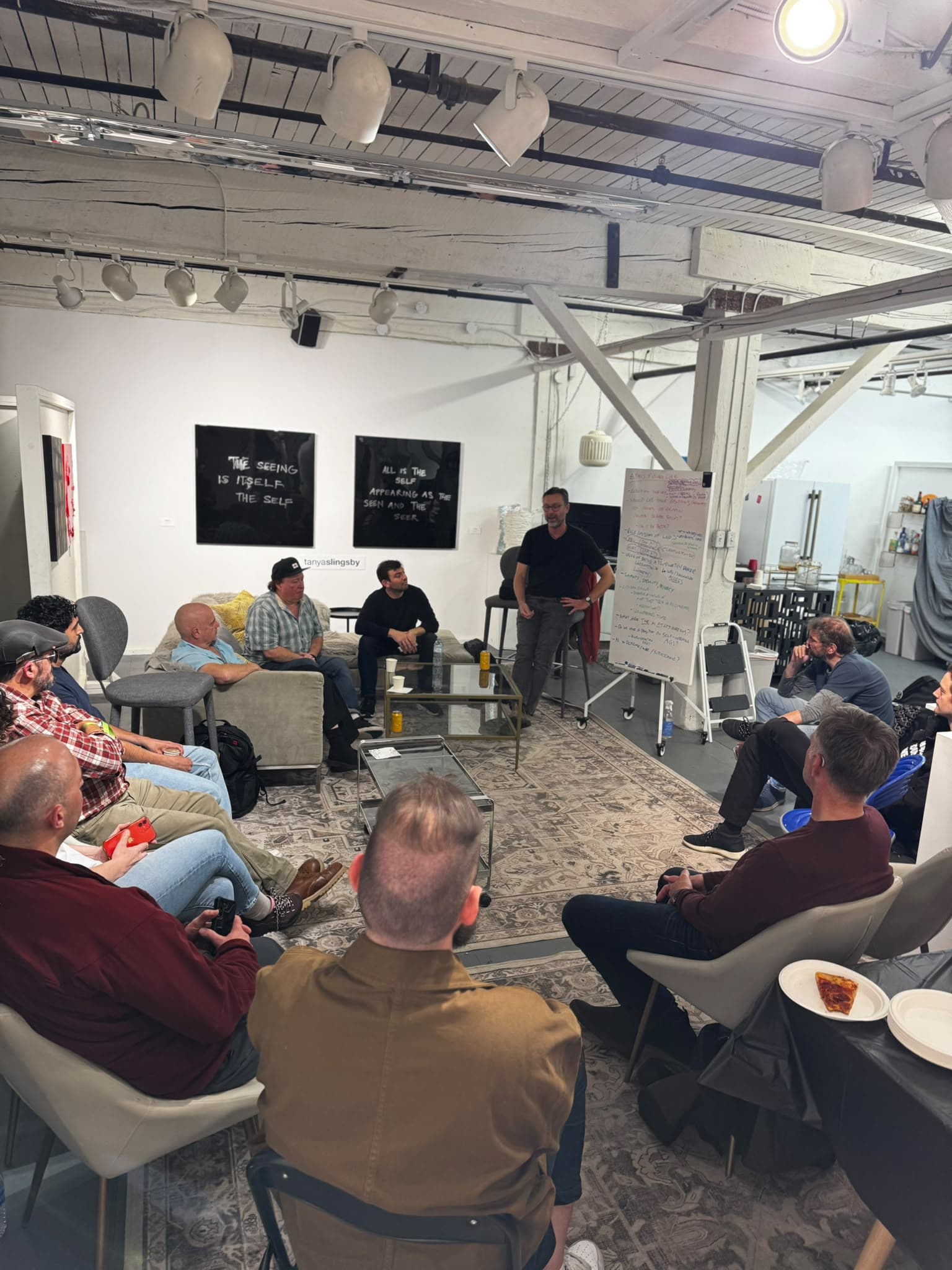
Participants in a discussion circle, with a whiteboard of AI ethics questions at Parker Street Studios.
Parker Street Studios, Vancouver / October 6
Tuesday, October 6 · 6:30–8:30 PM PDT · VancouverAI Ethical Futures Lab ↗

Steve Jones wanted B.C.'s political parties to explain what they would actually do about AI. Where should data centres go? What happens when a government service uses an AI system to make a decision about someone? Who can that person call?

By the time AI Ethical Futures Lab #8 gathered at Parker Street Studios on October 6, he had turned a community discussion into a five-question policy questionnaire. He reported sending it to five provincial parties and was still waiting for replies. During the evening, he shared the full template so others could use it too.

That work gave the Lab's larger conversation something concrete to test. The group was considering becoming a clearinghouse for trustworthy AI information. Steve's questionnaire made the editorial questions concrete: what do we ask, how do we make the answers useful, and how do we leave people free to reach their own conclusions?

Steve Jones: five questions for political parties

The questionnaire had already gone through several rounds. Steve proposed it on September 29 as a short, non-partisan request to party leaders. An early draft grew to eight questions, covering classrooms, jobs, sovereignty, regulation, and AI in election campaigns. Feedback added more issues worth raising, including environmental costs.

There was a practical problem. A party can decline to complete a long survey. A question loaded with assumptions can produce an argument about the question instead of an answer.

Steve separated the material into five broad questions, followed by optional prompts. A party could explain its position in its own words. Readers would still have specific things to look for.

  • Infrastructure: electricity costs, water use, local jobs, siting, and ownership.
  • Government services: human assistance, oversight, appeals, healthcare, and education.
  • Regulation: privacy, creators' rights, Indigenous knowledge, discrimination, disclosure, and accountability for harm.
  • The economy: productivity, wages, displaced workers, small businesses, and who receives the benefits.
  • Sovereignty: control of data and infrastructure, foreign providers, Canadian technology, and Indigenous data governance.

Those details matter. “We support responsible AI” does not tell a parent what happens to their child's information. It does not tell a worker what support exists when a job changes, or a resident whether they can appeal a decision made with AI. The prompts give people somewhere to press for an answer.

Read Steve's complete questionnaire and optional prompts below, or download the questionnaire. The invitation requested replies by October 16 and proposed publishing dated answers on October 19. As of the October 6 discussion, Steve was still awaiting responses; this recap contains the questions, not a comparison of party answers.

What would a premier take responsibility for?

The discussion continued after the Lab. Steve drafted possible questions for a debate moderator about a government's overall approach to AI, data-centre development, and the division of responsibility between governments. The televised leaders' debate is scheduled for October 14, with Shachi Kurl moderating.

The jurisdiction question came out of that evening's discussion: what should Ottawa decide, what belongs with municipalities, and what would a provincial government take responsibility for itself? It asks for more than a promise to collaborate. People need to know who makes the decision, who can change it, and who answers when something goes wrong.

Later that night, Steve said he would email the moderator the following day. Whether any of the proposed questions would reach the debate remained open. He also invited people to adapt the questionnaire for municipal candidates, with the questions adjusted to what local governments can actually decide.

BC + AI's Vancouver Civic AI Voter Guide is a separate piece of work. Its seven-question framework is used to examine candidates' existing public records; those questions were not sent as a questionnaire. Steve's provincial survey asks parties for their own replies. Keeping that distinction visible lets readers judge what each source can tell them.
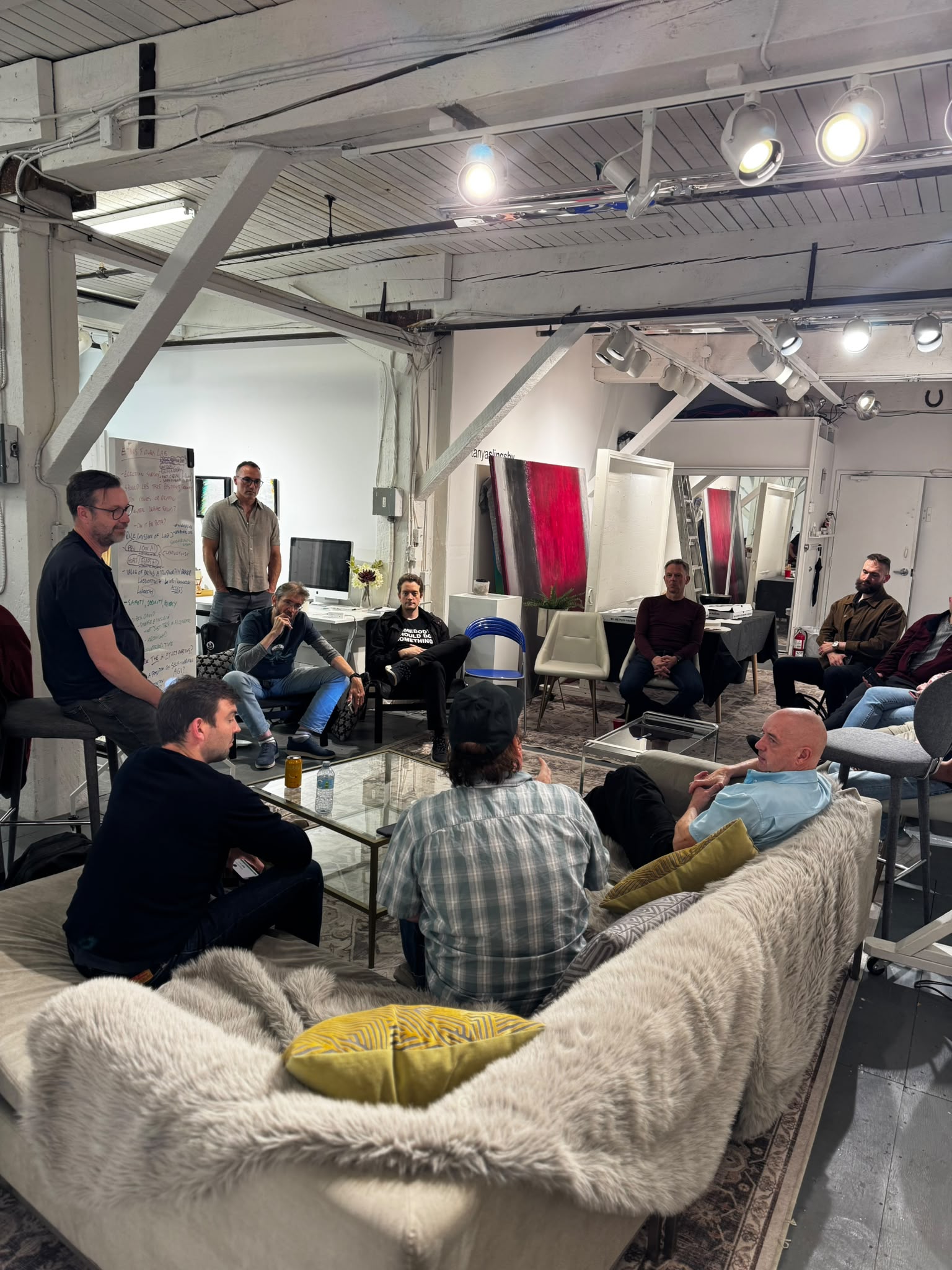
Participants seated in a discussion circle at Parker Street Studios during the October 6 AI Ethical Futures Lab.
October 6 at Parker Street Studios. Photographs supplied by BC + AI.

A clearinghouse has to show its work

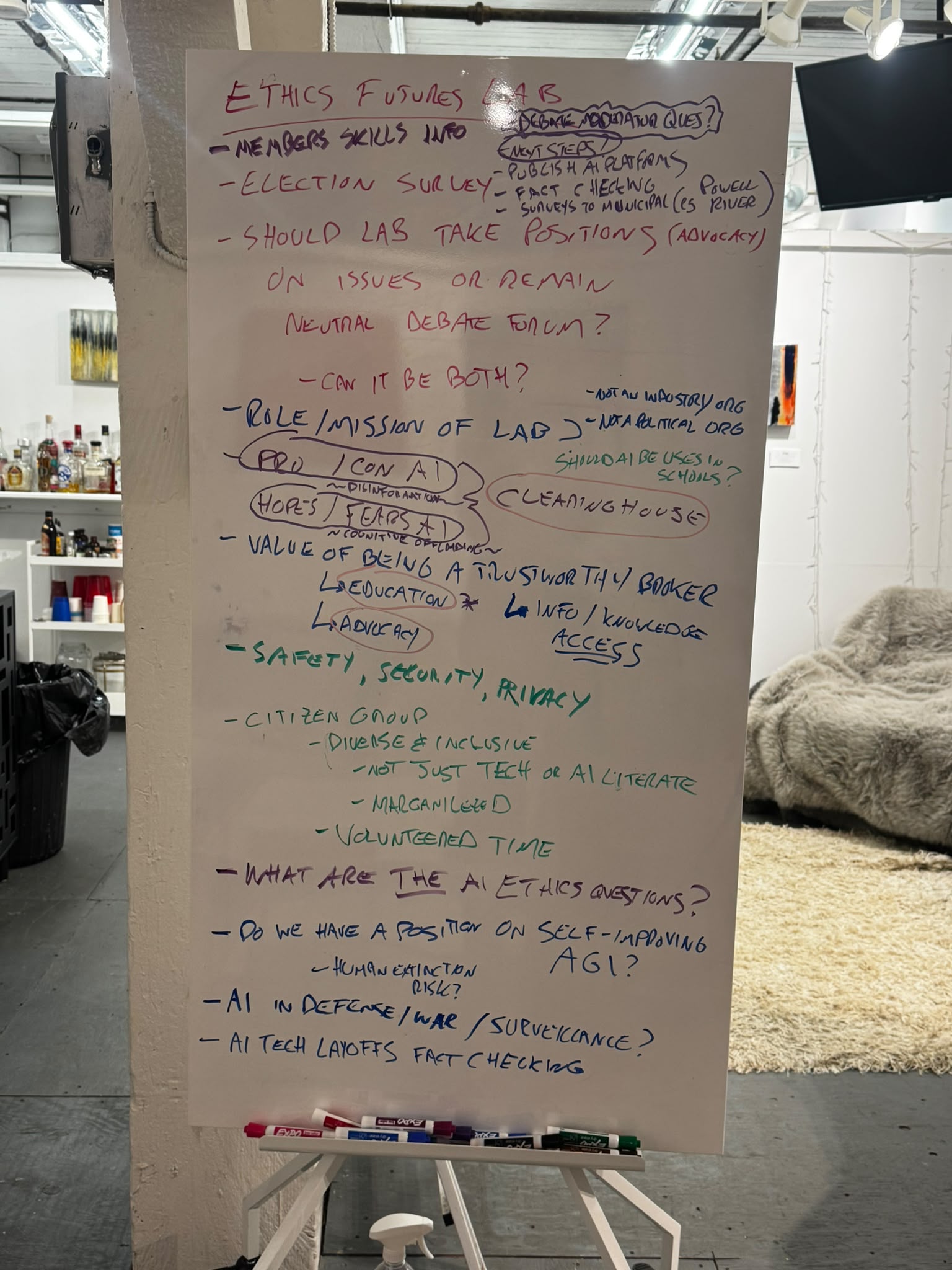
The whiteboard held the central tension: should the Lab take positions, remain a forum for debate, or attempt both?

A person should be able to bring a concern about AI without being dismissed as uninformed. Someone who uses it at work should be able to examine its harms without having to defend their entire job. Access to the same facts does not guarantee agreement about acceptable risks.

But collecting links is only part of the work. Someone chooses the sources. Someone decides which claims need checking, what context to include, and when a correction is necessary. The discussion kept coming back to making those choices inspectable.

Steve's questionnaire is an example of the problem at a manageable scale. Show the questions. Preserve the replies in the parties' own words. Date them. Distinguish an unanswered question from evidence of a policy position. Make the method visible before publishing a comparison.

Data centres make the stakes tangible: power, water, ownership, and consequences for the people living nearby. Both Hands on the Grid follows those questions in Kris Krüg's writing. The BC Public Compute Project asks who owns computing infrastructure and whose interests it serves.

There is a public record to build on

The Lab has already worked through the difficulty of turning a conversation into something people can inspect. Peter Van Garderen facilitated the August session; the Lab #6 archive keeps its meeting artifacts and labelled machine-generated outputs available. Sara Taherzadeh worked through the recording to develop the collective report. The public AI transparency response lets readers follow the resulting recommendations.

At the September 30 Vancouver AI meetup, Peter and Sara brought that work to a wider audience. Peter also demonstrated ImageSquid and discussed Content Credentials. A file's history can help people inspect its origins and changes; it does not settle whether every claim made with that file is true.

October's Lab brought that question home: could BC + AI review its own website imagery and make documentary photographs and generated images easier to distinguish? It was proposed follow-up work. This recap's photographs and the earlier consultation graphic below carry separate captions for the same reason.
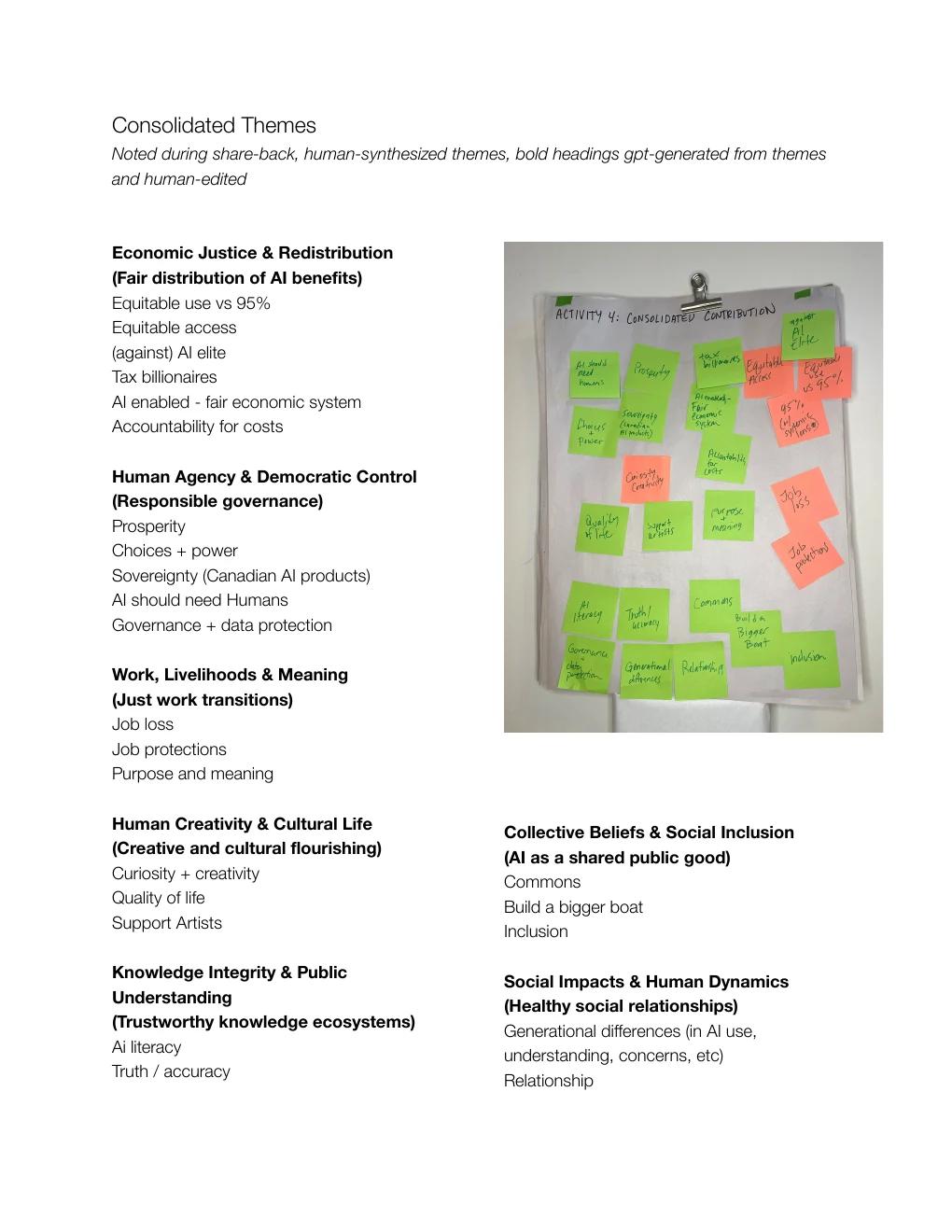
Consolidated themes from the March People's AI Consultation: economic justice, human agency, work, creativity, knowledge integrity, inclusion and social impacts.
Earlier work: consolidated themes from the Lab's March People's AI Consultation, synthesized by Jesi Carson Creative. The graphic identifies its headings as AI-generated and human-edited. Read the account of the workshop and its public report.

Help with the decision in front of you

The classroom discussion was about the questions a parent needs answered. Which tool is being used? For what purpose? What happens to student information? What does the learner still need to work out for themselves?

Yvan Boily's A Parent's Guide to AI came up as a practical example. It covers school and home use, privacy, conversation prompts, and a family agreement. Parents can use it to prepare questions for a teacher without first mastering the vocabulary.

Steve has worked on the design side too. Our May Comox Valley recap follows his demonstrations of SlowSpeak and a student AI tool built around one question a day, citations, and human review. The choices built into a product affect what people do with it.

Cognitive offloading came up in the Lab as a concern for students and people entering a profession. If the tool supplies the answer, where does someone get the practice needed to judge it? The conversation raised questions about learning rather than settling them.

Workplace policy has a similar problem. Guidance about sensitive information has to help at the moment someone is about to paste it into a tool. Could practical guardrails sit alongside that tool, where a worker needs to decide what they can share and when to ask for help? That question connects to the work in BC + AI's Responsible AI Professional program.

Make the work useful beyond the regulars

The Lab's AI Ethics Reading List already brings together resources shared by the community. A clearinghouse would need to help someone find what matters to their question, understand the source, and see where the evidence runs out.

Language, accessibility, marginalized communities, and volunteer time all came up. So did the possibility of public debates that leave a useful record of the arguments and the disagreements. A service built only around the interests and vocabulary of regular attendees will miss people it hopes to help.

The discussion ranged further, through self-improving AI, weapons, surveillance, and claims about job losses. An inventory of ethical questions was proposed as a way to choose future work. The overlap with Mind, AI & Consciousness offers another place to explore the longer philosophical questions.

A small steering group was proposed to help prepare agendas and work out what people could contribute. The clearinghouse's scope, editorial method, and any future debate format still need work.

On the same evening, the Comox Valley AI meetup was comparing everyday experiments with AI and the checking people had to do afterward. Both conversations asked how useful knowledge could travel beyond the person who first learned it.

For this Lab, there is already something readers can take away: five questions, the issues underneath them, and a way to ask for answers. The next part is seeing what comes back.
A resource from the October 6 Lab

Steve Jones’s AI policy questionnaire.

Five questions and 29 optional prompts, shared by Steve on October 6, 2026. These are the questions offered to provincial parties; party responses are not included.

What is your party’s position on each of the following issues?

The following are illustrative topics you may choose to address in your answers. You do not need to address any of these directly and may wish to comment on additional topics.

1. AI infrastructure
  • Criteria for locating and approving data centres
  • Electricity demand and impacts on electricity costs
  • Environmental impacts, including water use, emissions and land use
  • Local economic benefits and jobs during construction and operation
  • Ownership requirements or restrictions
2. AI use in delivering government services
  • Opportunities to improve service quality, accessibility and efficiency
  • Impacts on public-sector employment, roles and responsibilities
  • Availability of human assistance for people accessing government services
  • Human oversight and processes for appealing decisions influenced by AI
  • Use of AI in healthcare, including patient care and health-system administration
  • Use of AI in teaching and learning in schools and post-secondary institutions
3. AI regulation
  • Need for laws or regulations governing the development, training and use of AI
  • Privacy, consent and creators’ rights in the use of data and content to train AI
  • Use of Indigenous knowledge and cultural materials in AI training, including consent and Indigenous control
  • Safeguards against unsafe, discriminatory or deceptive uses of AI
  • Transparency about when AI is being used and when content is AI-generated
  • Accountability, oversight and enforcement when AI causes harm
  • Use of AI in election campaigns, including disclosure of AI-generated content and safeguards against impersonation and misinformation
4. AI’s impact on the economy
  • Opportunities to improve productivity and competitiveness, including for small businesses
  • Potential impacts on job creation, job displacement, wages and working conditions
  • Education, skills development and support for workers changing roles or careers
  • Role of the province in attracting and retaining AI companies, investment and talent
  • Implications of regulation for innovation and business competitiveness
  • Distribution of economic benefits across workers, businesses and communities
5. AI sovereignty
  • Location of data storage and processing, and who can access or control that data
  • Reliance on foreign AI providers, including exposure to foreign laws and service disruptions for BC governments, businesses, and residents
  • Development and use of Canadian-owned AI technology, intellectual property and infrastructure
  • Trade-offs involving Canadian control, cost and access to leading technology
  • Indigenous control over Indigenous data and cultural knowledge
Download Steve’s questionnaire as Markdown ↓

Steve invited municipal adaptations too. Adjust the questions to the decisions a local government can make. For official voting dates and information, use Elections BC.

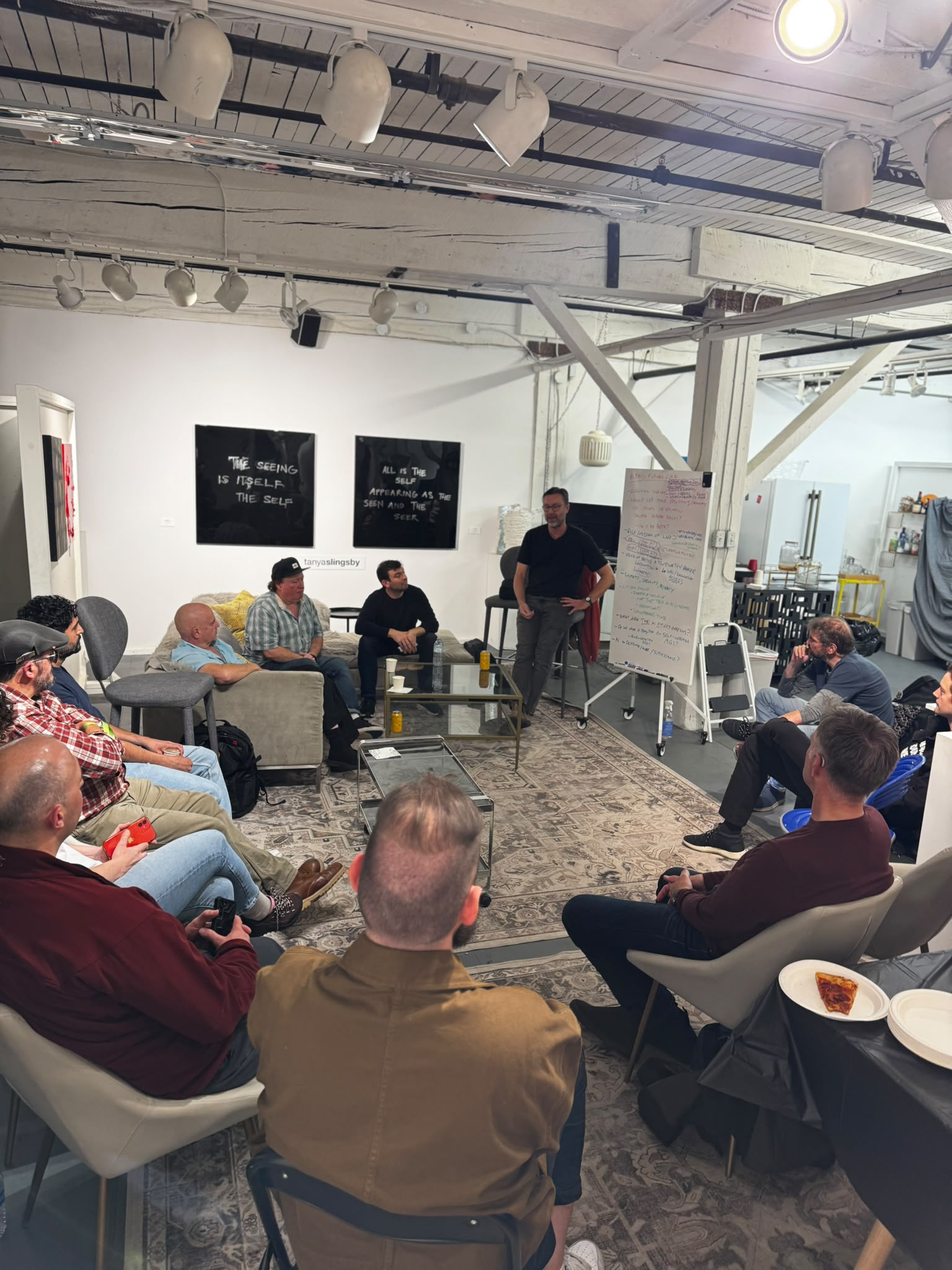
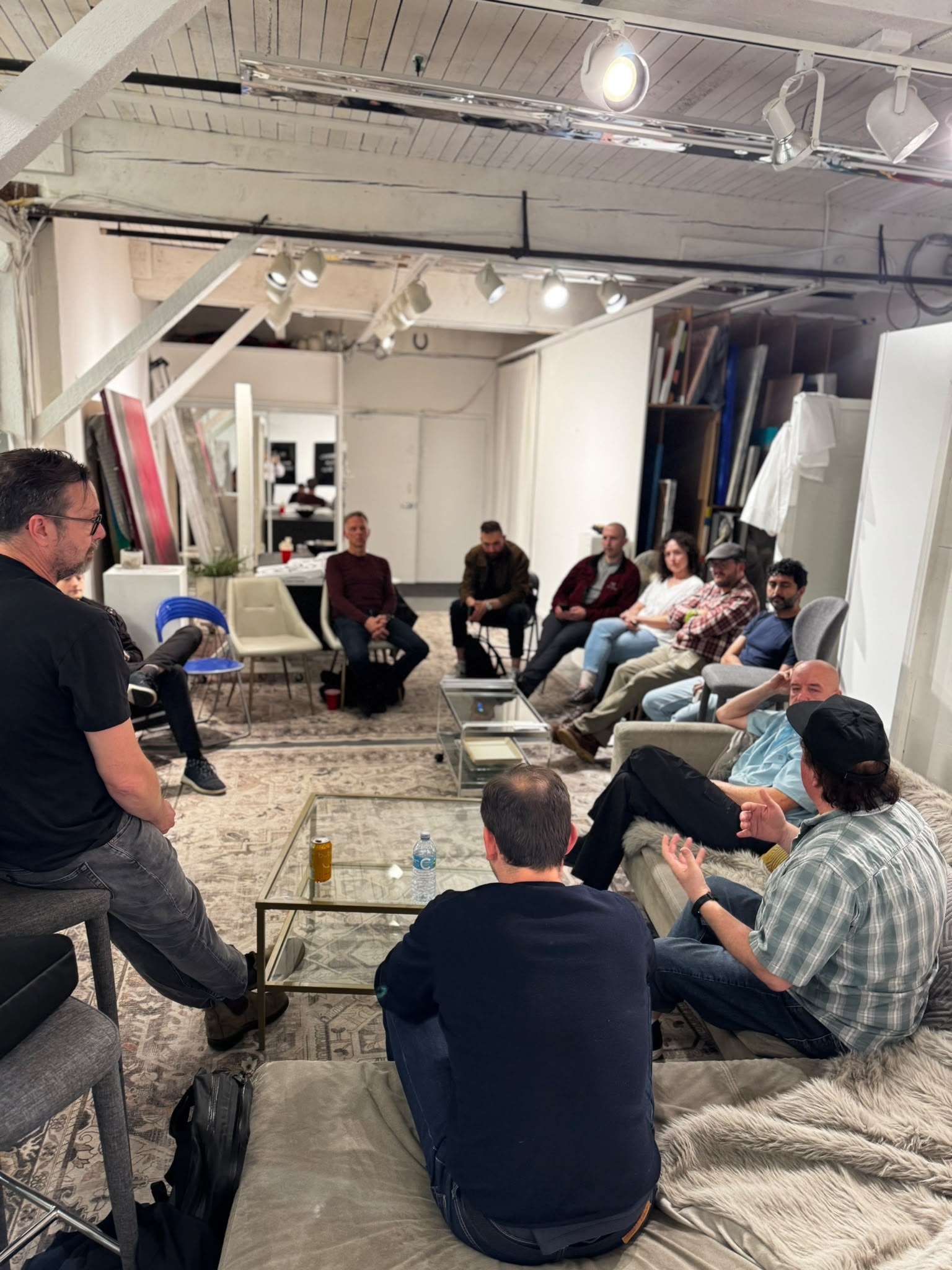
The evening in photographs

At Parker Street.

Three views of the discussion and the working whiteboard. Open any photograph for the full view.

Read the whiteboard notes

Readable transcription of the main notes. These are prompts and proposals from the discussion, not an adopted policy. Some handwriting is unclear.

  • Member skills and information
  • Election survey: publish AI platforms, fact checking, possible municipal surveys
  • Should the Lab take positions on issues or remain a neutral debate forum? Can it be both?
  • Role and mission of the Lab
  • Pro and con AI; hopes and fears; misinformation; cognitive offloading
  • A clearinghouse; the value of being a trustworthy broker
  • Education, advocacy, and access to information and knowledge
  • Safety, security, privacy
  • A diverse and inclusive citizen group, including people outside technology and marginalized communities
  • Volunteer time
  • What are the AI ethics questions?
  • Should AI be used in schools?
  • Self-improving AGI and human extinction risk
  • AI in defence, war, and surveillance
  • Fact checking claims about AI and technology layoffs

The discussion record

Edited transcript excerpts.

Selected excerpts from the supplied machine transcript, lightly edited for punctuation and repetition. Speakers are unattributed; introductions, personal details and workplace anecdotes are omitted. These excerpts preserve questions and differing views, not agreed Lab positions. Timestamps refer to the source recording. This is not a complete or verbatim transcript.

Participants spoke under the Chatham House Rule. These selected contributions do not identify speakers; the full recording is not public.

Download these excerpts as Markdown ↓
Read the selected discussion excerpts
00:18:20

What can the Lab produce?

What does action look like? What can we produce? Can we produce guidelines, frameworks? We want to discuss that.

00:20:11

Keeping the shared knowledge

We're talking about having a GitHub repo for this group, just as a good way to capture all the artifacts from every meeting. If we have side projects, I think it's a good way to have a place where we can capture our shared knowledge.

00:28:15

Dialogue and taking positions

Do we want this to be a platform where we are facilitating dialogue, where there's people who have very different ethical positions, and the point of the group is to provide that forum, or do we want to actually take positions on some things?

00:30:42

Making space for a response

If we allow people to express those views and then work collectively on a response, we may not satisfy everybody, but at least we're providing a place for dialogue and somewhere where we can provide frameworks.

00:33:51

Taking concerns seriously

Any amount of change is going to impact humans at some level, and they're entitled to that reaction to those situations. If we can let that information come in, use it to help us figure out how do we respect those.

00:37:00

Let people inspect the sources

I don't think we can be completely unbiased, as much as we want to be completely ethical. I think there's always going to be trade-offs. But if we can be as inclusive as possible and as wide-reaching as possible, like a clearinghouse, then at least people can see the original source information and make their own determination.

00:44:17

A possible public record

If we do get some responses, I don't think we will. And if we don't get responses, we'll be able to at least publish the parts of the platform that mention AI, if there are any, and we can also then add a layer of fact checking if there are things that need to be verified.

00:54:37

A map of the information

Essentially, a knowledge base and a map, like a quadrant or something like that. Some kind of orientation to understand where things stand with the requisite background knowledge that can be trusted. It comes from trusted sources, and that's another tool.

00:55:52

Where would a citizen go?

Wouldn't it be great as a citizen who's trying to learn more about data centers to be able to go somewhere and be able to look at everything? That's really what people are looking for. I hear all this about data centers. I really want to understand what's at stake. But you don't know where to go. You don't have trust. You don't know what's what.

00:56:13

Access is part of the responsibility

There's a spectrum of people when you think about citizens, and there's marginalized people, and there's languages. I think there's a huge responsibility there as well if you're a citizen advocacy group, making whatever you're making accessible to large numbers.

00:58:37

Facts do not end the debate

There's facts, but then what do you do with those facts? You pull it up in schools, you can argue both ways in that case. Who am I or who are you to say what's right or wrong? Having a forum where collectively we come together and have a conversation on that.

01:05:19

Casual use, consequential questions

Casual AI use and how it's crept its way into everyday life, in professional and personal life. I think that's another topic. We've got a list of topics.

01:08:47

Disagreement can stay

Everybody's going to have a different point of view on that spectrum. But I think it's another good example of a topic that we should provide information about. I think we shouldn't lose the concept of this being a home for debate, where we don't agree with each other, but we can still work together.

01:11:48

Who can act on a question?

Briefly about the idea of canvassing the municipal candidates as well. It's a bit unclear to me what the provincial and the municipal would have jurisdiction over. So, the question would be different.

01:16:20

Checking claims about jobs

You hear a lot about these tech layoffs, and tech companies like to say, 'We're replacing all these workers with AI,' but some people are also skeptical about how much of that is actually true. Investigating when they say AI is replacing a worker, is it actually replacing them? What's actually going on inside?

01:17:16

Start with the questions

One idea for a future lab would be to put together a taxonomy, an inventory of what the ethics questions are, without debating the questions themselves.

01:19:09

Debates as source material

We can use the results of debate, the pros and cons, whatever else, as part of the clearinghouse information. We can't decide for you, but this is what somebody said in favor of this argument, and this is what somebody said against. Make up your own mind. Use the debates as another way to build the clearinghouse.

01:20:13

Choosing what to take on

The hard part, where the discussion will be really valuable, is deciding which of these hundred things are the most relevant for this group in BC to raise.

01:24:25

A manageable starting point

Let's make it three or four people. If there's a decision to be made, at the very minimum its main responsibility is just setting the agenda for the next meeting as a starting point. So let's start with that.

Keep working on the questions

Bring a question.
Bring a source.

The Lab community page brings together upcoming sessions, earlier recaps, and the public consultation work. Start there if you want to participate, share a resource, or see how the discussion develops.

Next Lab: November 3 ↗
AI Ethical Futures Lab number 9 artwork for Tuesday, November 3, 2026.
Next session / November 3

Futureproof / October 28–30 / Vancouver

Take the questions to the festival.

Futureproof Festival artwork with salmon and ravens against an aurora, October 28–30, 2026.
Futureproof Festival of AI / October 28–30

Futureproof Festival of AI extends the conversation through sessions on governance, public knowledge, and human judgment at the H.R. MacMillan Space Centre.

The published program includes Sarah Downey on adopting AI without losing your values, Kristen Delphos on public understanding of safety, and Ben Shneiderman on human-centered AI.

Explore the Futureproof program ↗

Prepared from the October 6 meeting transcript, supplied photographs, and the Lab’s ongoing discussion. The recap includes context shared before and after the meeting. Steve’s questionnaire is presented separately from the edited, unattributed meeting excerpts. Proposals and planned follow-up are identified as such.