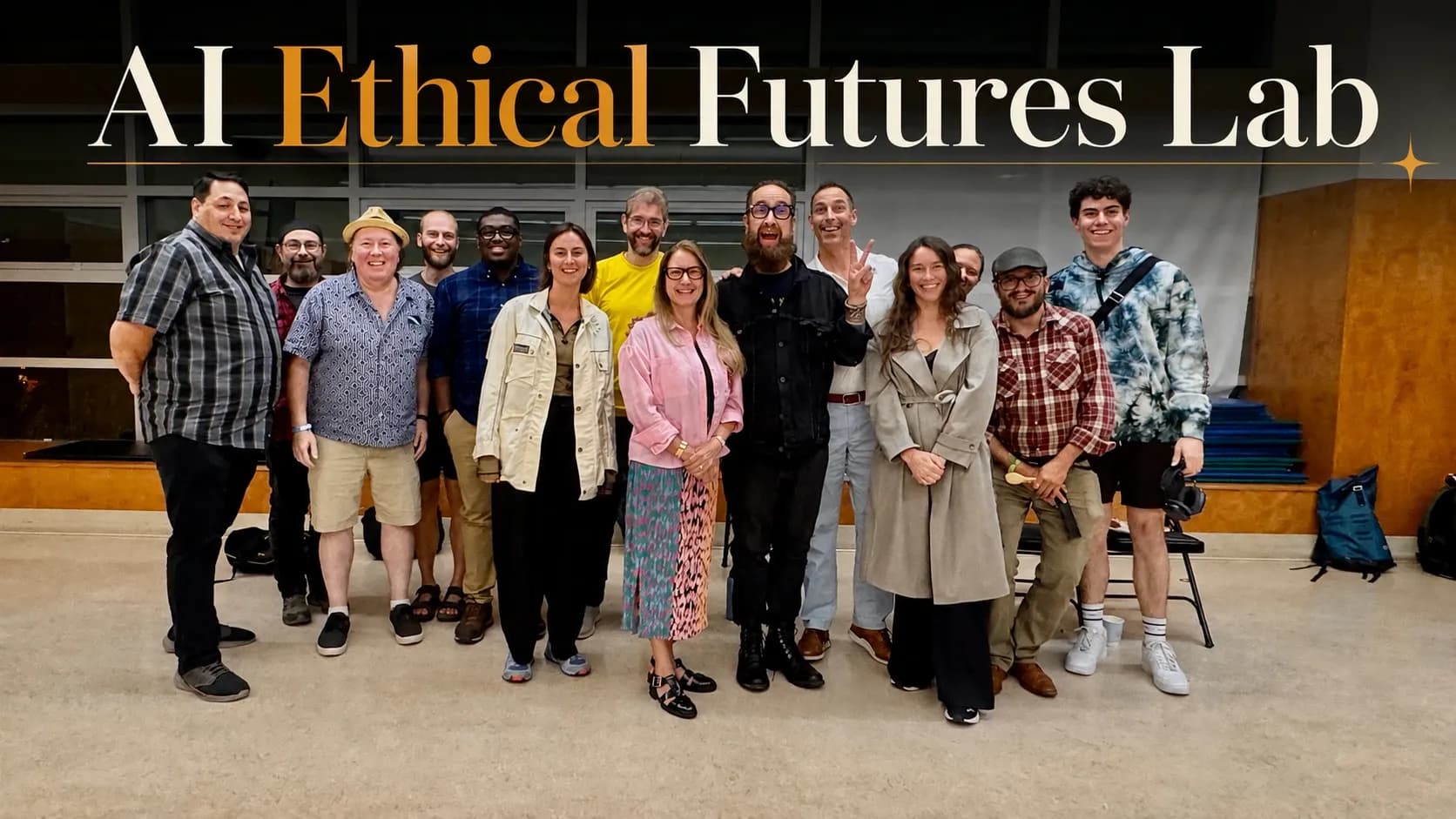
Community submission / AI Ethical Futures Lab #6 / September 2026

What BC told Ottawa about AI transparency.

A label is not accountability. Transparency counts when people can understand what is happening, then choose, refuse, contest, correct, or get it fixed. About twenty people in one Vancouver room worked through Canada's five transparency questions together. This is what they said.

Prepared by the BC + AI Ethical Futures Lab Collective, part of the BC + AI Ecosystem, from a facilitated session held during the ISED public comment period, July 23, 2026 to September 23, 2026.

Closes September 23, 2026

The Government of Canada consultation on AI transparency.

Open the consultation

Executive summary

Two things we want Ottawa to hear.

In July 2026, Innovation, Science and Economic Development Canada asked Canadians where AI transparency matters: knowing when content was made by AI, knowing when you are talking to a system rather than a person, getting clear information about what a system can and cannot do, tracking serious incidents, and tracking what agents do on someone's behalf. The government says plainly that transparency will not fix every problem. Two things came out of our room that matter to this consultation specifically.

01

What was said lines up with what the government already knows.

The government's own discussion paper includes a case study about an AI shopping agent that overspent a person's money, with no clear answer as to who was responsible: the person, the business, or the developer. Independently, a participant in our session described a closely similar situation from personal experience: an unauthorized, system-driven transfer between bank accounts, with no consent obtained, no clear record of what happened, and no straightforward way to get it corrected.

The paper also describes a car dealership's chatbot making an offer the dealership later said it was not authorized to make. Participants raised the same pattern on their own: when an AI system causes a problem, it is often unclear who is answerable, and there is often no record detailed enough to establish what happened.

02

The bigger concern isn't one of the five questions asked.

The most consistent thing said in the room was not about any specific transparency mechanism. It was doubt about whether this process changes anything. Versions of the same statement came up repeatedly: that this looks like an exercise to make people feel heard without changing what happens next.

Whether or not that is an accurate read of the government's intent, it is what a number of participants believe, and it will affect whether any transparency measure that comes out of this process is trusted enough to be used.

The five federal questions

Five questions, one room.

ISED's survey runs to 24 questions across five areas. The facilitator read the government's framing for each, then opened the floor. Pick an area to see what Ottawa asked, what the room answered, and what already exists that the room pointed to.

Cover of the Government of Canada discussion paper Enhancing trust in artificial intelligence through increased transparency, July 2026.The document Ottawa put outEnhancing trust in artificial intelligence through increased transparencyISED discussion paper, July 2026. Read it on canada.ca

01 / What Ottawa asked

Would it help you trust what you see online if you could tell whether something was created by AI or by a person? When and for what kinds of content is it most important to know if something was created or modified by AI?

What the room said

  • Yes, but the useful question is how AI was used, not whether it was used. Hybrid media is already normal.
  • A label is a cigarette warning. Prevention and public-health-style education have to travel with it.
  • If most content ends up AI-touched, it may be more useful to mark what is human-made.
  • Real-time consent is the missing piece in every provenance standard. Quebec’s Law 25 was named as the model.

What already works

C2PA, an open technical standard for labelling AI-generated or AI-edited content, backed by Adobe, Google, Microsoft, and others.

Try it

A label is not accountability. Build the receipt.

Ottawa is asking which pieces of transparency to require. The room kept answering with a different question: what can a person do afterwards? Pick a situation like the ones the room raised, switch on the pieces one at a time, and watch what you could do change. The situations are illustrative. The pattern is not.

Step 1 / Pick a situation

Step 2 / Switch on transparency

Transparency receipt01 / 05

A video of you, saying something you never said

It is in a group chat before you have seen it. It looks like you. It sounds like you.

A label that says AI was involved: Not disclosed.
What it is optimized for, and who built and deployed it: Not disclosed.
What data it used, and whether you consented: Not disclosed.
A person you can reach who can override it: Not disclosed.
A record of what it did, when, and on whose instruction: Not disclosed.
A way to reverse it, or be made whole when you cannot: Not disclosed.

What you can actually do

  1. Not yet: Understand. You know a system was involved and what it was doing.
  2. Not yet: Decide. You have enough to walk away, or not.
  3. Not yet: Contest. There is a person and a record to push back against.
  4. Not yet: Correct. What it did can be changed or undone.
  5. Not yet: Be made whole. Someone is answerable when it cannot be undone.

Nothing disclosed. You do not even know a system was involved. This is where several of the room’s stories started.

What the room asked for

Each person should own their face and voice. A deepfake of a real person is a line not crossed.

What was said

Fear and hope, often from the same person.

The group sorted its own responses into two piles: those rooted in fear or risk, and those rooted in hope, benefit, or attachment to what the technology could make possible. Both were present all evening, sometimes a few minutes apart in one voice.

Risk, harm, and what has already gone wrong.

No one consented to it. No one contacted either party. But the actions still happened. They had no traceability, no auditability, and couldn’t explain what happened, who did it, or when.
Fear / On an unauthorized AI-driven bank transfer out of a family member’s account
Am I suing the government? Am I suing the Anthropic? I don’t want to have to sue anybody. What system is going to be in place that has a built-in way to make this right?
Fear / On the absence of a clear path to accountability
This is just a red herring, a fake, pretentious way to appease us. How are they actually going to verify if something was made with AI or not?
Fear / On skepticism toward the consultation’s premise
Someone can just clone a whole me and put it on video. In the future we’re going to need some kind of ownership of our identity. It cannot be duplicated by someone else.
Fear / On deepfakes and identity
If the training data doesn’t include humans with a particular characteristic, a minority, a woman, a child, the system may simply fail to recognize them as human at all.
Fear / On bias embedded in training data
There’s no trust. That’s the whole problem. How do we repair the trust?
Fear / Said in direct response to another participant’s story

Quotes are a selected, high-impact sample from the recording, not a full transcript. Where a speaker could not be reliably identified, and that was most of the time, nothing is attributed. That is by design.

Themes

Six threads, and what each one connects to.

For each recurring theme: the risk that was raised, what participants pointed to as a possible opening, and what already exists, whether or not they named it directly.

  • Identity and authenticity

    The risk raised
    Deepfakes and cloned voices and faces. One participant described the risk in personal terms: someone could put a false version of them on video, including as evidence in a legal proceeding.
    The opening
    Open, non-proprietary content-labelling standards exist and are already used by major platforms.
    Already working somewhere
    C2PA, an open technical standard for labelling AI-generated or AI-edited content, backed by Adobe, Google, Microsoft, and others.
  • Accountability and redress

    The risk raised
    No traceable record when an AI system causes financial harm. No agreed answer to who is responsible or how to get it fixed.
    The opening
    A model where every party in the chain, developer, deployer, institution, carries some responsibility, similar to models already used in other regulated industries.
    Already working somewhere
    Human review and override for consequential automated decisions, audit trails, and incident reporting modelled on existing safety practice in other sectors.
  • Consent and data use

    The risk raised
    Health, financial, and behavioural data used or shared without clear consent. Terms-of-service agreements treated as though they were binding law.
    The opening
    Interest in personal data stores that let a person or community grant or withdraw access to their own data.
    Already working somewhere
    Minimum consent standards set by government that override one-sided terms of service, similar to BC’s Residential Tenancy Branch standard lease terms.
  • Training data and group-level harm

    The risk raised
    A system trained on incomplete data may fail to recognize people outside that data. Harm to a group or a shared cultural resource, without one identifiable victim, does not fit current legal definitions of harm.
    The opening
    Interest in documentation of what is in training data, written so a non-specialist could actually read it.
    Already working somewhere
    Plain-language documentation requirements, and a broader legal definition of harm that includes harm to groups, not only individuals.
  • Who the benefits reach

    The risk raised
    Concern that funding and infrastructure investment concentrate among large platforms, while small organizations and local groups are left out, a pattern participants compared to what happened with local news and social media.
    The opening
    Local and community-run AI infrastructure, using smaller open-source models that run without sending data to outside servers.
    Already working somewhere
    Directing a share of federal AI investment specifically to community and grassroots organizations, not only large vendors.
  • Trust in the process

    The risk raised
    Direct statements that public consultations, including this one, may be symbolic rather than a real input into decisions.
    The opening
    This session itself, open floor, real time, no single voice dominating, produced substantive, specific input.
    Already working somewhere
    The group treated this as the central issue, not a secondary one. See the trust finding below.

The finding

The room doubted the process. That doubt decides whether anything else works.

Distrust of the process is not a separate issue from the transparency questions being asked. It is the condition that determines whether any answer to those questions will be believed. A well-designed transparency measure introduced into a process people don't trust will still not be trusted.

One further observation is worth naming plainly. The same room that expressed distrust of government process also, without being asked to, ran a process with the features described as missing: open floor, no single voice dominating, and enough time for people to actually think together before answering. Whether or not that was intentional, it is a description of what a different kind of engagement could look like.

If you want to be cynical, you could say this is just an exercise so they can pat us on the head and say, we took your feedback, and then give the money to someone else anyway.
On the consultation’s perceived function
I don’t think they’re even going to look at these. There’s too much information. They’ll just feed it into an AI and ask, what’s the general consensus, and put that into a protocol.
On whether individual submissions are actually read

What repair would require

Three things came up repeatedly, from different people, describing the same gap.

  1. 01

    Plain language

    Several participants pointed out that the consultation’s own questions are written in language that assumes prior knowledge most people don’t have. Language that assumes expertise excludes the people it is asking to participate.

  2. 02

    Time to think, not just time to answer

    The group needed a full evening, open discussion, and room to disagree before members could say clearly what they meant. A single survey sitting does not allow for that. Skipping this step produces answers, but not necessarily the answers people actually hold.

  3. 03

    A visible link between input and outcome

    Trust is not repaired by being told feedback was considered. Participants who had filed complaints through existing channels, with banks, privacy regulators, financial regulators, described being met with process, not resolution. The same pattern, repeated at the level of a national consultation, produces the belief that consultation is symbolic.

Score a consultation

Three questions the room would ask of any public process.

Apply them to the ISED survey, a city hall open house, or the next consultation that lands in your inbox. Tick what is true.

0/3

Consultation theatre. People will answer, and few will believe it mattered.

Methodology

How the room worked.

One recorded, facilitated session, the sixth in an ongoing series, held during the ISED public comment window. Rather than dividing into smaller groups by topic or expertise, the group chose to work through the government's questions together, so people with different backgrounds could respond to and build on what others said in real time.

The facilitator read the government's framing for each topic, then opened the floor. Everyone present was invited to speak, and no one voice took up more time than others. The first questions turned out to be shallow, the conversation kept drifting to deeper issues, and the facilitator steered it back to the list a few times. The group did not complete all 24 questions in the time available, and said so directly rather than rushing to finish.

When
Tuesday, August 4, 2026
Where
Parker Street Studios, Vancouver
Who
About twenty people
How long
One hour and seventeen minutes on the recording
Convenor
Kris Krüg, BC + AI
Facilitator
Peter Van Garderen
Host
Tanya Slingsby, Parker Street Studios
Report
Sara Taherzadeh
Format
Full-group discussion, recorded, with live notes
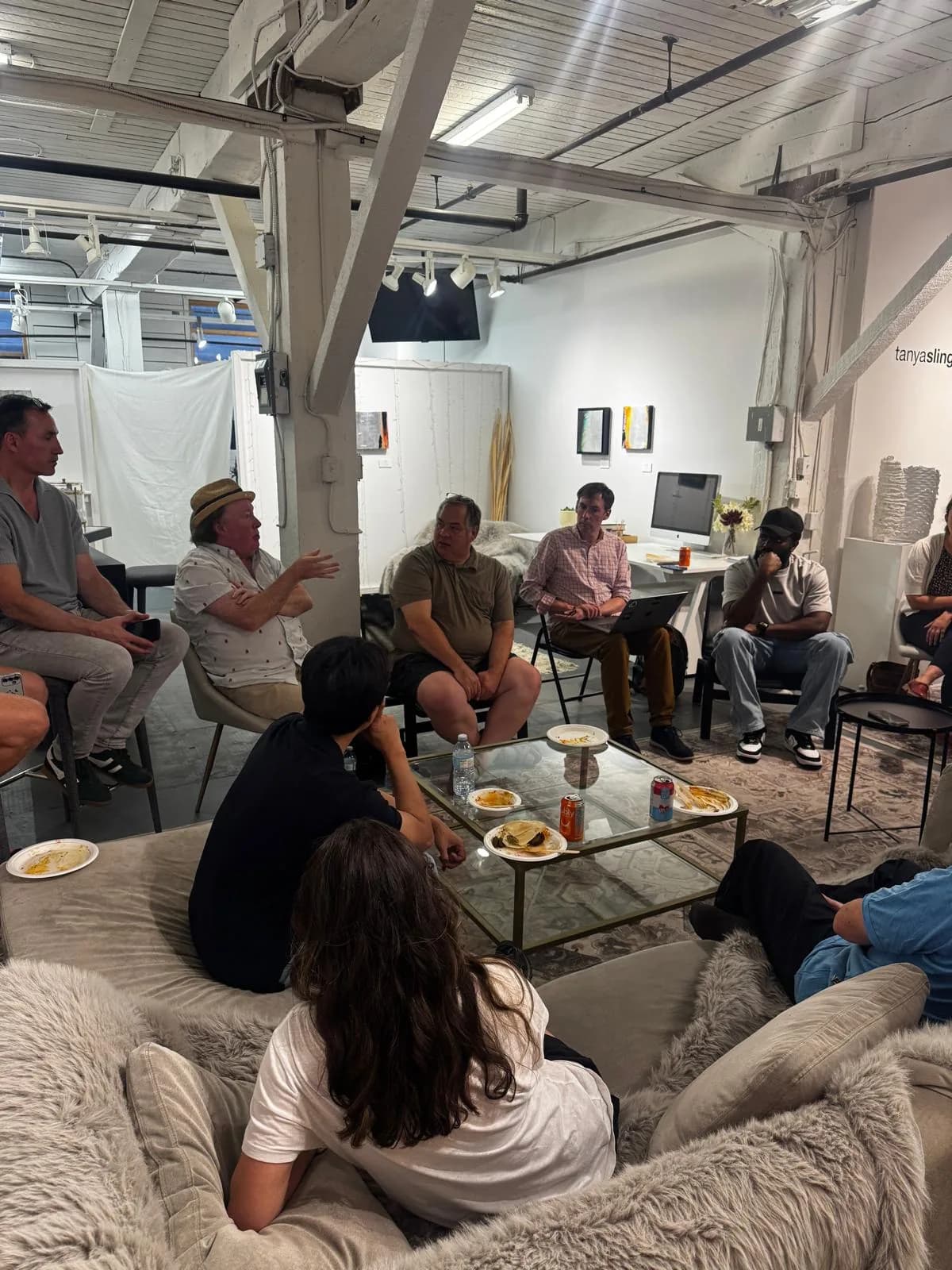
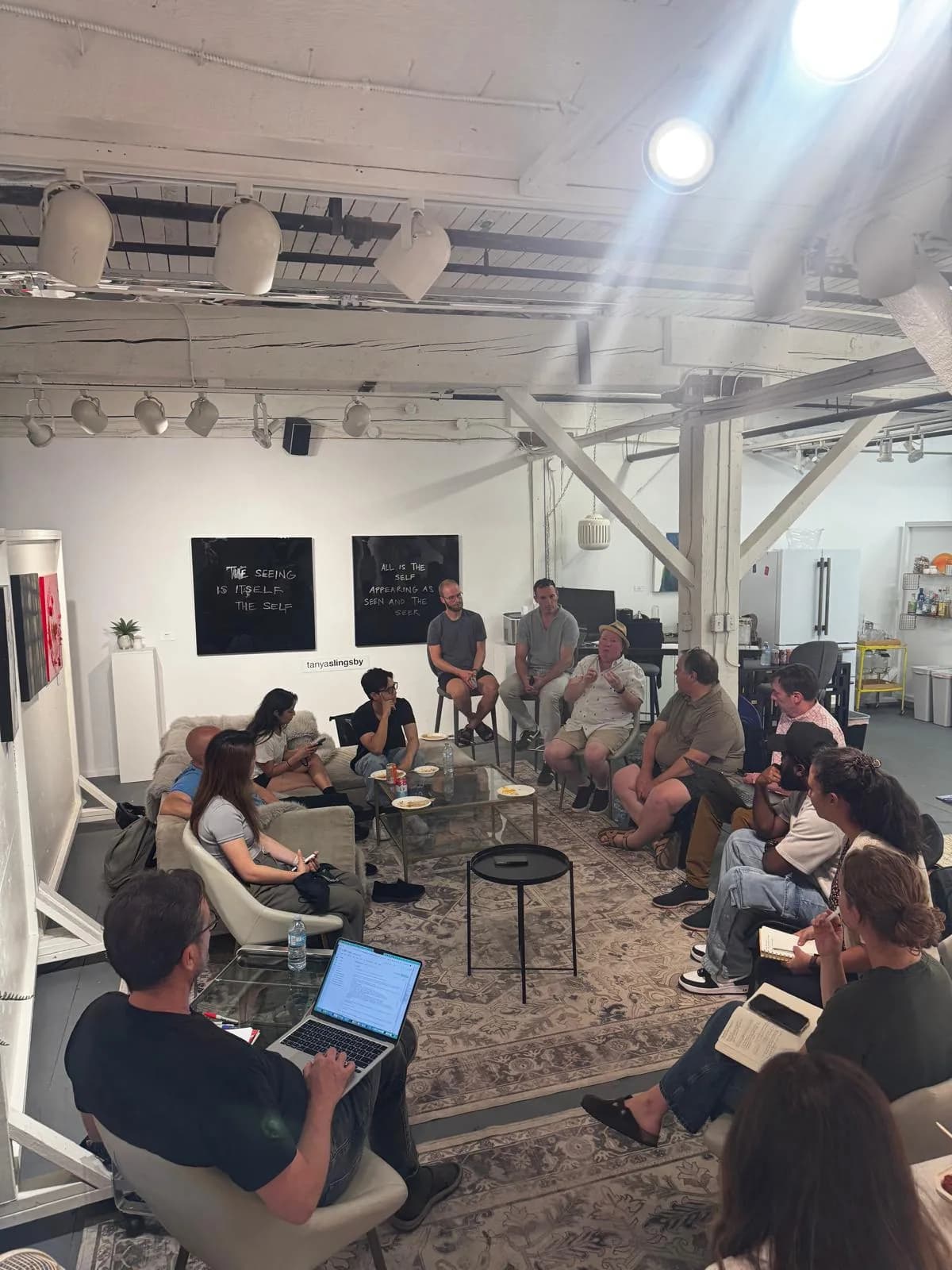
About twenty people seated in a circle of couches and chairs at Parker Street Studios for AI Ethical Futures Lab number 6, with a laptop open in the foreground and paintings on the gallery wall.
One room, one conversation. No breakouts.
Participants in conversation around a glass table at AI Ethical Futures Lab number 6, one person gesturing while others listen.
The facilitator read the government’s framing, then opened the floor.

Photos: AI Ethical Futures Lab, Tuesday, August 4, 2026

From the room to this page

The recording, the facilitator's live notes, and a transcript cleaned up with an AI tool were published the next day as a public repository. An AI-generated topic summary and a set of draft survey answers were added as inputs, clearly labelled as machine output. The written submission was then composed by a person from all of it. Quotes were chosen because they represent a view that was echoed, built on, or directly responded to by others in the room.

BC + AI files its written response by email to ISED's consultation inbox. Submissions are public documents and may be posted by ISED. Nothing here names a participant without consent.

Timeline

  1. AEFL #1 runs the People’s AI Consultation

    The first room. Jesi Carson designed the process and turned the worksheets into a nine-page public report.

  2. BC + AI answers the AI for All strategy

    Adoption Is Not the Goal: trust is infrastructure built through accountability, not a literacy deficit to be corrected.

  3. ISED opens the AI transparency consultation

    Five areas, a discussion paper, a survey, and a written route. Open until September 23.

  4. AEFL #6 works the questions as one room

    About twenty people at Parker Street Studios. Facilitated by Peter Van Garderen. Recorded, with notes.

  5. The public record goes up on GitHub

    Recording, transcript, facilitator notes, an AI-generated summary, and the five pre-read briefs.

  6. The collective report

    Sara Taherzadeh turns the room into the written submission this page carries.

  7. The consultation closes

    ISED then reviews submissions and publishes a What We Heard report.

Who we are

The AI Ethical Futures Lab, and why it exists.

The Lab is a recurring, open discussion group within the BC + AI Ecosystem, a network of people across British Columbia working on AI from clinical, technical, creative, legal, and community vantage points. It meets monthly in Vancouver to work through the practical and ethical questions AI raises as they come up, not only after policy or legislation has already been set.

Attendance is open and voluntary. There is no formal membership structure. People come because the questions are relevant to their work or their lives, not because they represent an organization. August was the group's sixth meeting.

It exists because consultations keep arriving with short windows and expert language, and the people most affected need a room to think together before they answer. The Lab carries public-safe notes into BC + AI's responses. Taking part does not mean endorsing a submission, and nothing is attributed without consent.

We have done this before

Come to the next room

The Lab meets monthly in Vancouver. Sessions are small, laptops-open, and built for disagreement that goes somewhere.

About BC + AI

BC + AI is the member-supported nonprofit association growing out of Vancouver AI. Membership keeps rooms like this one open and turns what happens in them into public work.

Join BC + AI

Sources

  1. [1]ISED, Enhancing trust in artificial intelligence through increased transparency (discussion paper), July 8, 2026, updated August 13, 2026
  2. [2]ISED, Have your say on advancing AI transparency in Canada (consultation overview and submission instructions)
  3. [3]Government of Canada news release, Government of Canada launches public consultation on AI transparency, July 23, 2026
  4. [4]ISED, Canada’s National Artificial Intelligence Strategy: AI for All, launched June 4, 2026
  5. [5]Sophia Harris, Dealership revoked offer to buy back customer’s BMW, blaming wayward AI chatbot, CBC News, June 11, 2026
  6. [6]KPMG, AI fraud hits Canadian companies’ bottom lines, March 2, 2026
  7. [7]Coalition for Content Provenance and Authenticity (C2PA), About C2PA

All sources were accessed directly. Links current as of August 2026.

Credits

Convened by
Kris Krüg, Executive Director, BC + AI Ecosystem Association
Facilitation
Peter Van Garderen, BC + AI member
Host
Tanya Slingsby, Parker Street Studios
Written submission
Sara Taherzadeh
Published by
BC + AI Ecosystem Association

Kris brought the consultation to the Lab, opened the public record with Peter, and carries the final submission to Ottawa. Peter ran the room and published everything the next day. Sara turned the night into the written response. Tanya opened the studio.

By all of us showing up tonight and having this conversation about AI transparency, I think everybody in this room is already doing something about it. That’s worth marking.
Closing statement from the session