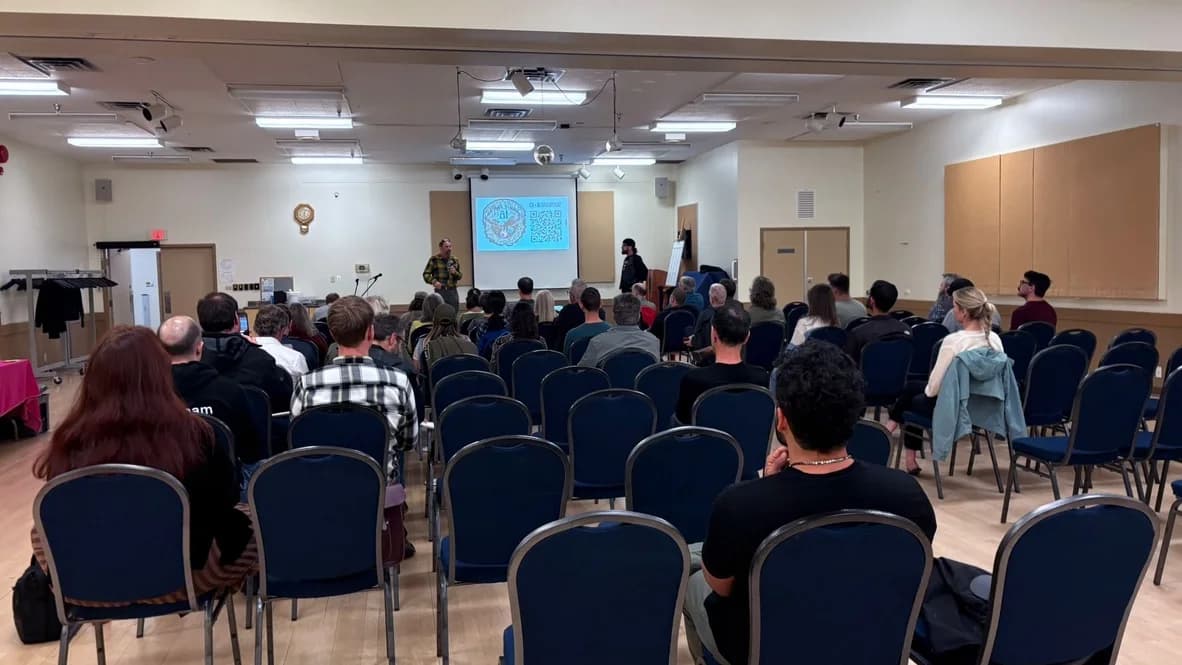
After two gatherings in Courtenay, Comox Valley AI is no longer a satellite of Vancouver. It is becoming its own regional node, with farmers, teachers, mayors, software people, parents, artists, sponsors and island makers asking better questions about artificial intelligence than most boardrooms.
The first thing you learn when you bring an AI meetup to the Comox Valley is that the valley was already having the conversation.
You just have to give it a room.
A month ago, we called it Meetup #0 because I did not want to show up from Vancouver and pretend to know what the valley needed. I have lived enough island life to know how badly that can land. Sometimes people bring something from the city and the room says, keep your slick thing over there. Sometimes the room says, yes, we have been waiting for this, but let us make it ours.
Comox Valley chose the second path.
We expected a dozen people. Around 65 showed up. There were software people, parents, educators, artists, founders, local government folks, farmers, nonprofit leaders, students, retirees, and the kind of quietly brilliant island hermits who only come out when the topic is real enough to be worth leaving the house for.
By the end of Meetup #0, the question had changed. It was no longer, should we start a Comox Valley AI chapter? It was, what does this chapter want to become?
On May 6 at the Florence Filberg Centre in Courtenay, CV + AI Meetup #1 gave us the first answer.
Not the final answer. The first one.
The room was about half returning people and half first timers. That matters. A meetup becomes a community when the first people come back and bring the next people with them. Lourdes Gant, our regional lead, looked around near the end of the night and noticed something else worth saying out loud. Half the room was women.
In technology, that is not a vanity metric. It is a sign that the invitation is different.
BC + AI has always tried to hold a space beyond the usual booster versus doomer binary. The booster says, get on board or get left behind. The doomer says, the systems are extractive, biased, power hungry, legally messy and socially dangerous. Both are seeing something real. Neither position gives a parent, teacher, farmer, artist, mayor, founder or student a practical way to move through Thursday afternoon.
So we walk forward holding both.
That line has become one of the spiritual operating principles of BC + AI. Curiosity and critique. Tools and values. Local action and provincial connection. The valley seems to understand this instinctively.
Meetup #0 Found the Room. Meetup #1 Found the Work.
Meetup #0 was discovery. It had that wild open mic energy where every second person turned out to be more interesting than expected. A Meta AI contractor on Hornby with a home GPU cluster. A Linux kernel developer working on hard problems in defence and drone systems. Educators trying to understand how to teach when the old academic integrity model is already broken. Natural Pastures showing how a cheese company can use AI for grants, HR, farm support and packaging.
Meetup #1 was more structured, but not more sterile.
Mayor Robert Wells opened with a welcome that carried real local texture. Before politics, his life had already moved through early web work, MLS.ca, independent film video sites, Shaw Cable, My Tech Guys and the Comox Valley tech ecosystem. That matters because AI is not landing in empty places. It is landing in communities with memory, labour, history, infrastructure and their own way of talking about change.
Then Steve Jones gave one of the clearest public explanations I have heard about the difference between AI models and AI products.
He started with chocolate covered strawberries.
A strawberry is good. Cover it in enough chocolate and it becomes something else. That does not mean the strawberry is bad for you. It means the wrapper changes the experience.
That is where a lot of AI discourse gets sloppy. GPT is not ChatGPT. A frontier model is not the same thing as the commercial product wrapped around it. The model is the engine. The product is the car, the dashboard, the seatbelt, the ad system, the memory layer, the voice, the pacing, the personality, the entire designed relationship between human and machine.
This distinction matters because a lot of the harm lives in the interface.
Steve's question for builders was simple and sharp: is this product element delivering value through intelligence, or is it manipulating the user?
That question should be taped above every AI product team's desk.
Slow is not a bug. Slow is the feature.
Steve did not just critique the wrappers. He built different ones.
His first example was SlowSpeak, a custom voice interface for AI. Most commercial voice agents are racing toward real time intimacy. They stumble, giggle, apologize, flatter and simulate a person just enough to make your nervous system forget there is no person there.
Steve wanted the opposite. No fake friend. No persona. No first person performance. No emotional dependency. No pretending that a phone knows your hopes and dreams.
He wanted depth, citations, intellectual honesty, playback controls and better answers. So SlowSpeak takes time. Five to ten minutes if it needs to. It can return a 17 minute sourced audio response instead of a fast little dopamine pellet. It uses frontier models, but rejects the design pattern that says intelligence has to arrive disguised as a companion.
That is a deeply important move.
The public conversation about AI safety often stays at the model layer. But communities are going to experience AI through interfaces. Through voices. Through school tools. Through insurance forms. Through customer service agents. Through phones, dashboards, procurement systems and classroom software. If those interfaces are designed to harvest attention, deepen dependency, or blur the line between tool and relationship, people will feel the harm long before they can name the model architecture.
Steve's second example was a student safe AI system. It uses email instead of chat. One question per day. Human review before a student sees the answer. Citations. Related research. Curiosity expansion. Age appropriate responses.
This is the kind of middle path education desperately needs.
Banning AI from schools is not serious. Letting every student sit alone with an infinitely patient, sycophantic chatbot all day is not serious either. The serious work is design. Scarcity. Review. Pedagogy. Consent. Age appropriate boundaries. Human adults staying in the loop.
That conversation started in Meetup #0 and deepened in Meetup #1. Education may become one of the valley chapter's defining themes, because the valley has parents, teachers, post secondary people, technologists and civic leaders all close enough to sit in the same room.
That is rare. Use it.
The cloud is not a country.
Quanah Parker brought the room into another layer of the stack: where the data goes, who controls the compute, what local actually means, and who gets chain of custody over the outputs.
He did not talk about local AI as one magic app. He talked about a stack.
Data. Storage. Indexing. Embeddings. Retrieval. Chunking. Ranking. Prompting. Inference. Evaluation. Access control. Governance.
At every layer, a choice appears. Cloud or local? API or self hosted? Personal machine or shared server? Frontier model or open source model? Fast answer or private answer? Best answer or safest answer? Who sees the output? Who logs it? Who can audit it? Who is accountable when it goes wrong?
Then the room did something I love.
It turned into a local AI lab for ten minutes.
Kris asked who was running local AI across parts of the stack. Around seven hands went up. That is not normal for a regional community meetup. Someone had a home lab with around 160 terabytes of drive space and was experimenting with Weaviate, PostgreSQL vector plugins, Supabase, Open WebUI and Python. Travis described a custom stack with Claude Code, an MCP server, RAG, Neo4j, Qdrant, custom memory, agent orchestration, orchestrators, workers and a kind of subconscious agent layer. Chris talked about local models, Open WebUI, Obsidian as a markdown knowledge base, and remote access to a home machine while driving after the ferry.
This is what I mean when I say the valley was already having the conversation.
The room also made the beginner path visible. If you are using ChatGPT now and want to try local AI, start with LM Studio or Open WebUI and Ollama. Ollama puts the model on your computer. LM Studio or Open WebUI gives you the familiar chat interface. Ask an AI assistant to look at your machine specs and walk you through setup. Start small. Do not download the giant model first unless your computer is ready for it.
That little exchange may become one of the most useful outputs from the night. The seven or eight local builders should document their stacks, share them in the group chat, and let the rest of the community watch, ask questions, copy patterns and learn where to start.
Quanah was also clear about why local AI matters. Privacy. Control. Cost predictability. Customization. Resilience. If Claude or OpenAI goes down and your whole brain goes with it, you learn quickly why local capability matters. If your agentic coding workflow burns through tokens and stops, you learn why local inference can be more than a hobby.
But he did not romanticize it.
Local AI gives you power, and power creates new attack surfaces. A local agent with access to your files, accounts and internal network can do wonderful things or terrible things. Models can hallucinate packages. Bad actors can fill missing package names with malicious code. A tool that feels local and safe may still be talking to the cloud. A model running in your house may still need to be treated like something that can escape the sandbox.
Quanah's safety pattern was practical: do the risky work in a sandbox, on a separate machine or virtual machine, with separate accounts, separate email, clean backups and no real files on the experimental box.
The future is hybrid.
Use cloud AI when the data is not sensitive, when speed matters, and when you need the strongest frontier models. Those systems are powerful because they have money, supercomputers, talent and millions of users reinforcing them every day.
Use local AI when the data matters. Student records. Medical information. Legal documents. Sensitive organizational knowledge. Anything where privacy, jurisdiction and control are not abstract policy words, but real obligations.
The sharpest part of the conversation came when people asked about Azure, Bedrock, American companies and Canadian servers.
For years, procurement logic often reduced data sovereignty to physical location. Keep the data on Canadian servers and you are fine. AI makes that assumption look dangerously incomplete. If the provider is an American company, US legal access can still matter. If your workflow sends data outside the purpose for which it was collected, Canadian privacy compliance can get messy fast.
This is not a theoretical problem for Ottawa white papers. It is a live problem for nonprofits, schools, municipalities, clinics, small businesses and associations in rooms like ours.
That may be one of the most useful things a regional AI chapter can do. Not build hype. Not sell tools. Help ordinary organizations update their risk models before the law, the software and the procurement templates drift too far apart.
The sponsors are part of the story.
Natural Pastures and Tree.io did not show up as logos. They showed up as local people doing the work.
Natural Pastures brought cheese, yes, which already makes them heroes. But the more interesting part is how practical their AI use is. Grants. HR. Farm support. Packaging. The cheese is the visible joy at the end of a long chain of land, labour, regulation, trucks, farmers, early mornings and community relationships. AI is not replacing that chain. It is helping a person inside that chain answer stupid forms, tell clearer stories, and get more useful work done.
That is what adoption actually looks like.
Tree.io brought another kind of signal. Technical people in the valley are tired of driving to Vancouver every time they want to be in a serious room. Colin talked about the shift from skepticism to real use of agentic coding tools. As a software engineer, the magic was never magic. He understands the math. What changed is that the tools finally became useful in daily work.
Then came one of the night's most important reminders: it has never been a better time to be non technical if you can explain what you want clearly.
Agentic coding does not eliminate expertise. It changes when expertise enters the process. A non technical founder can now build the first messy prototype, learn what they actually want, then bring a developer something much more concrete. That can save money, reduce frustration, and make the expert's work more valuable.
The future is not everyone becomes a software engineer. The future is more people become clear thinkers, better spec writers, stronger collaborators and more capable stewards of their own ideas.
The valley has something to teach the province.
What I loved most about the night was that it did not feel like a tech event trying to cosplay as community.
It felt like community using a tech event as an excuse to have the conversation it needed.
There were announcements about the new BC + AI life sciences chapter, with physicians, geneticists and researchers looking at drug discovery, medical imaging and digital health records. There were reminders about the animation accelerator and the Responsible AI Professional Certification. There was a mention of RIPEN, a platform connecting organizations with student developers across Canada, with a founder from Campbell River. There was a Linux zero day warning from someone who knew exactly why it mattered.
Then Lourdes closed with a story about principle centered leadership.
A construction company discovered that some workers did not have the tools they needed because buying them meant choosing between groceries and making a living. The barrier was around $500. The lesson was not really about construction. It was about the gap between what leaders assume and what workers are carrying.
That is the AI lesson too.
We can talk about frontier models, local inference, synthetic data, governance frameworks and constitutional AI all day. But if we do not ask what people are actually carrying, we will build systems that miss the point.
A parent is carrying fear about deepfakes and schoolwork. A teacher is carrying broken assessment models. A farmer is carrying paperwork and margins. A mayor is carrying civic risk. A student is carrying temptation and uncertainty. A developer is carrying new leverage and new responsibility. A nonprofit is carrying privacy obligations it may not fully understand. An artist is carrying both possibility and grief.
The work is not to flatten those into one AI narrative.
The work is to make a room where they can all speak.
That is what Comox Valley AI is starting to become.
What other communities can learn
If you are trying to start an AI community in another region, here is what I would take from Comox Valley.
Start with humility. Do not arrive with a finished format. Ask who is there. Ask what they need. Let the room surprise you.
Keep the conversation mixed. Technical depth matters, but so do parents, artists, teachers, farmers, civic leaders and people who are just trying to make sense of the thing.
Name the tension. People do not need another room where AI is either salvation or apocalypse. They need a room where both the possibilities and costs can be held without anyone being treated like a fool.
Make the local specific. Comox Valley AI should not become Vancouver AI on the island. It should sound like Courtenay, Comox, Cumberland, Hornby, Denman, Cortes and Campbell River. It should have cheese on the table and data sovereignty in the Q and A.
Treat education as public infrastructure. The student AI question is not just a school issue. It is a parent issue, a workforce issue, a mental health issue, a privacy issue and a civic readiness issue.
Talk about wrappers. Most people will not interact with model weights. They will interact with product design. Voice, memory, pacing, persona, friction and consent are now community safety topics.
Talk about jurisdiction. The cloud is not neutral. Procurement needs to catch up with AI workflows, and local chapters can help ordinary organizations ask better questions before they upload everything.
Document the stacks. The people already running local AI should share their home lab patterns, software choices, safety practices and beginner routes so the rest of the room can learn without starting in the deep end.
Build provincial connection without erasing local autonomy. The BC + AI ecosystem is strongest when every chapter becomes a listening node, not a franchise.
Meetup #0 proved that the Comox Valley had the people.
Meetup #1 proved those people had the questions.
Now the work is to keep meeting, keep learning, keep building, and keep refusing the false choice between hype and fear.
We walk forward holding both.