A BC + AI public-interest initiative

Working draftv0.2.0 · Updated

BC Public Compute Project

What we power. Who benefits. What stays here.

British Columbia has started deciding which large data-centre projects may advance toward scarce clean electricity. The next step is to make the public bargain around ownership, resources, rights, local capability and delivered benefit visible.

The project examines private, public, academic, community and Indigenous-relevant data-centre and compute infrastructure through a public-interest lens. Public-access compute is one possible outcome, not the complete meaning of public compute.

15

normalized registry tables

165

described registry fields

4

explicit disclosure classes

The argument

Electricity allocation is not the whole public bargain.

B.C. has real machinery for deciding which large data-centre requests may advance. The missing layer is one understandable public view of ownership, resources, rights, promises, performance and change over the project’s life.

When a project asks for scarce clean electricity, the public should be able to see what it is powering, who controls it, who carries the cost and what durable value remains in British Columbia.

Five public tests

Every major project should answer five questions.

The questions are simple enough to remember and demanding enough to expose where a proposal is specific, incomplete or asking the public to take a great deal on faith.

  1. 01

    Who owns it?

    Identify the facility owner, beneficial owner, operator, parent and controlling entities, related phases and material changes in control.

    Makes visible

    Facility identity · Ownership and control · Material changes

  2. 02

    What does it consume?

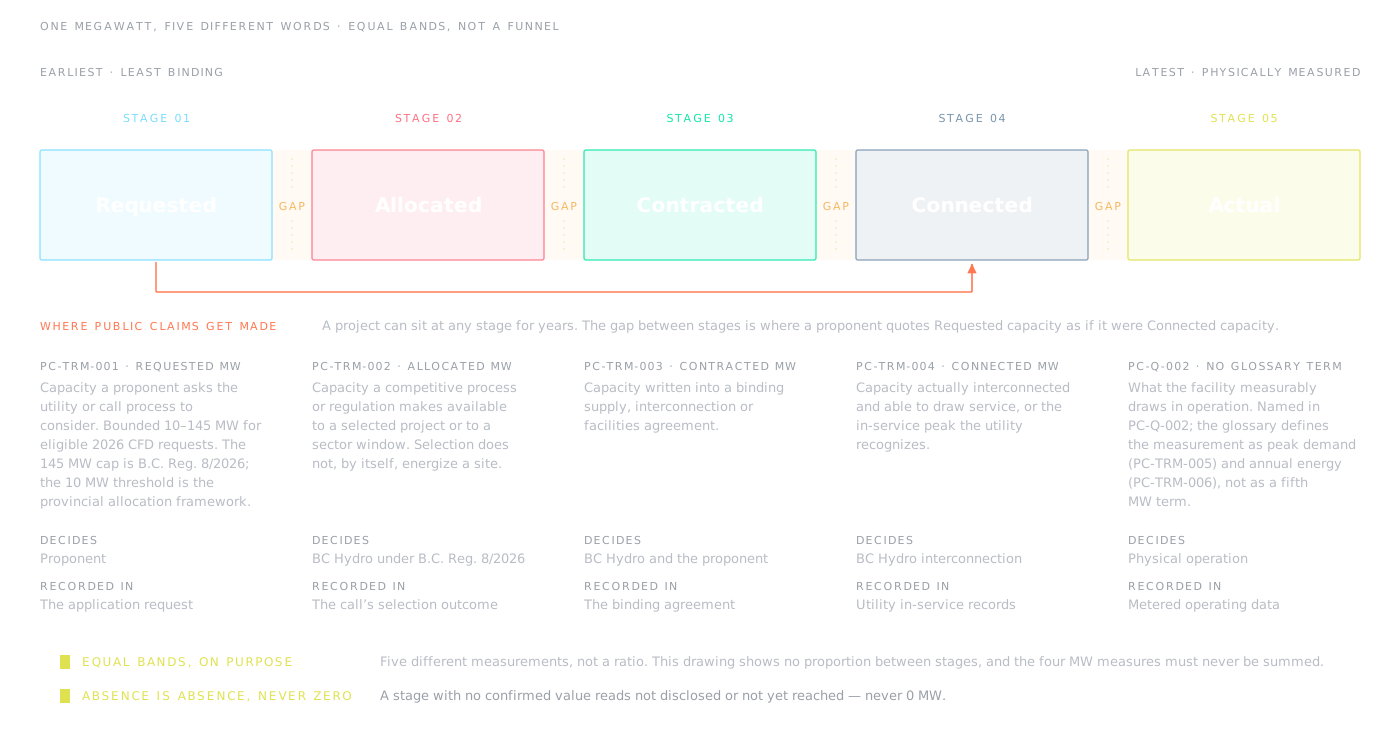
    Keep requested, allocated, contracted, connected and actual electricity separate. Report water, cooling, heat, backup generation and environmental impacts with defined boundaries.

    Makes visible

    Electricity · Water and cooling · Environment

  3. 03

    Who pays for the load?

    Make project-specific electricity, grid, municipal-service, emergency-response, monitoring and decommissioning costs visible and assign responsibility clearly.

    Makes visible

    Grid upgrades · Infrastructure contributions · Financial security

  4. 04

    What remains in British Columbia?

    Track permanent work, wages, apprenticeships, procurement, research, companies, public and SME compute access, sovereign capability and delivered outcomes.

    Makes visible

    Jobs and procurement · Compute access · Commitments and performance

  5. 05

    Who has power over the decision?

    Distinguish First Nations governments and rights holders, local governments, the Province, BC Hydro, regulators, federal bodies, communities, proponents and qualified professionals.

    Makes visible

    Authority context · Authorized Nation-controlled disclosure · Approvals

The B.C. position

Start from what exists. Finish what is missing.

Calling the current process nothing would be false. Calling it a complete lifecycle accountability framework would be equally convenient.

B.C. already has

  • A regulation requiring a competitive process for specified new AI and conventional data-centre capacity.
  • Capacity limits, a maximum request size, price and curtailment requirements, and economic, environmental, sovereignty and First Nation benefit and impact criteria.
  • Separate provincial, utility, local-government, federal and First Nations laws, responsibilities and decision processes.

B.C. still needs

  • One public lifecycle view of ownership, requested and connected power, water, cooling, commitments, actual performance and material changes.
  • Common definitions that prevent requested megawatts, water withdrawal, PUE, WUE, heat availability and promised benefits from becoming misleading shorthand.
  • A practical, authority-aware review process for local governments, First Nations, communities and technical reviewers, without pretending they hold the same powers.
  • Versioning, corrections, disclosure controls, monitoring and remedies so public commitments survive ownership changes and do not quietly become forgotten press-release archaeology.

The first column describes current law, policy and process at a high level. The second column contains BC + AI recommendations, not legal requirements.

Two practical tools

Turn public-interest questions into usable infrastructure.

The first release is deliberately a schema and working toolkit, not an official government registry or a machine that awards virtue points to server buildings.

Schema prototype

BC Public Compute Registry

A proposed public data standard and evidence system for ownership, resources, capability, commitments, compliance and material change.

What exists
The versioned schema and an 18-sheet fictional prototype workbook are complete.
What comes next
Public-safe projection, correction and disclosure governance must land before an explorer or real facility records publish.

Public route planned at /public-compute/registry · Delivery issue #1992

Under development

Data Centre Decision Toolkit

A structured evidence, authority, gate, condition and monitoring system for reviewing a data-centre proposal through its lifecycle.

What exists
The shared research and authority foundations exist. The workbook and guided experience are being built.
What comes next
The First Nations pathway remains under funded co-development and cannot be replaced by a generic checklist.

Public route planned at /public-compute/decision-toolkit · Delivery issue #1994

Disclosure

Transparency needs layers.

The project is not arguing that every byte belongs online. It is arguing that public consequences need a visible disclosure decision instead of disappearing behind one universal confidential stamp.

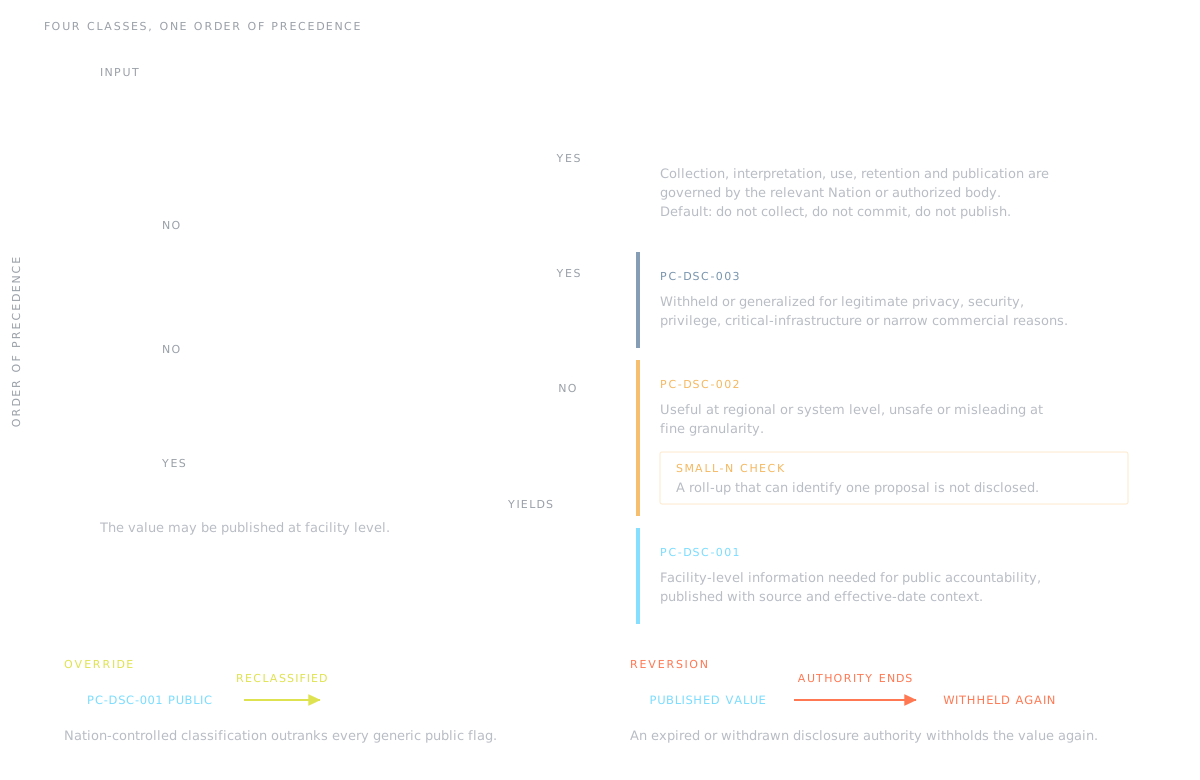
Public

PC-DSC-001

Facility-level information needed for public accountability, with source and effective-date context.

Still carry source IDs and source status.

Aggregated

PC-DSC-002

Information useful at a regional or system level but unsafe or misleading at excessive granularity.

Small-N geographic roll-ups can identify a single proposal. When they can, drop to not-disclosed.

Protected

PC-DSC-003

Information withheld or generalized for legitimate privacy, security, privilege, critical-infrastructure or narrow commercial reasons.

Ordinary statutory and commercial confidentiality only. If the material is Nation-controlled, use PC-DSC-004 instead, even if a contract also marks it confidential.

Nation-controlled

PC-DSC-004

Information whose collection, interpretation, use, retention and publication is governed by the relevant Nation or authorized body.

Default: do not collect, commit, or publish. Issue #1995 and PC-REV-001 own the pathway. Agents do not invent disclosure rules to 'be helpful.'

Review status

Publish the gaps instead of varnishing over them.

A working public-interest project should say what has been reviewed, what still needs qualified judgment and what autonomous agents are explicitly prohibited from inventing.

Foundation complete

Public policy and sources

The canonical source, claims, terminology, proposition and authority pack is merged. It remains subject to updates when primary sources change.

Human review required

First Nations governance

Nation-specific pathways and disclosure rules require funded, Nation-led review. No autonomous completion.

  • PC-REV-001: First Nations pathway, consent, and disclosure rules
  • PC-REV-002: Unapproved Nation-controlled records
Pending review

B.C. legal and municipal authority

Hearing duties, water authorization, corporate-control disclosure and adoption status require legal review.

  • PC-REV-003: Hearing duties, Vancouver Charter vs LGA, and BCUC role
  • PC-REV-004: Water licensing vs municipal utility vs cooling-system facts
  • PC-REV-008: B.C. corporate beneficial-ownership collection vs LOTR vs CBCA
  • PC-REV-010: Adoption status of any BC + AI public position
Pending review

Utility and engineering

Tariffs, interconnection, facility metrics, noise, backup generation and emissions need qualified review.

  • PC-REV-005: Interconnection cost responsibility and tariff application
  • PC-REV-006: CFD evaluation weights and mid-September 2026 outcomes
  • PC-REV-007: Facility-level energy, water, heat, and compute figures
  • PC-REV-013: Backup generation, noise, and air emissions
Pending review

Privacy, security and data control

Public projections and claims about sovereignty, administration and lawful access need privacy and security review.

  • PC-REV-009: Personal information, application confidentiality, and cyber claims
  • PC-REV-011: Data-residency vs control vs lawful access
Pending review

Accessibility

Interactive tools, tables, workbooks, diagrams and publications need automated and human accessibility review.

  • PC-REV-012: Registry and toolkit interfaces, PDFs, and field guides

Version path

From schema to stewarded civic infrastructure.

A registry without maintenance is a spreadsheet with political ambitions. The work becomes public infrastructure only when corrections, versions, review and stewardship survive the launch day.

  1. 01Complete

    Foundation

    Canonical sources, claims, terminology, authority and registry schema.

  2. 02In review

    Public argument

    Position paper and permanent project hub.

  3. 03In development

    Decision tools

    Decision workbook, public registry explorer and guided toolkit.

  4. 04In development

    Governance

    Corrections, versions, safe disclosure, retention, review and export controls.

  5. 05Planned

    Stewarded public infrastructure

    Source-backed facility records, ongoing maintenance, expert review and accountable releases.

Governance

Versioned, correctable and honest about its own history.

A public record earns trust by showing how it changes. These are the operating rules for versions, corrections, evidence states and disclosure, adopted with release 0.2.0 of the working draft.

Version history

  1. v0.2.0

    Governance release: the public governance contract, correction and dispute policy, verification states, disclosure projection rules, staleness model and this version history.

  2. v0.1.0

    Initial public working draft: the project hub at /public-compute, the canonical research and source pack, and the registry schema prototype with its fictional demonstration workbook.

No public corrections yet. When one is published it appears here with the affected record IDs, the outcome and the reason.

Request a correction

Anyone: proponents, governments, Nations, communities, researchers, journalists and the public. Name the value or sentence, say what is wrong and point to checkable evidence.

  • 14dTypos, formatting, broken links, presentation errors. No factual meaning changes.
  • 30dA published fact, figure, classification or attribution is wrong.
  • 30dCredible sources or parties disagree and the record should show the dispute.
  • 30dA request to withdraw a value or record entirely.

Response targets are goals for a volunteer-stewarded prototype, not contractual guarantees. Corrections use the existing contact route below; the caution about sensitive material applies there too.

A subject of sourced public-interest reporting can obtain a correction of errors, not a veto over accurate sourced material. While a credible material dispute is unresolved, the affected value carries a visible disputed state.

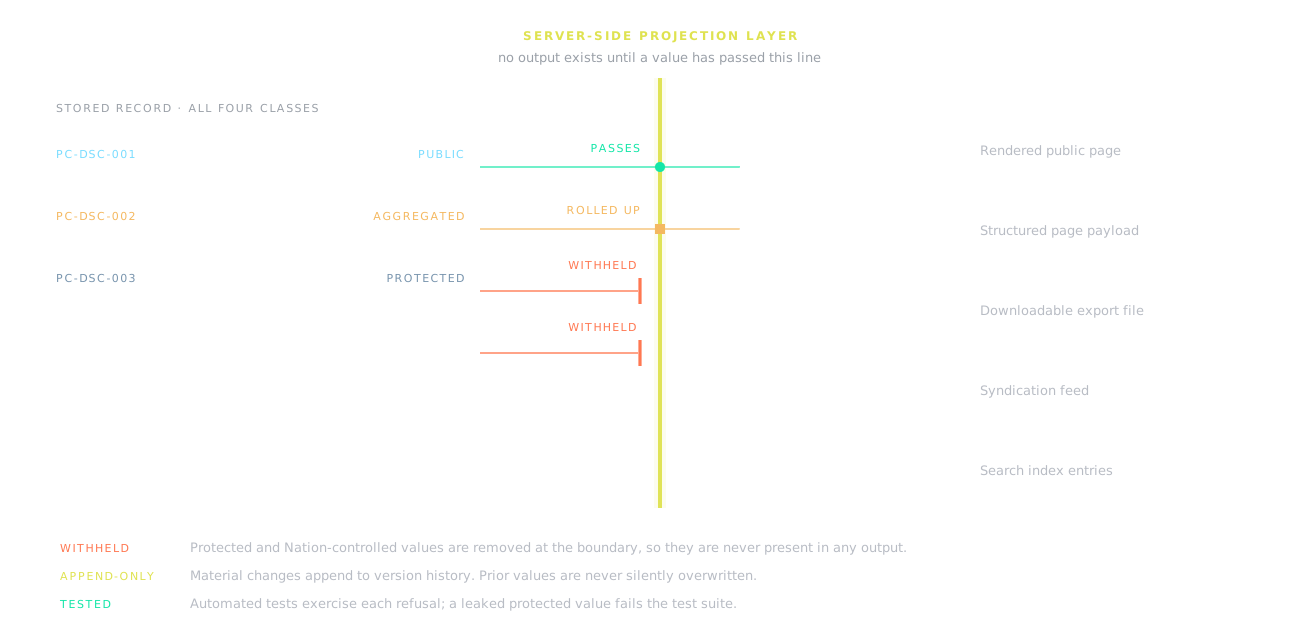
One projection layer decides what publishes

Protected and Nation-controlled values are withheld by a single server-side projection layer before any page, payload, export, feed or index is generated. Nation-controlled classification outranks every generic public flag, and an expired or withdrawn disclosure authority withholds the value again. Material changes append to the version history; prior values are never silently overwritten. Automated tests exercise each of these refusals.

Verification states

official-source
Published by the named public authority, utility, standards body or rights-holding organization as its own record.
proponent-reported
Stated by a project proponent, owner or operator without independent verification.
independently-verified
Confirmed by a second, named, independent public record. Verification covers the cited fact, not the whole project.
third-party-estimate
A modelled, projected or calculated figure from a party other than the proponent. Method and vintage travel with the number.
awaiting-confirmation
A value has been reported and a confirmation request or check is open. Not yet verified, not yet disputed.
not-publicly-disclosed
The field is in scope and the public record does not contain it. Absence is shown as absence, never as zero.
disputed
Cited sources conflict or a credible public challenge exists. Both sides stay recorded.
superseded
A later official instrument, edition or observation replaces this value for the cited point. The old value stays in history.
retracted
The project withdrew this value or record via a published correction. A labelled tombstone remains.
not-applicable
The field does not apply to this record. Distinct from unknown and from not disclosed.

Every public value keeps its source ID, effective period, retrieval date, review date and verification state as separate fields. They are never collapsed into one unexplained confidence score.

Method and participation

Evidence first. Corrections visible. Authority left where it belongs.

BC + AI is publishing a working framework and evidence tools. We are not a regulator, utility, Crown decision-maker, local government, Nation government or substitute for qualified legal and engineering review.

Method in plain language

  • Every material claim carries a source ID and a classification: law, policy, standard, comparator, inference, recommendation or unresolved question.
  • Requested, allocated, contracted, connected and actual electricity remain separate.
  • Unknown, not disclosed, disputed, superseded and not applicable do not become zero.
  • Promises remain separate from commitments, milestones and delivered outcomes.
  • Nation-controlled information is excluded unless the relevant Nation or authorized body permits publication.
  • Material changes and corrections append history instead of silently rewriting it.

Bring a missing piece

Challenge the evidence. Improve the tool.

We are looking for source corrections, municipal and utility expertise, water and cooling review, privacy and security review, accessibility review and properly scoped, compensated First Nations governance and data-governance participation.

Contribute evidence or review

Do not send confidential, personal, security-sensitive or Nation-controlled information through the general contact route.