Working prototypebcai-public-compute-registry-v1 · effective
BC Public Compute Registry
A transparent prototype and data standard for facility-level accountability: who owns a project, what it consumes, what it commits to and what actually gets delivered. The interface is built to make evidence, missing information and verification status legible instead of hiding them behind confident-looking totals.
Fictional demonstration data
FICTIONAL DEMONSTRATION DATA: NOT A REAL, PROPOSED, APPROVED, OR OPERATING FACILITY. Records whose identifiers begin with DEMO are labelled fixtures that exist only to exercise the schema. They describe no real facility and never mix into the public-source count.
Public-source records, staged for review
PUBLIC-SOURCE RECORDS, STAGED FOR REVIEW: every value traces to a cited public source and nothing here is a determination about any project, person, Nation or authority. Sources were retrieved on . These records render on the staged, noindex registry route only. Removing noindex requires the fairness contact step, the privacy and security review of the projection surfaces, and a named steward.
6
total records in the explorer
4
public-source records, staged and not indexed
15 · 165
normalized tables and described fields
Test whether the schema can carry what is known, promised, operating, changed and undisclosed across real British Columbia projects. The pilot is not a ranking and not a survey. The pilot deliberately publishes a small number of records that could be sourced to the standard rather than a longer list padded with inference. Where a candidate could not be sourced, it was dropped and the reason recorded.
Dropped: Skeena Data Centers, Terrace. The municipal process is real and the City of Terrace is drafting data centre zoning, but terrace.ca and the City's council documents refused automated retrieval, leaving journalism as the only available source for every material claim. That is below the standard for a facility record, so no record was created.
Before any of these records is indexed, the subject gets a factual correction opportunity. Each identified subject gets a factual correction opportunity before any record containing ownership, control or adverse material is indexed. A correction opportunity is a fairness step, not a veto over sourced public-interest reporting. Corrections go through the contact route.
Method, disclosure and corrections
Evidence first
Every displayed value carries a source reference, a value state, and effective or reporting context. Requested, allocated, contracted and connected MW stay separate fields. Unknown, not disclosed, disputed, superseded and not applicable never become zero.
Four disclosure layers
Public, aggregated, protected and Nation-controlled information are classified field by field. The public projection strips protected and Nation-controlled material on the server before anything renders or downloads. The registry does not identify or determine rights holders, consultation or accommodation duties, consent, engineering feasibility, security posture, or legal compliance.
Corrections and versions
Material changes append history instead of overwriting it; the demonstration records include a worked supersession example. The public correction workflow and versioning governance are being defined in issue #1998. Until then, challenge a source or flag an error through the contact route.
Downloads
The machine-readable download uses the same public-safe projection as this page and carries its schema version and fictional-data warning. The versioned 18-sheet prototype workbook and field guide are prepared and ship for public download with the branded artifact release in issue #1999.
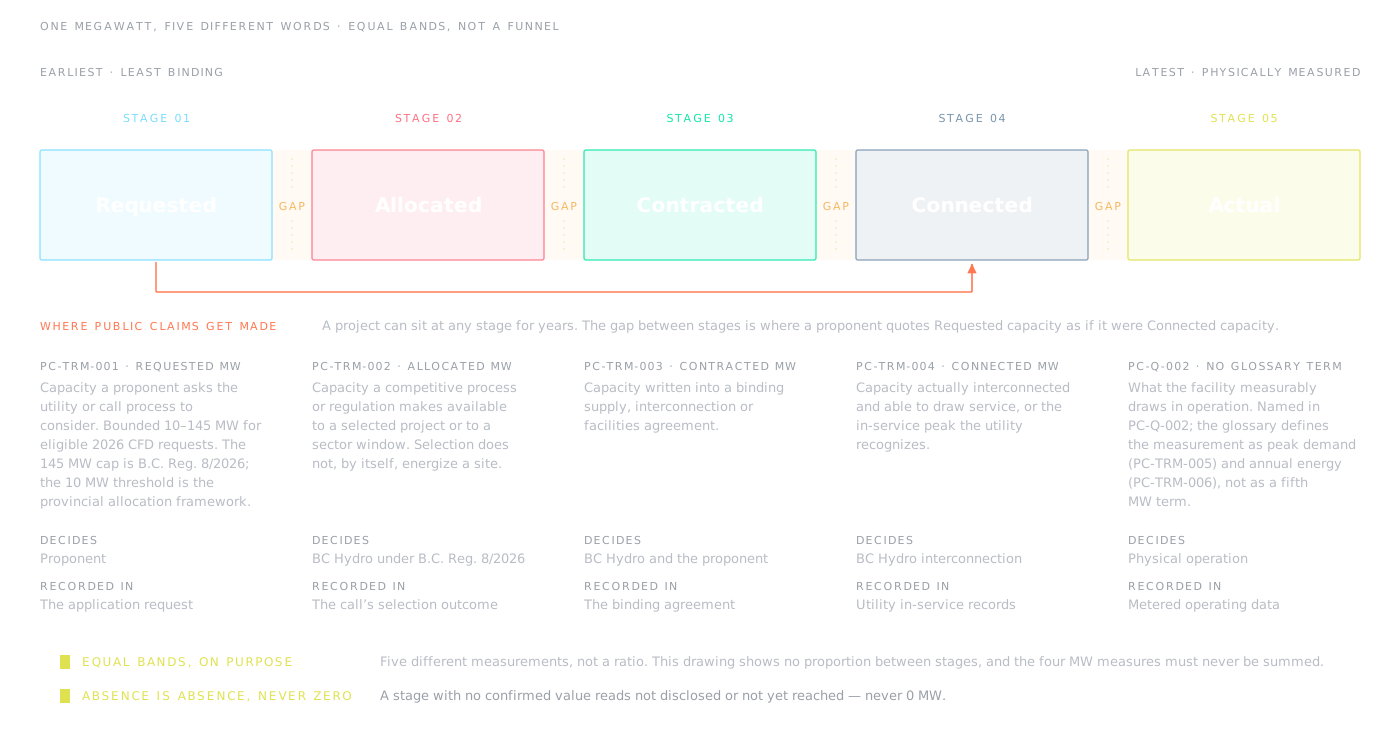
These terms are imported from the canonical terminology pack. A project is never just “50 MW”: the registry records which MW, under which instrument, for which period.
requested MW
The electrical capacity, in megawatts, that a proponent asks a utility or competitive process to consider. In the 2026 CFD this is the application request, bounded at 10–145 MW for eligible projects.Limit: A request is not a right to service.BC Hydro 2026 Call for Demand RFA (2026-02-01)B.C. Reg. 8/2026
allocated MW
Capacity a competitive process or regulation makes available to a selected project or to a sector window. Under B.C. Reg. 8/2026 and the CFD, selection makes a project eligible to enter or keep an interconnection-queue position. It does not, by itself, energize a site.Limit: Sector windows (100 MW storage / 300 MW AI in the first two-year period, with unused storage available to AI) are availability caps, not connected load.B.C. Reg. 8/2026BC Hydro 2026 Call for Demand RFA (2026-02-01)B.C. Industrial Electricity Allocation Framework (updated 2026-03-31)
contracted MW
Capacity that appears in a binding electricity-supply, interconnection, or facilities agreement. Distinct from CFD selection and from in-service load.Limit: The CFD RFA does not itself create the supply contract. Naming a contract MW figure requires the agreement or an official public extract.BC Hydro 2026 Call for Demand RFA (2026-02-01)BC Hydro Electric Tariff
connected MW
Capacity that is actually interconnected and capable of drawing service, or the in-service peak the utility recognizes. Energized load, not a press-release allocation.Limit: Connected MW can be lower than contracted or allocated MW. Never label a CFD window as connected MW.BC Hydro 2026 Call for Demand RFA (2026-02-01)BC Hydro Emerging industries connections page
PUE and reporting boundary
Power Usage Effectiveness as defined by ISO/IEC 30134-2: total data-centre energy divided by IT equipment energy, with a stated measurement category and boundary (what meters, what on-site generation, what mixed-use space is in or out).Limit: PUE is not carbon, water, or compute efficiency. A number without category and boundary is not comparable.ISO/IEC 30134-2:2026 (PUE)
WUE and reporting boundary
Water Usage Effectiveness as defined by ISO/IEC 30134-9: water consumed per unit of IT equipment energy, with source and boundary stated (on-site vs source water, direct vs electricity-related water).Limit: WUE is not a watershed-stress metric and must not mix withdrawal with consumption.ISO/IEC 30134-9:2022 (WUE)LBNL CoE, Water Efficiency
How values are labelled
Every value in the registry carries one of these states, drawn from the canonical schema. The state is part of the data, not a styling detail.
Reported
A stated value with its source, boundary and period attached.
Unknown
The field is in scope and no public value exists yet. Unknown is not zero.
Not publicly disclosed
The field is in scope and the public record does not contain it.
Not applicable
The field does not apply to this record at this lifecycle stage.
Disputed
Cited sources conflict or a public challenge exists. Both sides stay on the record.
Superseded
A later record replaces this value. The prior value stays in history.
Browse the records
Showing 6 of 6 records
Registry records with record type, lifecycle status, location and organizations. All current records are fictional demonstrations.
Simon Fraser Universityhost-institutionDigital Research Alliance of Canadafunder-allocator
PC-SRC-107
Related and phased projects
Records DEMO-FAC-001 and DEMO-FAC-002 are flagged for aggregation review as a BC + AI recommendation. This flag is not a legal determination that the fictional phases form one project.
Records PC-FAC-002 and PC-FAC-003 are flagged for aggregation review as a BC + AI recommendation. TELUS presents 150 West Georgia and the Kamloops facility as parts of one B.C. cluster with a shared initial power figure and a shared capacity trajectory. This flag is a BC + AI recommendation to review them together. It is not a legal determination that they form one project. The 111 East 5th Avenue record is not included because the public record BC + AI retrieved does not confirm it is the M3 facility named in the proponent release.