Position essay, August 21, 2026. Edited for publication on September 20, with the original dateline retained. This is my public-interest argument for B.C. compute policy. The project tools described below remain prototypes awaiting qualified and Nation-led review. This essay is not legal, utility, engineering or Nation-specific advice.
Compute draws power and land like heavy industry, so the civic questions are load-bearing, not optional colour.
British Columbia is choosing which data centres may advance toward scarce clean power. Here are five questions that make the public bargain visible.
AI now arrives as heavy industry.
The build-out is land, transmission, substations, cooling, water, backup generation, fibre, steel, concrete, specialized chips and a great deal of electricity. It needs permits, public infrastructure and decisions about what gets built, where it goes, who pays and what the rest of us receive in return.
That does not make it bad. Heavy industry can build things a society needs. It can create capability, research, companies, services and public value. It can also consume scarce resources, shift costs and leave a region hosting somebody else’s infrastructure while the value travels elsewhere.
I want British Columbia to build serious compute infrastructure. I want researchers, companies, public institutions and communities in this province to have access to the systems that will shape the next economy. I also want the bargain in public.
When a project asks for a share of B.C.’s clean power, people should be able to see what it is powering, who controls it, who carries the cost and what durable value remains here.
That is the premise of the BC Public Compute Project: a public-interest framework, a pilot registry and, later, a practical decision toolkit organized around five questions every major project should be able to answer.
B.C. is not starting from zero
British Columbia has already moved beyond first-come, first-served treatment for specified new data-centre loads.
Under B.C. Reg. 8/2026 (PC-SRC-002), BC Hydro must use a competitive process for specified new AI and conventional data-centre capacity. For the first two-year window, the regulation caps new capacity made available at 100 megawatts for conventional data centres and 300 megawatts for AI data centres, plus any unused conventional allocation. A single competitive-process request cannot exceed 145 megawatts.
The Province’s Industrial Electricity Allocation Framework (PC-SRC-012) and BC Hydro’s 2026 Call for Demand (PC-SRC-018) add price, curtailment, economic, environmental, data-sovereignty and First Nation benefit and impact considerations.
That is real policy machinery. It matters. It recognizes that clean electricity is finite, that a large data-centre load is not an ordinary commercial connection and that access to the grid should involve more than arriving early with a large cheque.
It also needs to be described accurately. Selection through the Call for Demand makes a project eligible to enter or retain a position in the interconnection queue. It is not, by itself, a power-supply contract. It is not a completed connection. It is not evidence that the full requested load is operating.
Some projects that had reached specified study or deposit milestones continue through the existing interconnection process. We should not claim that every major B.C. data-centre proposal went through the 2026 call.
This distinction sounds fussy until a 100-megawatt request becomes a headline saying 100 megawatts were “awarded,” then becomes a chart saying 100 megawatts are “in operation.” Infrastructure policy accumulates fiction one convenient verb at a time.
Ontario’s August 2026 draft Data Centre Playbook (PC-SRC-022) is useful context. It proposes an economic and strategic assessment alongside electricity-system review and asks what projects contribute to economic development, digital sovereignty and public confidence. The consultation closed on September 12; the notice remains a proposal as of this edit. It is not B.C. law. The useful lesson is not that B.C. should copy Ontario. It is that provinces are beginning to state the public bargain around compute more plainly.
Electricity allocation is not the same as public accountability
Swipe horizontally to inspect the full diagram →
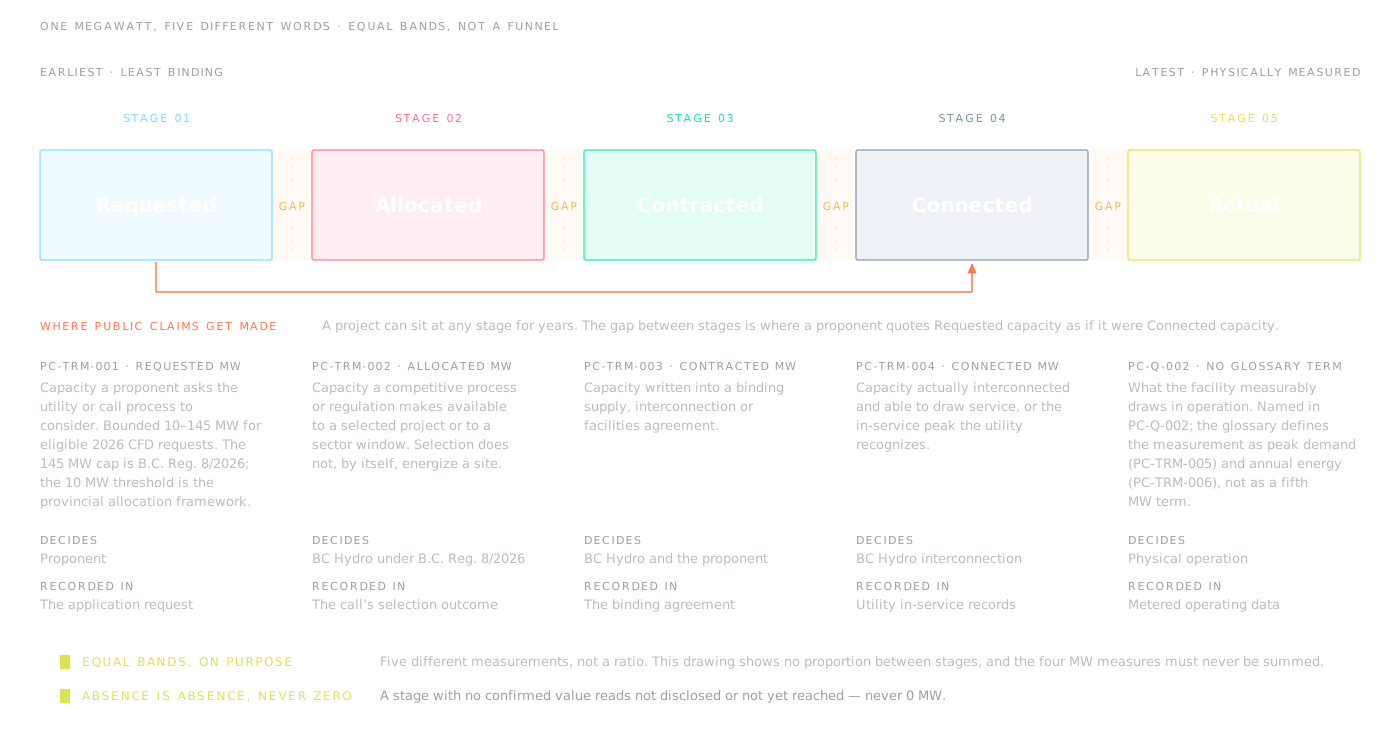
Read this figure as text
| Stage | Term | What it measures | Who decides | Where it is recorded |
|---|---|---|---|---|
| 01: Requested | PC-TRM-001 | Capacity a proponent asks the utility or call process to consider. Eligible 2026 Call for Demand requests are bounded from 10 to 145 MW. | Proponent | Application request |
| 02: Allocated | PC-TRM-002 | Capacity a competitive process or regulation makes available to a selected project or sector window. Selection does not energize a site. | BC Hydro under B.C. Reg. 8/2026 | Call selection outcome |
| 03: Contracted | PC-TRM-003 | Capacity written into a binding supply, interconnection or facilities agreement. | BC Hydro and the proponent | Binding agreement |
| 04: Connected | PC-TRM-004 | Capacity actually interconnected and able to draw service, or the in-service peak recognized by the utility. | BC Hydro interconnection | Utility in-service records |
| 05: Actual | PC-Q-002 | What the facility measurably draws in operation, recorded as peak demand and annual energy rather than a fifth MW term. | Physical operation | Metered operating data |
- Equal bands, on purpose. The figure shows no proportion between stages, and the measures must never be summed or relabelled as one another.
- A project can remain at any stage for years and may never reach the next. Those gaps are where requested capacity is often quoted as if it were connected capacity.
- Absence is shown as “not disclosed” or “not yet reached,” never as zero.
The current B.C. process answers an important utility question: which eligible projects may advance toward scarce electricity capacity?
It does not yet provide one complete public view of the project across its life.
A community may still have to hunt through utility documents, corporate registries, land records, council agendas, permit systems, company announcements and environmental reports to understand who owns a project, how much power it requested, what it actually connected, where its water comes from, what it promised, what it delivered and whether ownership or operating plans changed later.
That fragmentation favours the party with the most lawyers, consultants and time. It does not produce better decisions.
I propose a practical next layer for BC + AI to develop: a public-interest framework built around five questions every major project should be able to answer.
1. Who owns it?
The name on the building is not always the owner. The landowner may not be the operator. The operator may not be the controlling parent. A project company may be governed through financing rights, management agreements, related entities or a later change of control.
British Columbia already has beneficial-ownership tools, including the Land Owner Transparency Registry (PC-SRC-017). Federal corporations have separate individuals-with-significant-control rules (PC-SRC-025). Those are useful records, not a complete project-control map.
A serious public record should distinguish the facility owner, beneficial owner, operator, parent and controlling entities. It should show related or phased projects and record material ownership changes over time.
That is the minimum information required to know who is making the promise and who will still be responsible for it after the ribbon cutting.
2. What does it consume?
Start with electricity, but use the right words.
- Requested megawatts are what a project asked for.
- Allocated megawatts are capacity made available through a process or decision.
- Contracted megawatts are governed by an executed service arrangement.
- Connected megawatts are physically available at the site.
- Actual use changes over time and should be reported for a defined period.
Those values are related. They are not interchangeable.
Water reporting has the same problem. Withdrawal is the water taken from a source. Consumption is the portion not returned to the same source in a usable form or timeframe. A “closed-loop” system can still consume water through cooling-tower evaporation. Peak-day demand can matter more to a local system than a smooth annual average.
PUE and WUE are useful standards when they are reported honestly. Power Usage Effectiveness (PC-SRC-028) needs a measurement category and reporting boundary. Water Usage Effectiveness (PC-SRC-029) measures consumed water per unit of IT energy. It is not a watershed-stress score. A decimal without its boundary and operating context is mostly typography.
A renewable-power claim needs the same precision. A facility can sit on a high-renewable grid without causing one new unit of clean generation. Renewable share and additionality are different claims, with different evidence.
Heat reuse needs the same discipline. Heat that exists is not heat that is captured, delivered and used. A credible claim needs temperature, volume, seasonal availability, an identified offtaker, infrastructure, milestones and measured delivery.
Electricity is not compute capacity either. Different chips, numerical precisions, interconnects, workloads and utilization rates make one “H100-equivalent” or “megawatts of compute” number unreliable across unlike systems. Name the hardware, count, dated method and workload context instead.
3. Who pays for the load?
A project’s electricity bill is not the whole cost.
Large loads can require generation, transmission, substations, distribution upgrades, municipal water or sewer capacity, roads, emergency response, fire planning, noise monitoring and eventual decommissioning. The question is not whether infrastructure costs money. The question is whether those costs follow the project or quietly spread across households, municipalities and future budgets.
My recommendation is simple:
The load pays for the load.
Project-specific costs, upgrades, studies, monitoring, emergency-service impacts and decommissioning obligations should be identified early, assigned clearly and secured where necessary. The actual assignment is a tariff, agreement and authority question, not something BC + AI can declare for a named project. The public record should distinguish an ordinary tariff payment from a commitment to cover a project’s full incremental cost.
4. What remains in British Columbia?
A construction boom is not the same as a durable industry.
The public-value case should identify permanent employment, wages, apprenticeships, local and B.C. procurement, tax and infrastructure contributions, research partnerships, company formation, intellectual property, skills and accessible compute capacity.
It should also separate four things that are routinely blended together:
- a promise,
- a binding commitment,
- a milestone, and
- a delivered outcome.
If a project promises local procurement, the record should define local, establish a baseline, name the reporting period and show actual spend. If it promises public or research compute, the record should show who qualifies, how capacity is allocated, what it costs, how much was used and what resulted.
Sovereign capability requires more than servers sitting inside a provincial border. Data residency is not data control. Remote administration, subcontractors, ownership, lawful-access pathways, technical support and the ability to allocate compute all matter.
The question is not whether every facility must be locally owned. The question is whether British Columbia is building durable capability or renting out land, water and electricity while remaining dependent on decisions made elsewhere.
5. Who has power over the decision?
This is where a tidy checklist can become dishonest.
First Nations are governments and rights holders. Local governments exercise delegated land-use and service authority. The Province, BC Hydro, the B.C. Utilities Commission, federal bodies, health and emergency authorities and qualified professionals each hold different responsibilities. A public meeting is not Crown consultation. A community-benefit agreement is not consent. A utility selection is not a land-use approval.
B.C.’s Declaration on the Rights of Indigenous Peoples Act (PC-SRC-005) requires provincial work to align laws with the UN Declaration through consultation and cooperation with Indigenous Peoples. That obligation does not transfer to BC + AI, a municipality, a proponent’s engagement plan or a spreadsheet.
Information governance also needs its own category. The First Nations principles of OCAP® (PC-SRC-027) concern ownership, control, access and possession of First Nations information. Nation-controlled information is not commercial information with a different redaction label. What may be collected, interpreted, retained or published must be governed by the relevant Nation and its own laws, protocols and decisions.
The BC Public Compute Project will not identify affected Nations, decide consultation adequacy or invent a universal First Nations pathway. That part of the work must be co-developed, properly scoped and paid for.
Two tools to make the bargain practical
A position without tools becomes another tasteful PDF explaining that accountability would be nice.
We have built working versions of two practical instruments. Neither is an approval system or legal authority.
The BC Public Compute Registry
The BC Public Compute Registry is a working prototype of a public data standard and evidence system for major compute facilities. It covers ownership, location, project stage, requested and connected electricity, water and cooling, environmental performance, jobs and procurement, authorized Indigenous governance information, compute access, approvals, compliance and material changes.
Every quantitative value carries a source, effective period and verification state. Unknown is not zero. Proponent-reported is not independently verified. A commitment is not an outcome. A fictional demonstration record cannot quietly become a real facility because somebody copied the row.
The prototype keeps fictional demonstration records visibly separate from source-backed public records. It is not an official government registry, and it is not a league table of virtuous and wicked server buildings. Its records remain excluded from search indexing while fairness, privacy, security and stewardship reviews are open.
The Data Centre Decision Toolkit
The toolkit is an internal draft of a question set and guided review system for local governments, First Nations, communities, proponents and technical reviewers. Its question modules remain pending expert and authority review, and its guided route has a separate launch gate.
It organizes intake questions, authority, required evidence, water, noise, heat, electricity, land, emergency response, ownership, community benefits, confidentiality, public engagement, conditions, monitoring and decommissioning.
Most importantly, it separates non-negotiable gates from weighted benefits. A strong jobs promise cannot mathematically offset an unresolved rights process, an unsafe design, unavailable utility capacity or an unproven water source. The draft First Nations module is a review inventory, not an approved or universal pathway. Humans have built enough scoring systems where the bonus points mysteriously defeat the laws of physics.
Transparency needs layers
Swipe horizontally to inspect the full diagram →
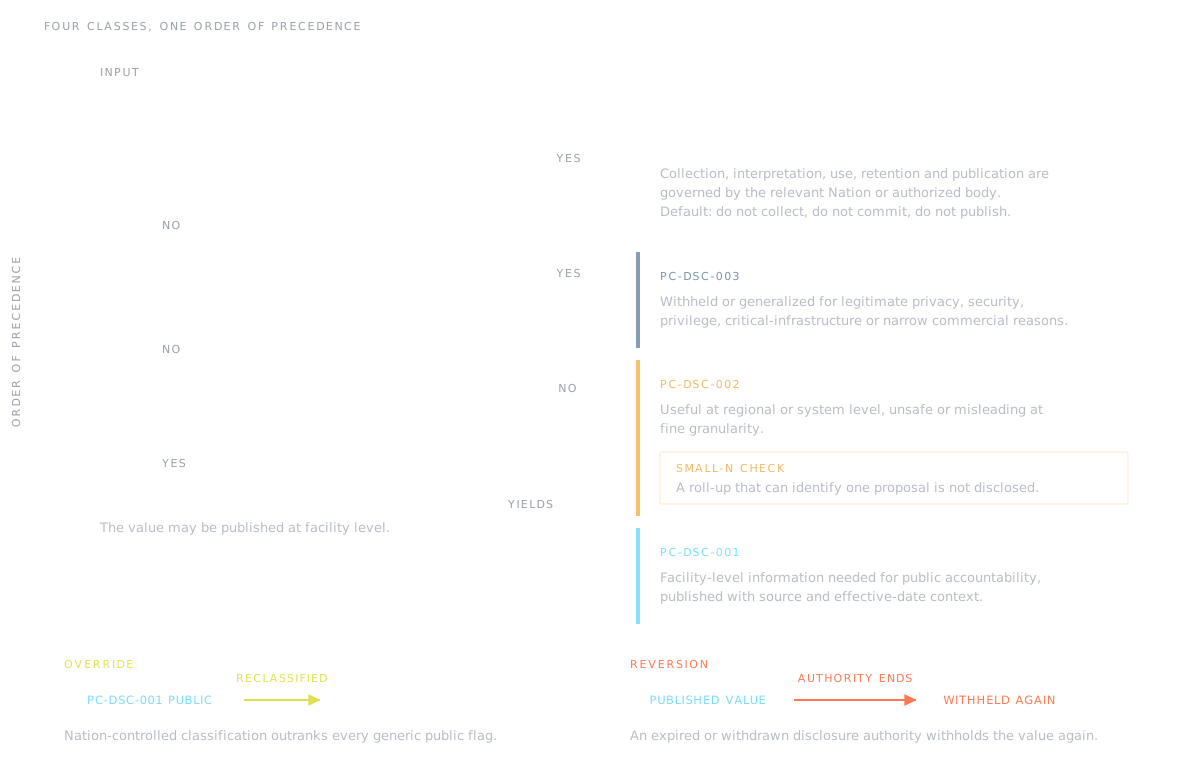
Read this figure as text
- Test 01: is this value governed by a Nation or an authorized body? If yes, PC-DSC-004 Nation-controlled applies. Collection, interpretation, use, retention and publication are governed by that Nation or authorized body. The default is do not collect, do not commit and do not publish.
- Test 02: is there a legitimate reason to withhold? If privacy, security, privilege, critical-infrastructure or a narrow commercial reason applies, PC-DSC-003 Protected applies and the value is withheld or generalized.
- Test 03: is facility-level detail safe and non-misleading? If no, PC-DSC-002 Aggregated applies. A roll-up that can identify one proposal is not disclosed.
- No exclusion applies. PC-DSC-001 Public applies, with source and effective-date context.
- Override
- Nation-controlled classification outranks every generic public flag, including a value already marked public.
- Reversion
- A published value is withheld again when its disclosure authority expires or is withdrawn.
Public accountability does not require publishing everything.
Some information should be public at the facility level. Some is useful only in aggregated form. Some deserves protection for legitimate privacy, security, privilege, critical-infrastructure or narrow commercial reasons. Some is Nation-controlled and governed through a different authority entirely.
The answer is not indiscriminate disclosure. It is a visible classification system, a reason for withholding, a review date and a correction process.
“Confidential” cannot remain the word that ends every public-interest question. Nor should transparency become an excuse to expose personal information, security architecture, customer workloads, cultural knowledge or Nation-controlled records.
Build it here, but build it on purpose
I am pro-AI. I am pro-compute. I am pro-building.
I am also against blank cheques, public costs disguised as private investment and benefit stories that disappear as soon as a project changes hands.
British Columbia has an opportunity to do this better. We have clean electricity, technical talent, research institutions, public-sector capacity, Indigenous governments, strong communities and industries that can use serious compute for work that matters.
The Province has already taken the important first step of treating large data-centre electricity requests as choices rather than inevitabilities.
Now those choices need a public record.
What we power says something about what we value. Who benefits tells us whether the bargain is real. What stays here determines whether we built an industry or merely hosted one.
The BC Public Compute Project is our working contribution: a public framework, a registry prototype and a decision toolkit designed to be challenged, corrected and improved.
If you can correct a source, test a definition or contribute municipal, utility, technical, accessibility or rights-holder review, start with the method and review notes, then contact BC + AI. Do not send confidential, personal, security-sensitive or Nation-controlled information through the general contact form.
Build it here. Pay the real costs. Respect rights and authority. Protect water and the grid. Make the promises measurable. Leave capability behind.
That is what serious growth asks us to do.
Method, tools and related work
- BC Public Compute Project hub, including the five questions, current status and contribution path
- Project methodology, source classes and review limits
- BC Public Compute Registry pilot
- Data Centre Decision Toolkit status and launch boundary
- B.C. Reg. 8/2026 (
PC-SRC-002) - B.C. Industrial Electricity Allocation Framework (
PC-SRC-012) - BC Hydro 2026 Call for Demand RFA (
PC-SRC-018) - Ontario draft Data Centre Playbook consultation (
PC-SRC-022) - ISO/IEC standards for PUE (
PC-SRC-028), WUE (PC-SRC-029), energy reuse (PC-SRC-030) and renewable energy factor (PC-SRC-031) - IEA, Energy and AI (
PC-SRC-035) and the LBNL 2024 U.S. Data Center Energy Usage Report (PC-SRC-034) for physical-load and compute context - Both Hands on the Grid
- What Kind of AI Province Do We Want to Build?
- Sovereign AI for Whom?
OCAP® is a registered trademark of the First Nations Information Governance Centre. This essay is public-interest policy commentary, not legal, utility, engineering or Nation-specific advice. AI assisted with drafting, editing and source comparison. Kris authorized publication. The cover is a generated concept illustration, not a photograph of a real facility. Publication of this essay does not constitute expert validation of the registry or toolkit, or approval by any First Nation.