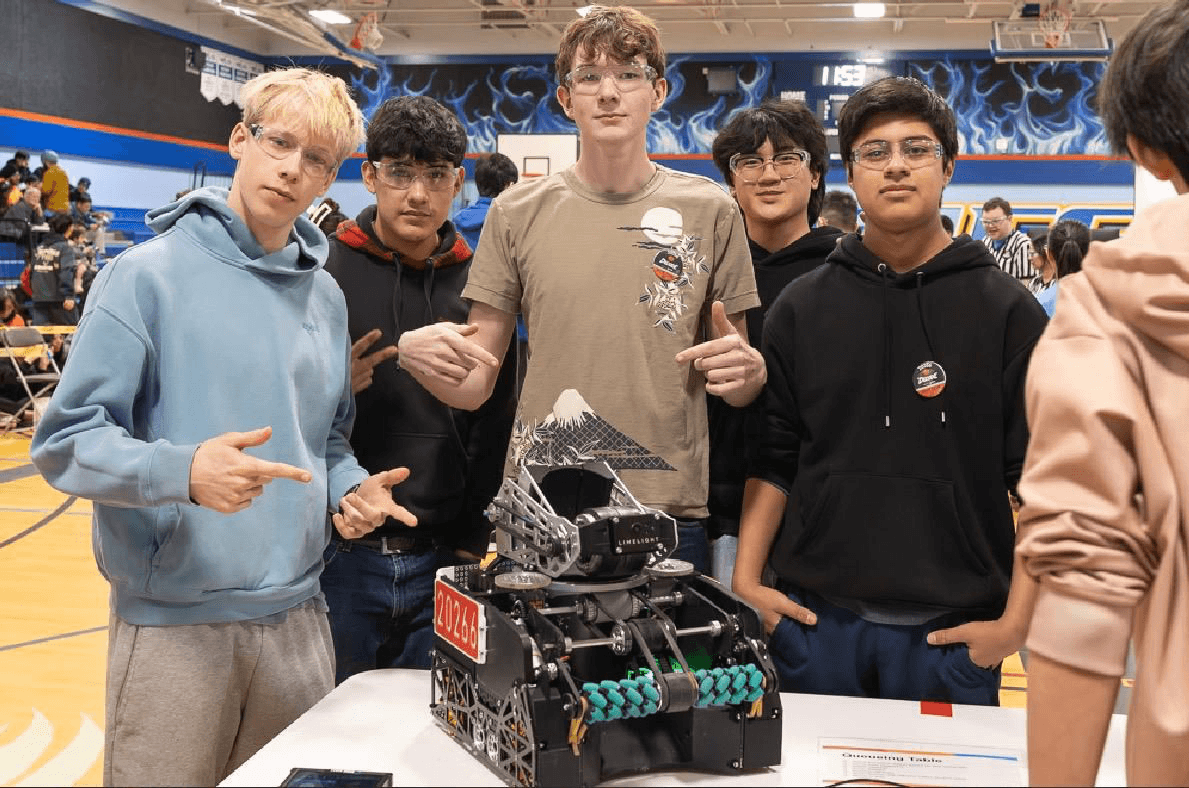
Cover: P.O.W.E.R., Prince of Wales’ FTC Team 20266, with their competition robot. Photograph supplied by Kris Krüg.
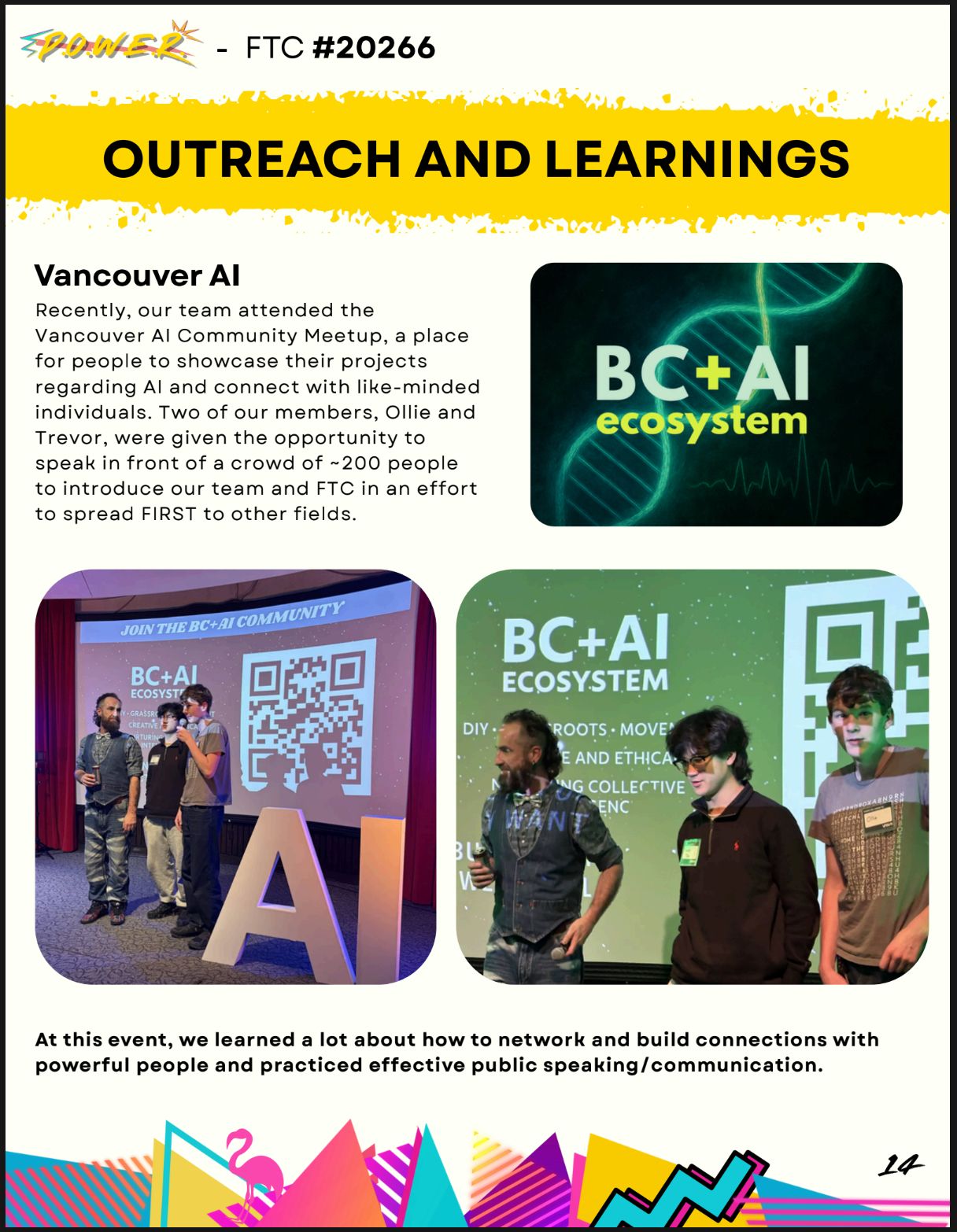
On page 14 of a student robotics manual, there’s a photograph of our stage.
The students are from P.O.W.E.R., the Prince of Wales robotics team that BC + AI sponsors. Under “Outreach and Learnings,” they describe Ollie and Trevor introducing their robot club and FIRST Tech Challenge to approximately 200 people at a Vancouver AI meetup. There’s our logo behind them. I’m standing beside them. They write about making connections and practising public speaking.
British Columbia is talking about a formal robotics cluster. Good. I want the people writing that proposal to spend a minute with this page. Two students explaining a machine they built, in front of people who might help them build the next one. That belongs in the robotics budget.
The students’ own account tells the story. The robot is theirs. So are the hours of design, programming and competition preparation. We sponsor them, give them the stage and introduce them to people who can help them keep going.
We’ve spent three years bringing people together through BC + AI, with robotics and physical AI in the mix. By physical AI, I mean AI that can sense and act in the physical world. Give the code a camera, a motor and a crowded building to deal with. Suddenly, the questions get very practical.
Bring the prototype. Show the work.
At Vancouver AI in May 2024, Prajwal Prashanth demonstrated JARVIS, an AI assistant attached to a baseball cap. Raspberry Pi, camera, microphone, speaker. Readily available parts assembled into something he wanted to make useful.
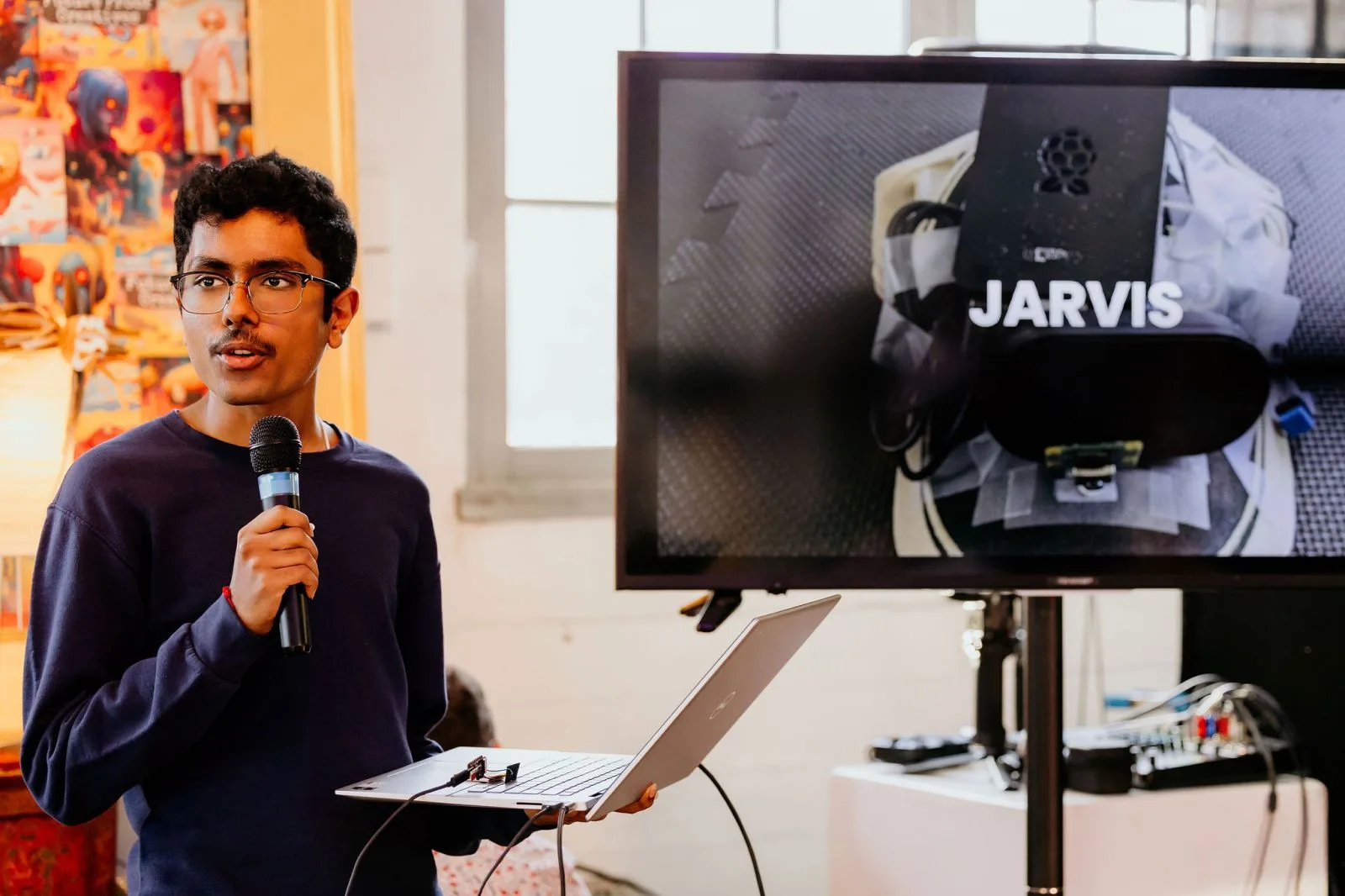
The demonstration took three attempts. In his account, a search function failed and the event microphone appeared to interfere with speech recognition. He adjusted and tried again. Matthew Wang recorded the demonstration.
Prajwal shared his code and spoke about the possibility of helping people with visual impairments. JARVIS is a wearable prototype, with that accessibility goal still requiring testing with the people it is intended to serve.
In August, he returned with a smaller version. He asked for introductions to organizations working with visually impaired people. People came forward to help. An unfinished project, an honest ask, someone in the room who could make an introduction. I want more of that.
Watch Prajwal’s JARVIS interview on YouTube · 2 minutes 18 seconds
BC + AI community interview, published July 21, 2025. Director: Viktor Serbin. Host and producer: Kris Krüg. This is a later interview, separate from the 2024 demonstrations described above. Interview details and related stories.
Lawrence Okolo brought a different problem to Vancouver AI in March 2026. His live OpenClaw demonstration connected an AI agent system to robot hardware. His work with VASI addresses indoor spatial intelligence, including building models that can support wayfinding, simulation and logistics.
A doorway has dimensions. Furniture moves. Other people have places to be. Lawrence is working where a spoken request has to become something a machine can actually do in that space.
Follow the code, too. The demo’s technical account credits Chris Matthieu’s AgenticROS, which connects AI agents with the Robot Operating System. Lawrence’s VASI integration builds on that work. The next person trying this should be able to find the recording, the code and the people who made it possible.
Lawrence Okolo at Vancouver AI, March 25, 2026. BC + AI recording, published April 25. The demonstration connects software to robot hardware.
You don’t have to introduce yourself as a roboticist to belong in this conversation. Steve Moon is a hardware and software hacker with interests all over the technical map. Parisa Nouri is a robotics and applied scientist. Others come through computer vision, electronics, fabrication or AI agents. Put them in a room with something to take apart.
For students, cost can decide whether they get into that room at all. Our Youth Access Fund supports access to robotics learning and competition. P.O.W.E.R. is FTC Team 20266; the Furious Frogs campaign supports a separate team, FTC 26025. Each has its own builders and its own story.
Ethọ́s Lab, our partner in Ed + AI, starts younger. Its fall 2024 robotics program for grades 5–7, with UBC Geering Up and facilitator PJ Muhigi, covered electronics, sensors, coding and an obstacle-detecting robot project. A kid curious about robots needs access to the parts, the tools and someone who will help them figure it out.
Sensors and cameras belong in this conversation
Artists bring different questions to the hardware. At Vancouver AI, Manuel Axel Strain and collaborator Will proposed using non-invasive sensors to study plant signals. Their talk asks what responsible sensing might look like when Indigenous knowledge and relationships with the land guide the questions. They came looking for equipment and collaborators. There is still research to do: collect the signals, test the methods, work out what can responsibly be said about them.
Lionel Ringenbach, also known as Ucodia, approaches the interface through play. His CompoVision uses physical objects and a camera as inputs for generative imagery. Moving things by hand changes what the system sees and makes. It is an interactive art system, with practical lessons for anyone working on perception and human control.
BC + AI recordings. Manuel Axel Strain’s full talk and chapters: proposed interfaces at 18:02; request for sensors and collaborators at 22:45. Lionel Ringenbach’s community interview was published April 30, 2025. CompoVision concept and realization: Lionel Ringenbach / Ucodia.
Before the humanoid pitch deck, there was a giant spider
BC’s mechanical imagination has a wonderfully strange history.
Mondo Spider grew from a wooden prototype at Vancouver’s 2005 Junkyard Wars into an eight-legged steel machine in 2006. Leigh Christie, Jonathan Tippett, Ryan Johnston, Sam Meyer and Charlie Brinson were its principal builders. Tippett’s account also credits Alex Mossman’s powertrain work and Rob Cunningham’s workshop support. Donated equipment, volunteer labour and personal money helped make it happen.
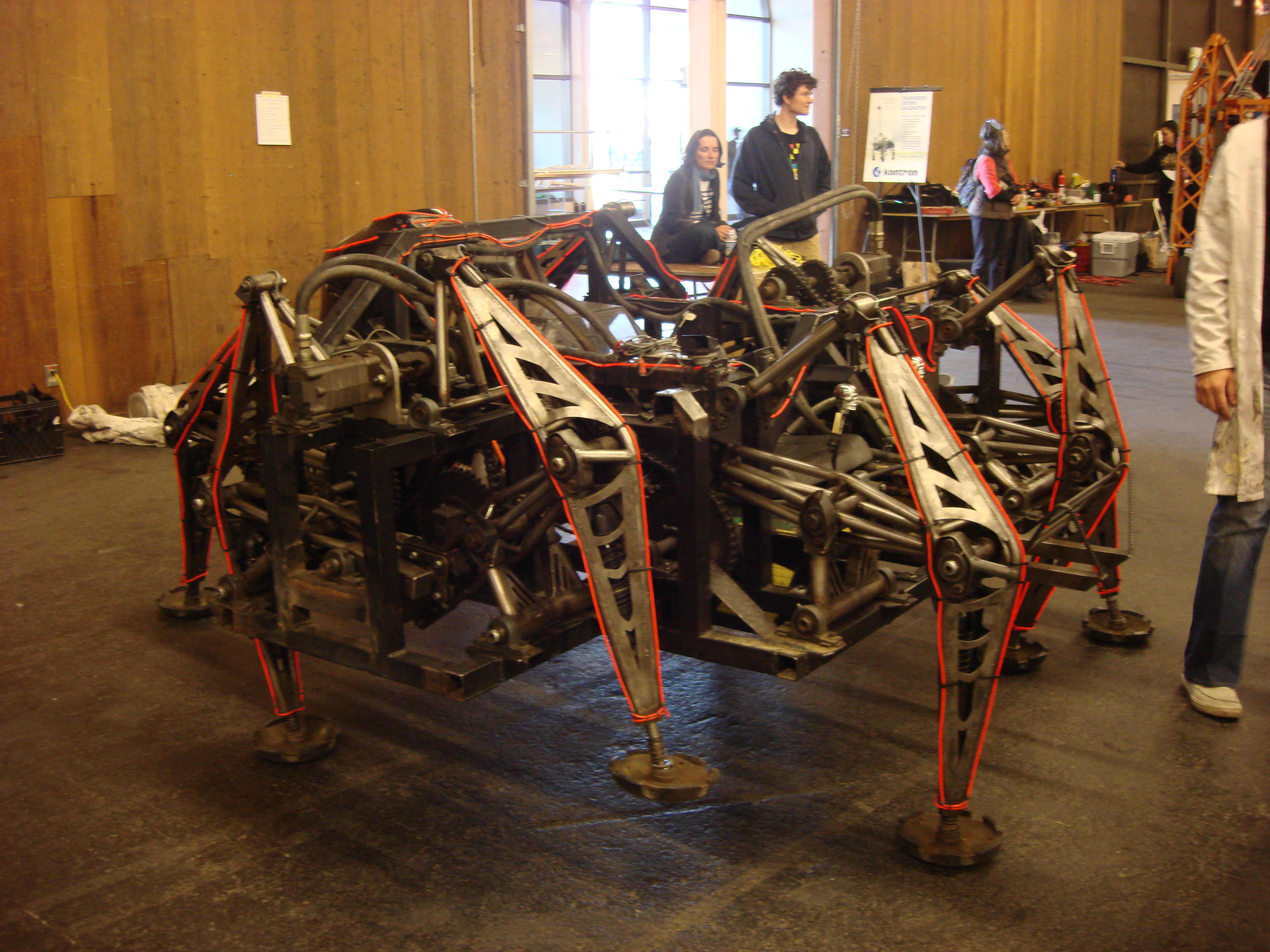

Mondo Spider and Daisy, the enormous solar-powered tricycle built by Bob Schneeveis in 2004 and cared for by Cunningham, helped inspire eatART: Energy Awareness Through ART. Mondo’s 2010 conversion to electric power put the energy question directly into the machine. Mondo Spider Zero Emissions, a film by Ben Z Cooper, documents that work.
Titanoboa, the giant electromechanical snake, brought another group of makers together. Charlie Brinson and Markus Hager deserve particular credit, alongside contributors including Jonathan Faille, Hugh Patterson, Michelle La Haye, James Simard and Julian Fong. eatART’s project history credits these contributors.
Tippett’s Alpha Leg became a testing ground for Prosthesis, his much larger walking machine. Volunteers and UBC student teams helped develop the prototype. Prosthesis drew on Aaron Fidler and Furrion’s backing, with contributions from Ryan Johnston, Sam Meyer, lead fabricator Sam Carter and the wider community. It is human-piloted: operating it is a skill the person inside has to learn.
Christie carried related energy questions into MIT Senseable City Lab’s Local Warming project, shown at the 2014 Venice Architecture Biennale. He served as project engineer alongside lead researcher Miriam Roure, with tracking technology from Dina Katabi’s group.
People could walk up to these machines and ask how the hell they worked. Behind the spectacle were shared workshops, patient collaborators, students and people documenting the process. Keep those people in the picture when the funding conversation starts.
People have to understand the machines
My own interest in this goes back further than BC + AI. In October 2010, I photographed my friend Heather Knight at PopTech in Camden, Maine, including her onstage with Data, her robot performer.
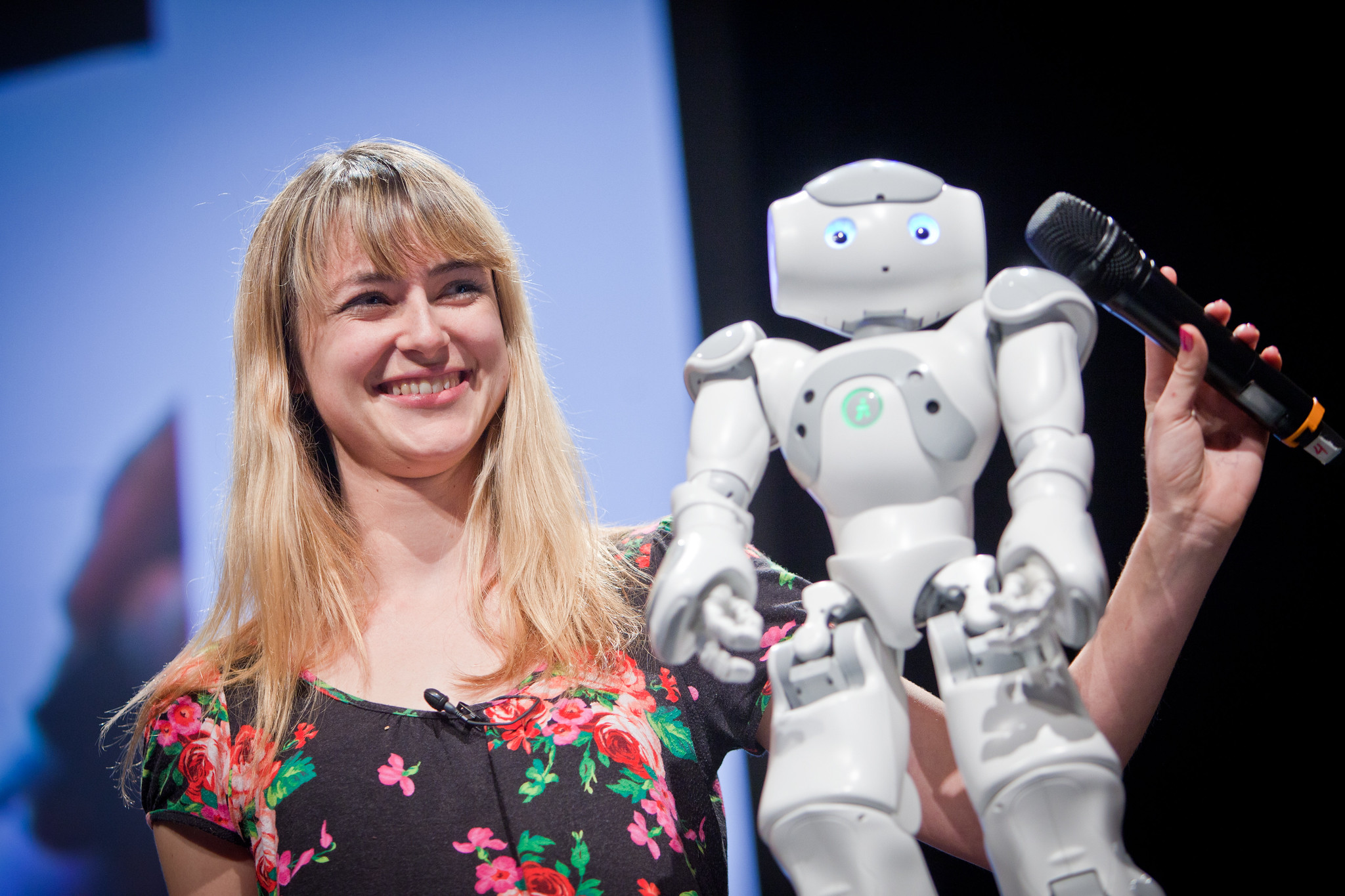
Heather’s robot-comedy work explored how a machine could respond to an audience. Put a robot on stage and the human side becomes impossible to ignore. Can people read its behaviour? Can it respond to theirs? That old friendship and those photographs are part of how I came to these questions.
Here in BC, Angelica Lim leads SFU’s ROSIE Lab, researching robots with social intelligence and empathy. At Vancouver AI in July, she invited the community to help broaden participation in a study with neuroscience and psychology collaborators. She wanted to reach beyond the university’s student population.
Who gets asked to participate matters. A community can help researchers hear from people outside their usual circles. Lim is also scheduled to bring “Learning to live with them” to Futureproof on October 29, with audience questions alongside Loki Jorgenson.
BC’s robots already have work to do
The province’s industrial history is longer still. James R. McFarlane founded International Submarine Engineering in 1974. Its work on remotely operated and autonomous underwater systems belongs in any account of BC robotics.
Today, Novarc’s Soroush Karimzadeh and Reza Abdollahi have helped bring collaborative robotics into welding. Customer Seaspan reports using Novarc’s Spool Welding Robot at Vancouver Drydock and Victoria Shipyards.
In Victoria, Julie and Colin Angus’ Open Ocean Robotics builds solar-powered uncrewed vessels for collecting ocean data. Salmon Arm’s 4AG Robotics builds machines for harvesting mushrooms. YVR’s 2024 trial with A&K Robotics explored self-driving mobility pods for airport passengers.
Some of that underwater experience is right here in our membership. Eric Jackson, founder of Burnaby’s Cellula Robotics, has spent more than 45 years developing robotic and telerobotic systems. Cellula builds long-endurance underwater vehicles. I want students building their first robot to meet people with that depth of experience.
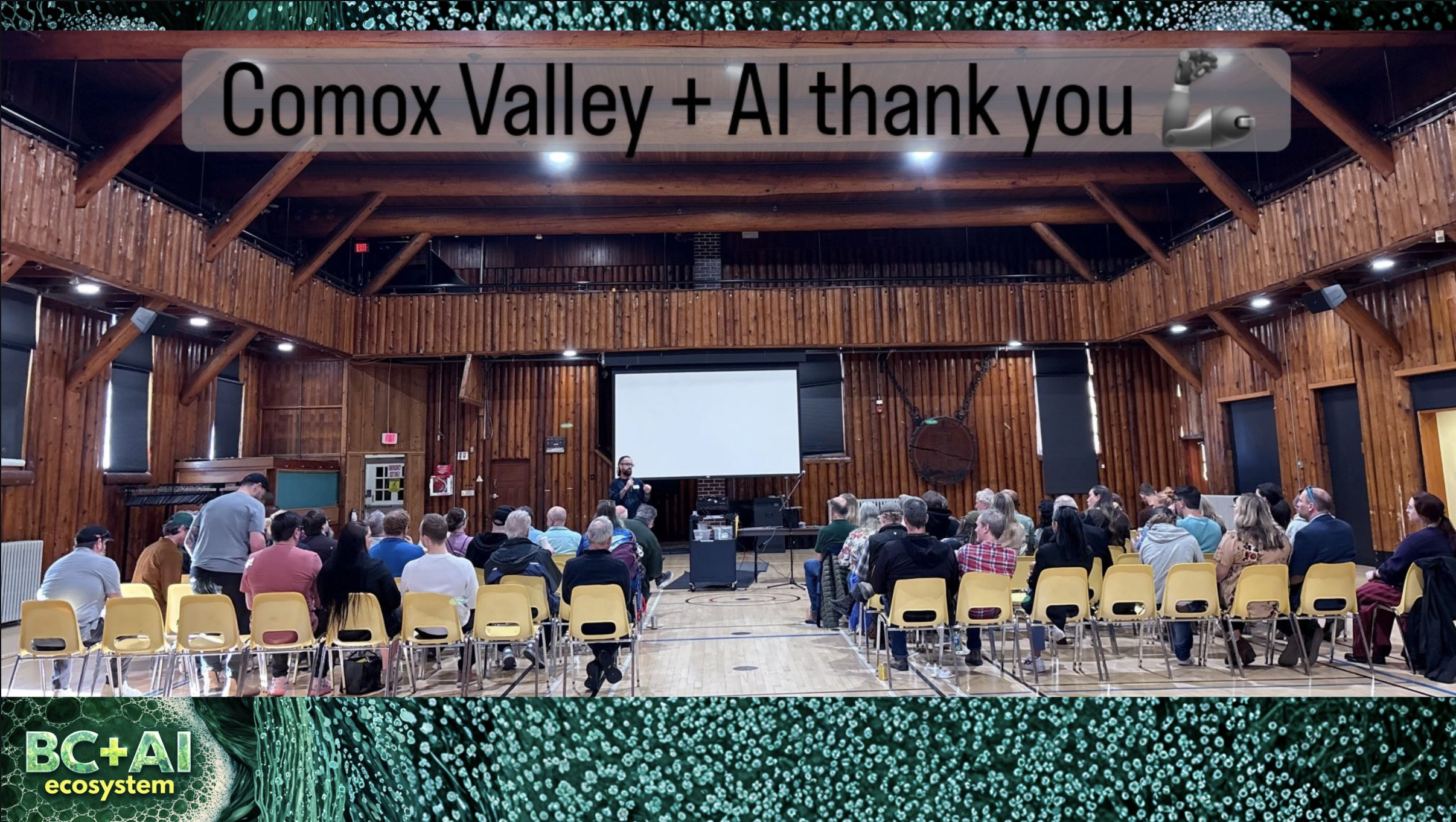
Our Comox Valley chapter’s launch report introduces Daniel Phillips and his work with drone systems. This is why the regional rooms matter. People find out who else is nearby, what they know and what they’re working on.
These companies have their own builders, customers and histories. Together, they make a provincial map that reaches well beyond downtown Vancouver. A welder, a mushroom grower and a passenger with limited mobility have different problems. Ask them what works. Let their experience help decide what gets built.
Sanctuary deserves attention and scrutiny
Sanctuary AI belongs in this story, both for its engineering and for the public expectations attached to it. In 2022, Ottawa announced $30 million through the Strategic Innovation Fund toward a $120.8 million project developing intelligence for general-purpose robots.
Suzanne Gildert, who co-founded Kindred and Sanctuary AI, spoke at Vancouver AI on October 30, 2024. Her public opening clip introduces her talk on quantum consciousness. She now leads Nirvanic’s research into robot learning and planning. I’m interested in the engineering, and I want the consciousness claims examined carefully.
Sanctuary’s commercial focus has become more specific. In June 2026, Sanctuary announced an expanded strategy using its AI on existing industrial robots. It reported more than 99.5 percent success at a 2.54-second cycle time for a wire-plugging proof of concept with an unnamed automotive supplier. Those figures describe one task under particular conditions; they do not establish general-purpose autonomy.
Video: Sanctuary AI, accompanying its June 17, 2026 announcement. The performance figures above are the company’s results for this specific task.
An October paper by Salar Asayesh, Hossein Darani, Todd Cao, Evgeny Andriash and Mani Ranjbar describes TIGER, a method that uses demonstrations to guide reinforcement learning for robot manipulation. The authors report more efficient learning and fewer measured safety violations on the tasks they tested.
Daniel Friedmann and co-founder Olivia Norton lead the company. Give their colleagues credit for the engineering. Then follow the public money. What skills and intellectual property stay in Canada? What say do workers have in deployment? What can the public point to as a benefit?
And show us the human work behind the demo. Who is controlling the machine? Which movements are programmed, and which decisions does it make itself? Credit the hardware makers, software developers, integrators and people testing it. Tell us what failed.
Fund the connections that make the work possible
Michael Bidu’s public proposal for ARM for BC describes a three-year, $6 million robotics program, with Circle Innovation leading delivery and an application to PacifiCan. It is a proposal, with funding still being sought. BC Robotics Cluster and Circle Innovation have announced an October 15 community consultation.
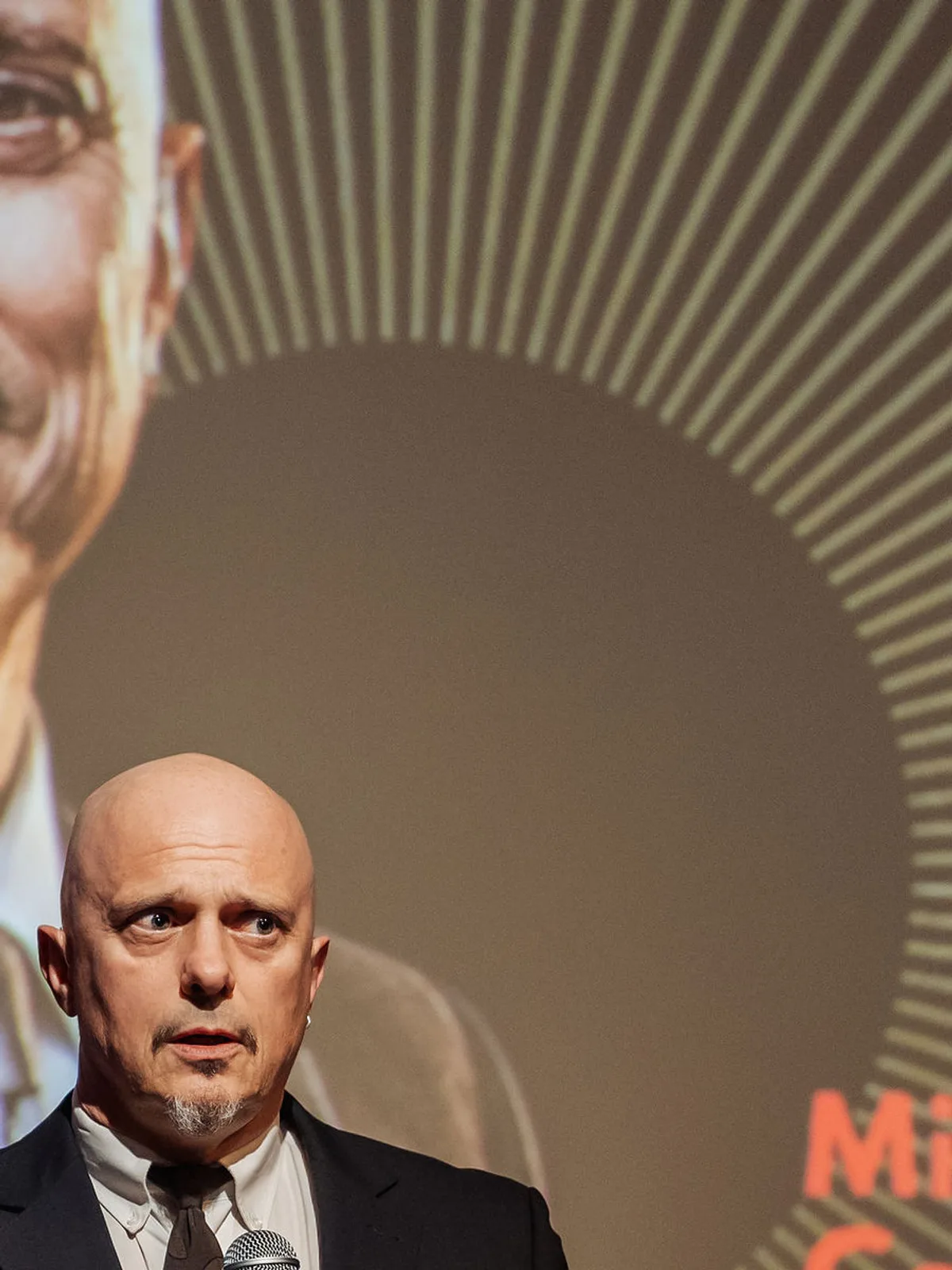
Loki Jorgenson is CTO of Circle Innovation and a BC + AI member. We’ve worked with Circle, as our account of the 2025 life-sciences AI adoption pilot documents. Circle’s Human in Motion Robotics case study describes its support for XoMotion’s manufacturing and quality systems. Bring that experience into the program design: what helped, what got stuck, what the next company will need.
Fund access to workshops and equipment. Pay mentors for their time. Help small businesses test a system before committing to it. Give students a route from their first competition robot to a paid technical opportunity. Budget for public demonstrations and documentation, including what failed and how much human supervision was required.
The Canadian Robotics Council’s 2024 symposium report also puts workforce collaboration, talent, testing facilities and adoption on the agenda. Give workers and the people expected to use these machines a say in testing them. Publish enough that the next builder can learn from the results.
Pay for the organizing, too. Somebody finds the mentor. Somebody records the demo, writes the caption, follows up with the student and makes the introduction. Put names, responsibilities and dollars beside that work.
BC + AI already sponsors student builders, hosts demonstrations and brings technical work into public conversation. We should help design and deliver the parts of a provincial robotics program that depend on those relationships.
The students on page 14 understood what those connections were worth. Let’s put them in the budget.
Kris Krüg is executive director of the BC + AI Ecosystem Association. Research and drafting were assisted by AI and reviewed by the author.