Drafted September 7, 2026. Polished and published September 20. The article keeps its original draft date in the news archive.
We put out a fairly specific invitation in July.
One builder. Five thousand dollars. Six weeks. Start with a collection of Canadian government publications. The snapshot behind the call held more than 100,000 text items, roughly 22 million scanned pages, and about 48 terabytes of material. Build something useful, strange, investigative, beautiful, or hard to classify. Keep the code open. Show your receipts.
Twenty-one serious proposals came back. There were zero duds.
So we expanded the AI Builders Fellowship. BC + AI has awarded two CA$5,000 fellowships, to Jacob and Daniel. Internet Archive Canada is our archive partner. Two projects, CA$10,000 in total, with open-source code as part of the brief.
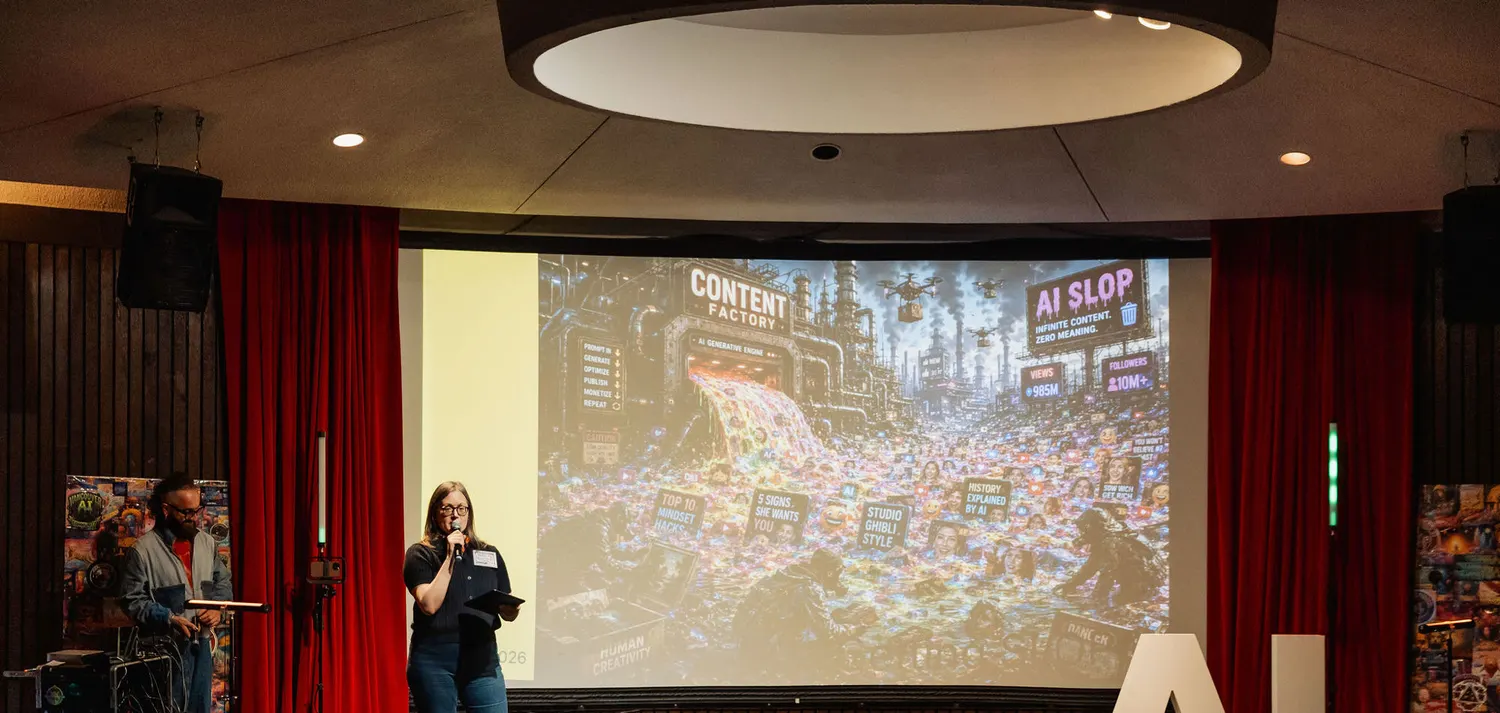
Photo above: Andrea and Kris at Vancouver AI in May, where the fellowship first met the room. Photo by Michelle.
Jacob: The Archive Argues With Itself
Jacob’s project starts with a problem anyone using AI for research should care about: an archive can look more complete than it is.
He proposes a way to follow a civic question through time, with the actual pages behind the answer. How did the official language change? Which jurisdictions are represented? Where does the record go thin enough that the honest answer is that we do not know?
The gaps belong in the interface. A reader should be able to see where an answer runs out of evidence.
Daniel: Tale of a City
Daniel’s project starts with municipal records and a question you can point to on a map: how did this place become what it is?
The idea is an animated history built from council decisions, with the scanned records behind them. Move through time, follow a street, see a decision in the place it affected. He is adapting the project toward Vancouver, with the scope shaped by the records he can access.
That gives the work a public test close to home. Could someone encountering it at a library follow the history of their own block and find the source, without needing to know how an archive’s catalogue works?
The archive is full of public life
Government publications sound dry until you open them.
Inside are council motions, farm experiments, disability policy, water measurements, Royal Commission testimony, school examinations, housing reports, public-health guidance, maps, forecasts, budgets, and the bureaucratic fingerprints of decisions that changed people's lives.
The proposals found different doors into that material: better descriptions, visible gaps, civic investigations, local histories, artworks. They also exposed how much useful work remains below the surface of a search box.
We are not going to describe the unfunded proposals in more detail than that. They are still their authors' ideas to build, pitch, or take somewhere else.
The work raises a hard question: when a government uses the same word in 1950, 1980, and 2025, is it still measuring the same thing? A language model can smooth those decades into one fluent answer. A responsible research tool has to show when the record supports continuity, when the definition changed, and when nobody knows.
The strongest proposals did not treat AI like an oracle
The pattern across the best applications was algorithmic humility.
We kept coming back to page-level citations, visible uncertainty, coverage maps, reproducible methods, and a clear line between what the archive says and what the machine inferred. The reader needs a way to check the answer.
They also noticed the same problems Internet Archive Canada already lives with. Missing dates. Uneven geographic coverage. OCR that reads a paragraph fine and chokes on a table. One institution described three different ways across three decades. A beautiful scan that is invisible to search.
Those imperfections are not an embarrassing footnote. They shape what people can find and what an AI system can responsibly conclude.
Andrea and Loren brought the archivist's test to our review: what feeds back into the collection? Does the project leave behind better metadata, a reusable method, a documented list of friction, or a tool another library can run?
I kept returning to the public doorway. Would somebody walk up to this thing at a library and start messing with it? Could the work make a room full of people care about a government-document collection they had never heard of five minutes earlier?
Both tests matter. Make the archive better. Make people care that it exists.
Choosing does not make the others wrong
I recused myself from the final judging because I knew a couple of the applicants and did not want those relationships quietly shaping the decision. I stayed in the conversation as the BC + AI program partner and the person thinking about the public experience and what could live on a stage.
Andrea and Loren know the collection, the infrastructure, and the government-information community around it. They led the final selection. The practical question throughout was whether a builder could make something useful in six weeks and leave enough evidence for somebody else to examine it.
The work that does not fit this round still matters. The archive’s missing dates, uneven descriptions, and difficult scans will not disappear when two fellows finish. Those problems deserve their own attention.
After three finalist conversations in early September, we made room for two projects.
What happens next
The brief gives each fellow six weeks to build with the public record, starting from the Government Publications collection, part of Democracy’s Library. The expected result is a working experiment, its source code, and enough documentation that another person can understand what it does and where it falls short.
If the projects are ready, the fellows have a chance to show them at Futureproof Festival in Vancouver on October 28. The aim is to put the experiments in front of people who can use them, question them, and find what we missed.
The fellowship is small on purpose. Five thousand dollars does not build national infrastructure. It gives one sharp person enough room to test an idea properly, learn where the archive pushes back, publish the method, and leave behind something the next builder does not have to reinvent.
The application process already did more than that. It introduced the Archive to researchers, librarians, artists, investigators, and civic-data people from Canada and beyond. It surfaced a cluster of recurring problems worth funding. It showed us that people want public AI with receipts.
Jacob and Daniel now have two different ways into the same problem. I want to see what happens when someone who has never heard of this collection sits down and starts using what they build.
For the origin of the collaboration, read Andrea’s Vancouver AI talk on preserving the open internet. The July invitation records the original one-builder call; this announcement records the two-fellow outcome.
AI assisted with editing and source checks. Kris approved publication.