In early 1996, somebody showed me Netscape and I started making web pages.
Then a strange thing happened. My communications professors started coming to me for help building their pages. Normally students want help from professors. Suddenly the professors were asking a student how this new medium worked. The centre of gravity had moved, and all of us could feel it.
Two years later I started Spark Online, an online magazine about electronic consciousness and digital philosophy. We were hacking together content-management systems before blogging was a normal word, and somehow still building a fresh pile of HTML pages every month. It grew. People wrote for it. Whole friendships and chunks of my young adult life happened through it.
Then the host died and most of Spark disappeared.
For years I wondered whether any of it had really been as alive as I remembered. Memory without evidence starts to feel like a story you keep telling about yourself. Then one day I typed the old address into the Wayback Machine.
There it was.
My twenties, sitting on a server. Preserved by people I had never met because they had decided the web was worth remembering on purpose.
That is the long version of why I am so fired up about this fellowship.
Internet Archive Canada and BC + AI have opened the AI Builders Fellowship. One builder will receive $5,000 and six focused weeks to make an open-source experiment from a huge collection of Canadian public records. Applications close August 21, 2026, at 11:59 PM Pacific.
We want a working thing. A research tool, an artwork, a civic instrument, a sonic journey, a map, a strange interface, or an idea none of us has managed to imagine yet. It should help somebody use, question, hear, see, or get productively lost in the archive.
Useful and weird. Open source and finishable. Show us something the public record contains but the public still cannot see.
The Wayback Machine gave me part of my life back
I have very little patience for the idea that archives are dusty storage rooms for things whose interesting days are over.
An archive once returned a piece of my own life to me.
It also gave me a better understanding of what the internet actually is. We make culture in public and store it on systems built to forget. A domain expires. A company folds. A government redesigns a website. A platform decides the work no longer fits its business model. A little hole opens in the record and, unless somebody notices, the hole becomes normal.
The disappearance is rarely cinematic. There is no smoke. A link simply stops working.
That matters for personal history, but it gets serious when the disappearing material is a public report, a local newspaper, a scientific study, a parliamentary debate, or the only online trace of a decision that changed a community.
The web gave almost everybody a printing press. It did not give us a memory.
Brewster was trying to save the whole damn web
The same year I discovered Netscape, Brewster Kahle founded the Internet Archive.
I was figuring out how to make a web page. Brewster was asking how to save all of them.
His proposition was gloriously unreasonable: Universal Access to All Knowledge. Build a library for a medium that changes every second. Keep it open. Keep going.
Thirty years later, the Internet Archive is one of the few places on earth where a slogan that enormous has accumulated enough actual machinery behind it to feel less like branding and more like a job description.
Internet Archive Canada has been part of that work since 2006, building a Canadian independent digital library and working with institutions here to preserve material that would otherwise be vulnerable to link rot, changing policy, failing infrastructure, or plain neglect.
Its work on Democracy’s Library is a perfect example. Government information is created with public money. People should be able to find it, read it, study it, and keep it available across election cycles and software migrations. In Canada, the project includes collaboration with a network of academic libraries preserving federal government material in multiple places.
The archive is the material. The public record is what it contains. Public memory is what becomes possible when people can actually enter it, understand it, and build with it.
Andrea brought the unfinished archive into our room
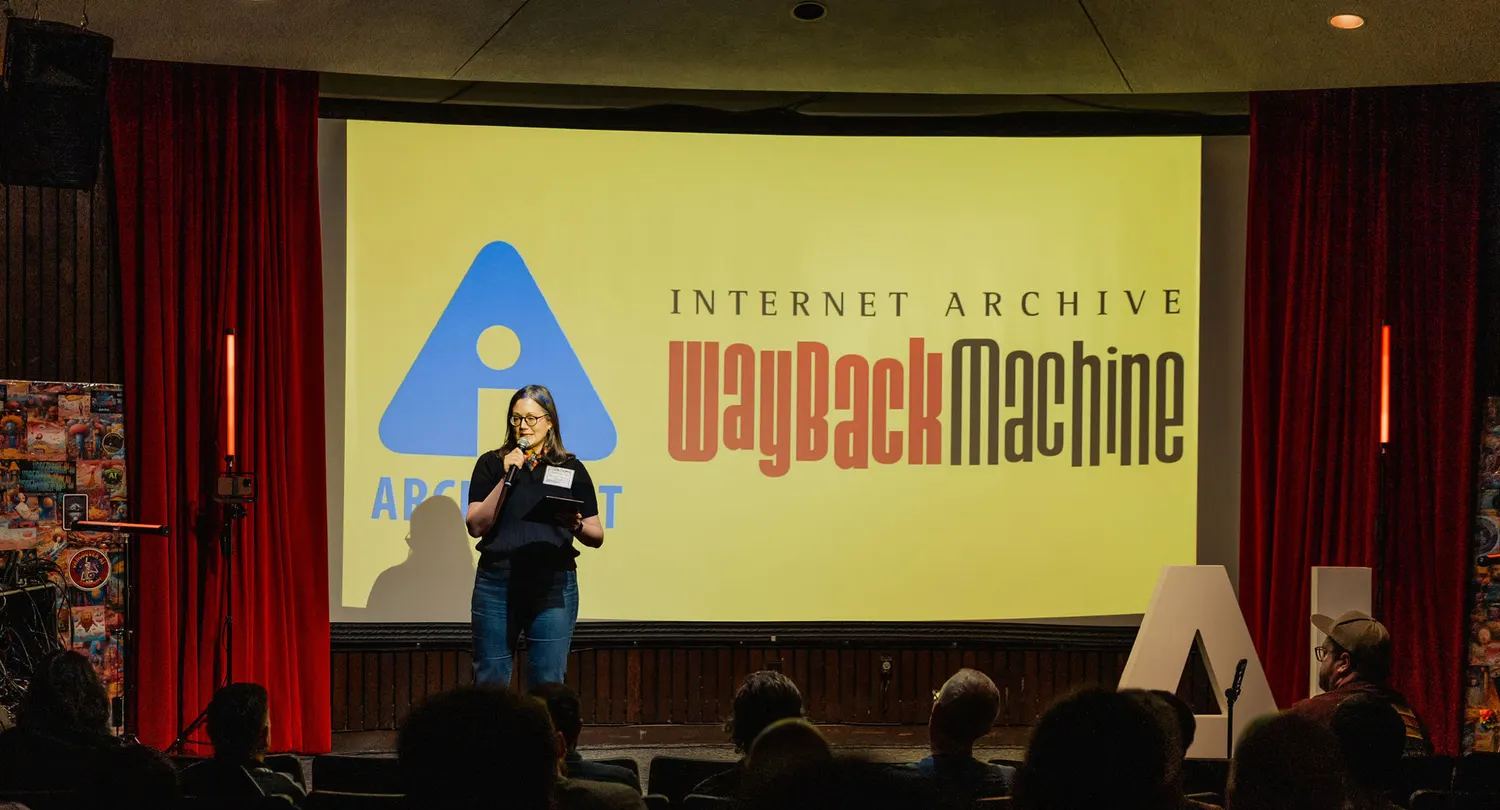
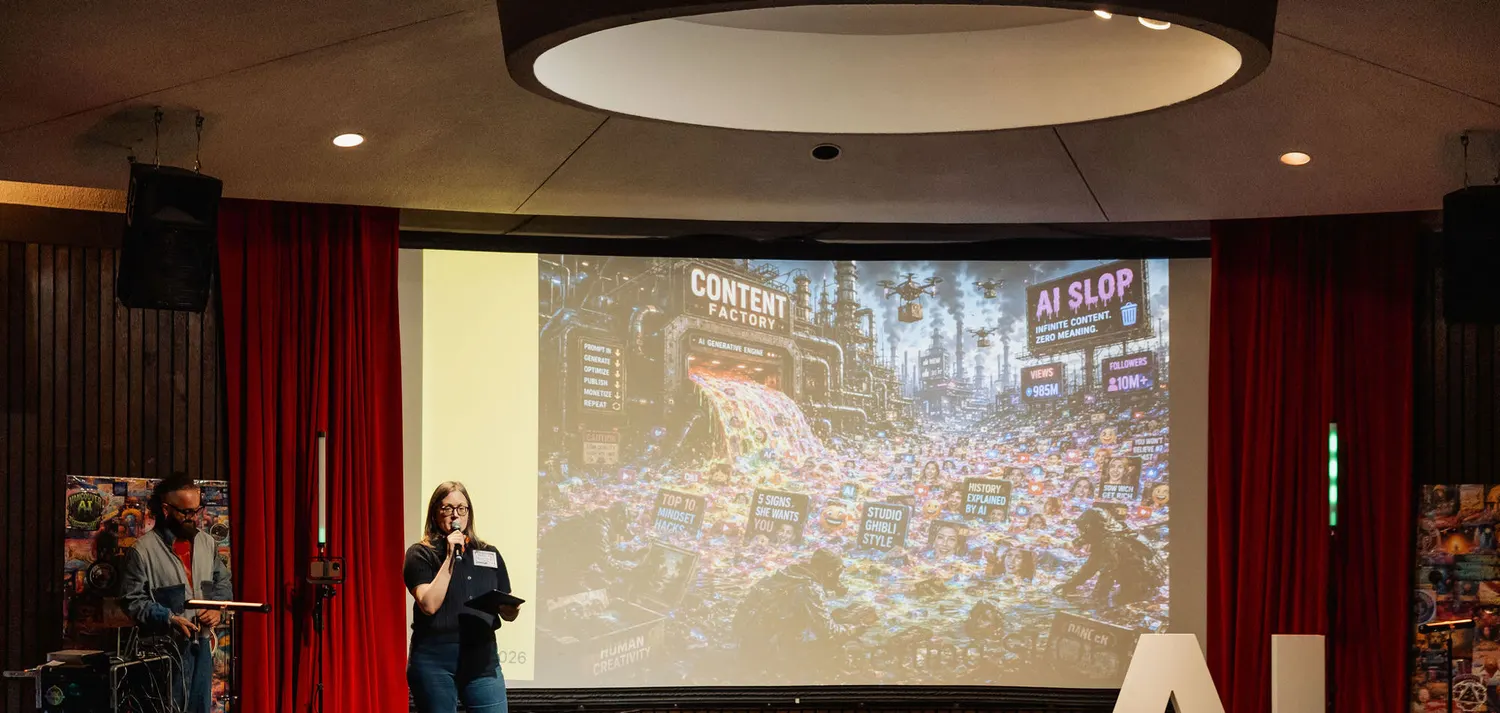
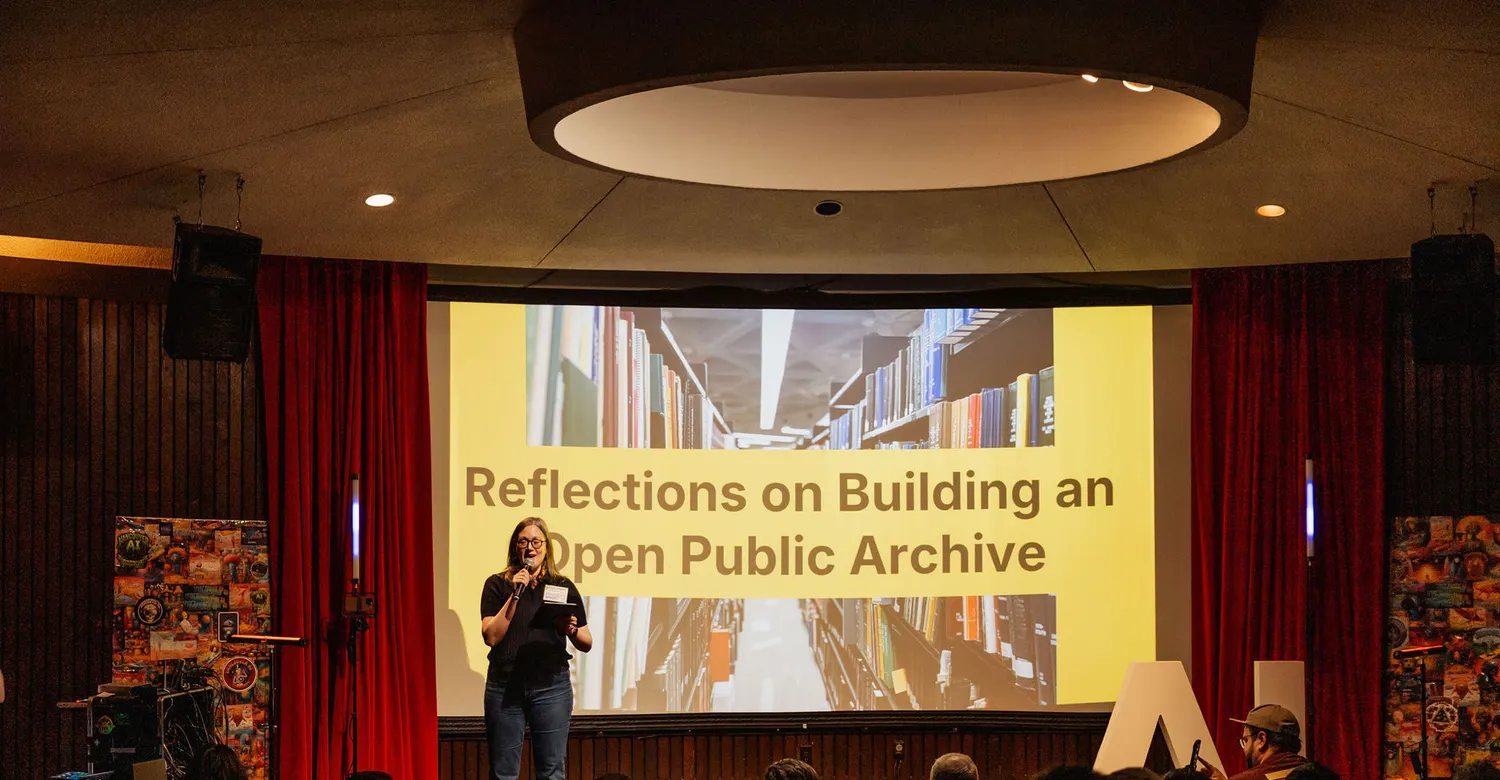
On May 27, Andrea Mills, Executive Director of Internet Archive Canada, came to Vancouver AI for a night we called Building the AI Commons.
She did not give us a clean triumph story. She showed us the difficult, unfinished thing.
The Archive had crossed one trillion web pages in the Wayback Machine. It held more than 200 petabytes. It was preserving a genuinely staggering portion of the intellectual and cultural output of the web.
It was also under pressure from the same AI boom that makes this fellowship possible.
Open archives are being crawled at a scale that can hammer their infrastructure. Smaller institutions have less capacity to defend themselves. Andrea described digitized collections that had lived online for years, only to be pulled when a publisher signed an exclusive AI deal. In some cases, the library had cared for the surviving copy and was still the institution being told to take it down.
In terms of functionality, it’s a DDoS attack by another name. The ravenous appetite of AI is a real thing.
Andrea Mills
That should bother anybody building with AI.
We have spent the last few years talking as if “open” means lying around for the biggest crawler to inhale. It does not. A commons is a relationship. Somebody maintains the servers, repairs the metadata, argues the copyright cases, works with libraries, replaces drives, describes old books again, and keeps the door open after the well-funded companies have taken what they came for.
Andrea put the underlying question to the room: do we trust a corporation with our collective data more than a nonprofit or a public utility?
My answer is no. But trust is not magic. Public institutions earn it through stewardship, transparency, rules, redundancy, and use. The archive has to be cared for, and it has to be alive enough that people care whether it survives.
Andrea also made a gloriously librarian-shaped argument about AI slop. As a creative practice, fight it. As a historical record, preserve evidence of it. People are making decisions based on the garbage circulating now. Future researchers will need to see the garbage too.
The commons has to hold the beautiful stuff, the bureaucratic stuff, the embarrassing stuff, and the machine-made junk. Archives do not get to keep only the flattering parts of a century.
We don’t have the concept of done.
Andrea Mills
That line has been stuck in my head ever since. Memory is maintenance. Every generation gets new tools, asks different questions, discovers a bad description, notices who is absent, and enters the collection from a door the original archivist could not have predicted.
Then, in the final minutes of her talk, Andrea slipped in the fellowship with the Canadian modesty of somebody mentioning there might also be coffee in the back.
A summer build. Internet Archive Canada and BC + AI. Put a real person on a real collection and see what happens.
Read the full story from Andrea’s talk, or watch the complete recording.
The public record is where decisions leave fingerprints
The fellowship starts with the Internet Archive’s Government Publications collection.
The working snapshot prepared for this call holds 104,104 text items, about 22.1 million scanned page images, roughly 48.25 terabytes of material, and 107 tagged sub-collections.
Those numbers are difficult to picture, so picture the contents instead.
Federal reports. Provincial publications. Municipal documents. Maps. Photographs. Parliamentary material. Scientific studies. Policy papers. Diagrams. Tables. Warnings. Promises. The wonderfully strange debris of public administration.
Bureaucracy is a terrible storyteller and a fantastic accidental historian.
A budget tells you what mattered enough to fund. A map tells you how somebody understood a place. A fisheries report can hold a century of ecological change without ever calling itself a climate story. The language in wildfire policy can show when an institution understood a danger, when it changed its mind, and what it still refused to say.
Somewhere in those millions of pages is a report that explains why your town looks the way it does. There is a diagram somebody spent six months drawing. There is an abandoned policy idea that suddenly looks relevant again. There is a pattern nobody has put on a timeline because no person could reasonably read the whole pile.
This is where AI can be genuinely useful.
Models are good at finding relationships across more material than one human can hold in their head. They are also very good at inventing a smooth answer when the evidence is thin. The interesting project does not turn a model loose to play oracle. It helps a person ask a better question and then points back to the exact pages, images, dates, or gaps behind the answer.
Receipts matter. Especially when the subject is government.
The gaps are part of the record
This is a real archive, so it is messy.
Provincial and municipal material leans heavily toward Ontario and Alberta. About 34.5 percent of the items have no recorded date. Metadata quality varies. A scanned page can be visible to the eye and functionally invisible to search. One institution may be described three different ways across three decades.
We are not handing somebody a manicured demo dataset and asking for a shiny interface on top.
The limitations are part of the brief. A strong project might reveal where the public record goes quiet. It might make uncertainty visible instead of sanding it away. It might document an extraction or metadata problem clearly enough that the Archive’s engineers and librarians can act on it.
That two-way loop matters. The fellow should learn from the archive, and the archive should learn from the fellow.
A scraper takes. A fellow should leave the place more legible than they found it.
What might you make?
Start with a person and a real question.
Maybe you make a sonic journey through a century of fisheries reports, so people can hear the language of abundance, collapse, regulation, and recovery change over time.
Maybe you build a research tool that accepts a plain-language question, shows its evidence, and opens the original page beside every claim.
Trace how wildfire language moved through public policy. Map where a town appears and disappears from federal attention. Build a visual work from diagrams buried in infrastructure studies. Make a timeline of policy promises and what happened next. Design an interface for wandering by place, institution, year, subject, or recurring bureaucratic phrase.
Build for a journalist on deadline. An artist looking for material. A student trying to understand a decision. A librarian dealing with ugly metadata. A public servant who suspects the answer already exists somewhere. A community that needs to prove it has been saying the same thing for thirty years.
Or bring us the project nobody on our side has imagined.
We do not need a generic chatbot sitting on top of a pile of PDFs. We need a point of view, a human use, a clear scope, and a reason this particular archive makes the work possible.
Why one fellow, and why six weeks?
A weekend can produce a spark. This collection deserves enough time for somebody to get past the first impressive demo and find the actual problem.
Six weeks is long enough to choose a corner, talk to people, build a working artifact, test the dangerous assumptions, document the rough edges, and release the code. It is short enough to force decisions.
Internet Archive Canada will provide archive context. BC + AI will provide project check-ins, community support, and help documenting the work in public. If the project is ready, the fellow will have a chance to present it at Futureproof Festival in Vancouver on October 28.
Enough structure to finish. Enough freedom to surprise us.
We are selecting for four signals:
- Useful: a specific person or community can do something with the result.
- Imaginative: the project makes an unexpected connection or creates a new way into the record.
- Open source: people can examine the work, learn from it, and build on it after the fellowship.
- Achievable: the scope can reach a credible working artifact in six weeks.
Your application needs the project, a practical work plan, and your definition of success. Tell us what you already know, what you need to learn, who the work is for, and where the six-week boundary sits.
You can apply from anywhere in the world. The archive is Canadian. The invitation is open.
Why this belongs at BC + AI
In 2009, eleven years after Spark, I described my life as a continuation of those early experiments in electronic consciousness. I think that is still true.
BC + AI is one current form of the same obsession: what happens when a new medium lands in ordinary people’s hands, and what kind of culture do we build around it?
Our community grew from people meeting in rooms to compare notes, show unfinished work, argue, teach each other, and try things in public. We are good at finding builders who do not fit neatly into one professional box. The archivist who codes. The engineer who understands that an interface can be beautiful. The policy researcher who makes music. The artist who reads municipal budgets for fun.
Those are exactly the people I want wandering around this collection.
There is plenty of AI money chasing faster extraction, tighter enclosure, and another layer between people and the source. This is a small bet in the other direction. Use public material to make a public thing. Show your work. Give the code back. Help the Archive understand what builders need and where the collection breaks.
Andrea said she wants the Archive’s servers stressed because people are using the material for research and creativity instead of simply scraping it again.
I want the servers to be stressed because they’re being used for stuff like that, rather than just getting scraped again.
Andrea Mills
People will offer you money to work on somebody’s bullshit dataset.
This is the Internet Archive.
Bring us the thing only you can see
Applications close August 21 at 11:59 PM Pacific. Reviews run August 22 to 30. We plan to make the fellowship decision on August 31, and the build begins September 1.
Explore the Government Publications collection behind the fellowship.
Read Andrea Mills on preserving the open internet and the AI commons.
Bring us a real question, a person you want to help, a scope you can finish, and the thing only you can see.