I owe a piece of my own memory to the Internet Archive. Years after Spark Online, the site I built in 1998, had mostly vanished, I found it again in the Wayback Machine. Somebody had kept a copy. A nonprofit had made a decision about what was worth saving, and my younger self was in there.
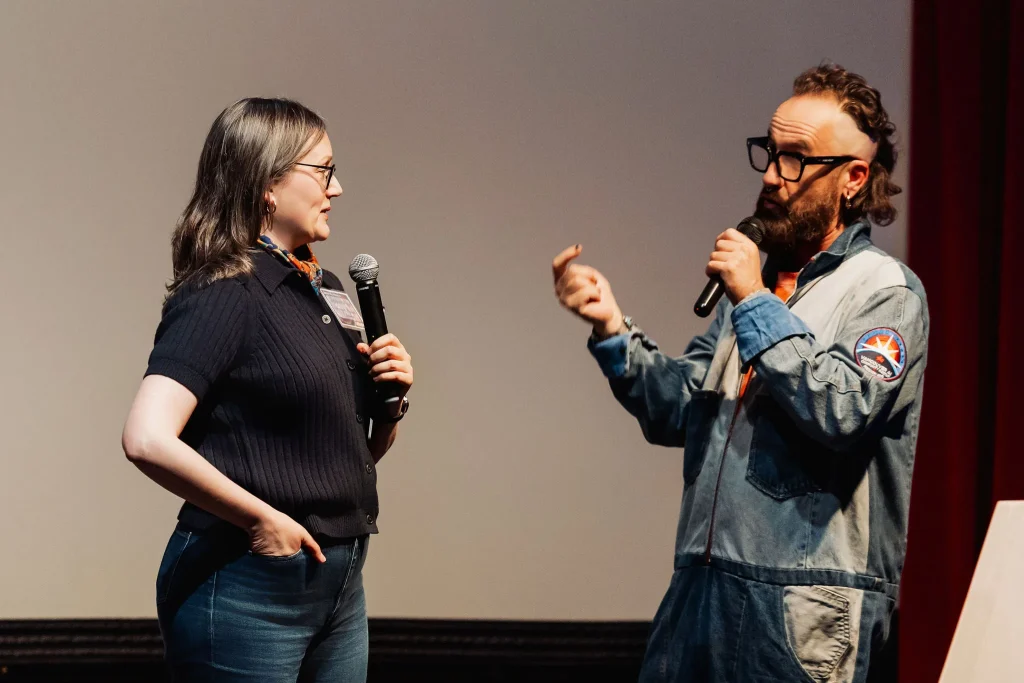
I wrote about that in May, when Andrea Mills, executive director of Internet Archive Canada, joined us at Vancouver AI. We talked about public memory, the pressure AI puts on open collections, and what people might build with the Archive: useful tools, methods and documentation for others.
Five months later, I can point you to working software.
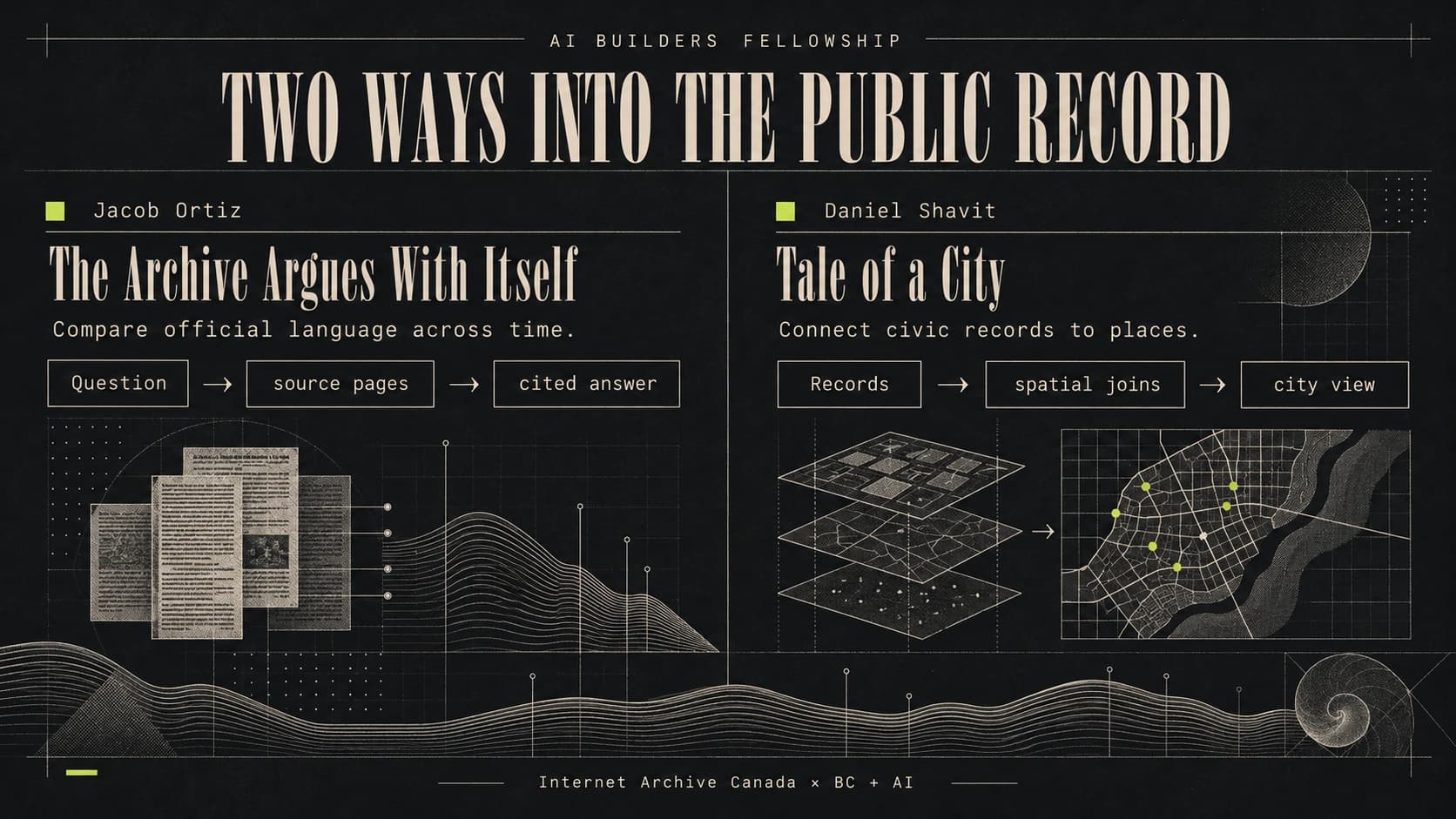
Jacob Ortiz built The Archive Argues With Itself, a way to ask questions of Canadian government publications and follow an answer back to the page. Daniel Shavit built Tale of a City, a pipeline connecting Vancouver's civic records to the places they describe, with a public city view on Qipu. Both came through the AI Builders Fellowship, our partnership between Internet Archive Canada and the BC + AI Ecosystem Association.
As BC + AI's executive director, I'm proud of these two. I'm also interested in what their work lets us ask of the institutions we live with. What did a government actually say? Which decision concerns this block? Can I see the evidence myself?
Those are good questions to put a computer to work on.
About the cover diagram
This explanatory illustration shows two paths into public records. Jacob's project follows a question through retrieved passages to a cited answer and its source page. Daniel's connects civic records to addresses and parcels, then presents them through a city map. The documents and city geometry are schematic, not archival evidence or measured data. Illustration: BC + AI. Projects: Jacob Ortiz and Daniel Shavit.
The work that made this possible started years ago
Before I get to the software, I want to put the librarians, archivists, scanning teams and contributing institutions in the picture. Internet Archive Canada's account of twenty years of digitization partnerships reaches back to the University of Toronto in 2006 and the University of Alberta in 2008. People have spent years preparing material, scanning it, describing it, and keeping it available.
A builder can open a laptop and work with these documents because that labour has already happened. It deserves credit every time we show the shiny new interface.
The Archive's work on access to Canadian government publications also describes how fragile that access can be. Records live in scattered repositories. Descriptions are inconsistent. Publications disappear when websites change. A document can be technically online and still be very hard to find, compare or understand.
For this fellowship, the collection behind the call contained more than 104,000 text items and roughly 22 million scanned page images. That is one government-publications collection snapshot, not the whole Internet Archive. It is already more material than any of us is going to read over a long weekend.
Our fellowship brief gave builders six weeks, support and a reason to make something useful with it. Code had to be open source. We wanted work that somebody outside the project could pick up, inspect and build on.
We meant to fund one builder
The original July invitation offered one CA$5,000 fellowship. We received 21 proposals. We ended up backing two builders at CA$5,000 each.
I've written about the selection already, including my part in stepping out of it. I knew some of the applicants, so I recused myself from the final choice. Andrea Mills and Loren Fantin led that work. Jacob and Daniel earned their places with two approaches to making public records usable.
I like that we made room for both. Jacob starts with a question and works toward a passage you can read. Daniel starts with a place and works toward the records attached to it. They offer different starting points for readers.
Jacob Ortiz: an answer you can argue with
Jacob's The Archive Argues With Itself works with Canadian public-health publications. You can ask a question, inspect the passages the system retrieved, open the cited scans, compare records, and look at where the collection has coverage or gaps.
He originally proposed housing as an example. Then he measured the material he could use and found that the clean housing collection was too small for his pilot threshold. He moved to public health. His methods document explains the choice.
I love that detail. The collection got a vote. He looked at what was actually there and changed the project accordingly.
There are two separate search scopes: a pilot of 3,477 items and a larger national microlog corpus of 13,539 items. They have different coverage. Neither contains 2020s material. Keeping those boundaries visible matters when the interface is willing to accept almost any question you type.
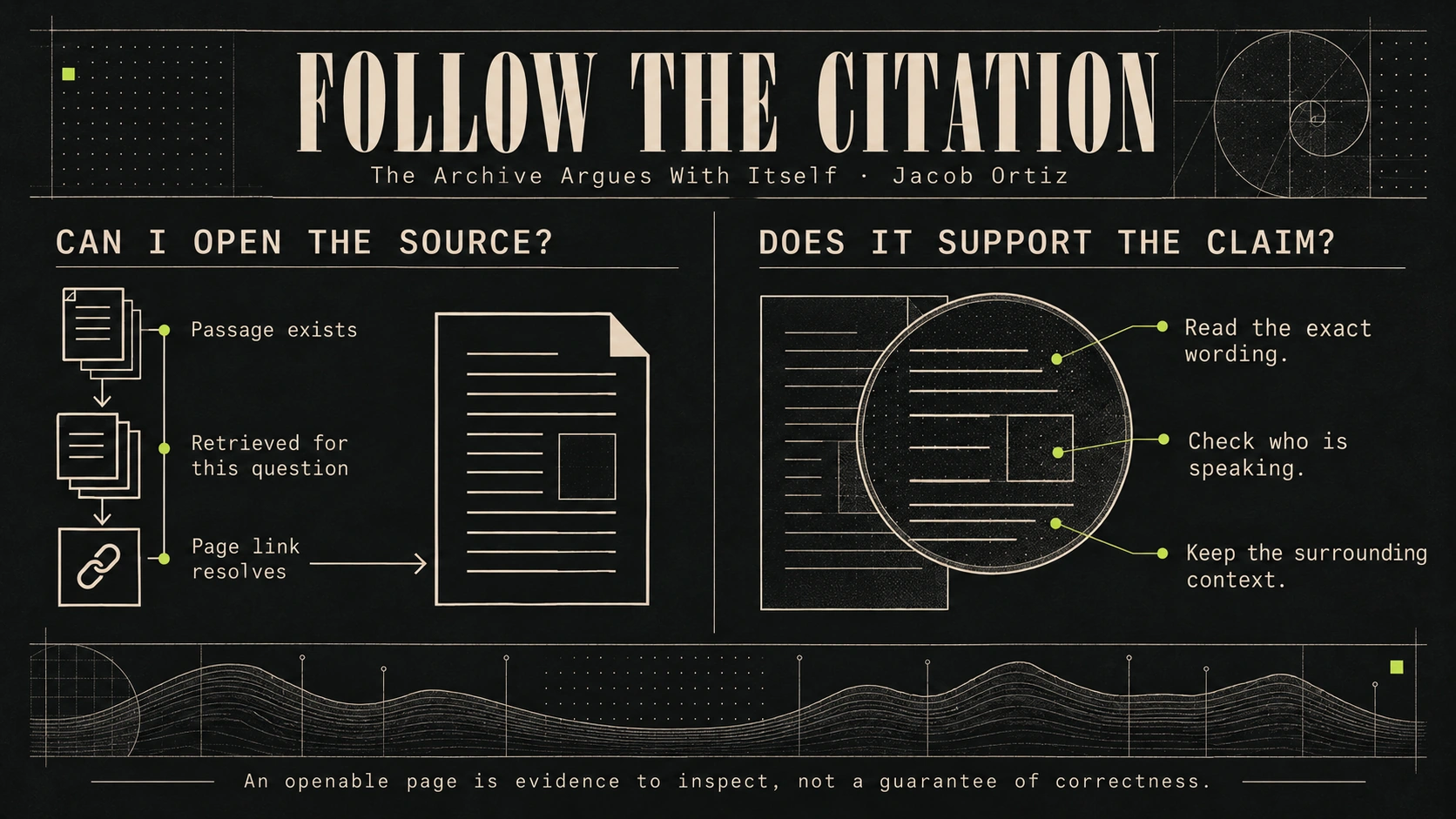
Underneath, keyword search and semantic search work together to retrieve passages. A language model drafts an answer, and citation checks test whether the referenced passage exists, was among the evidence retrieved, and links to a recorded page. The reader can then open that page.
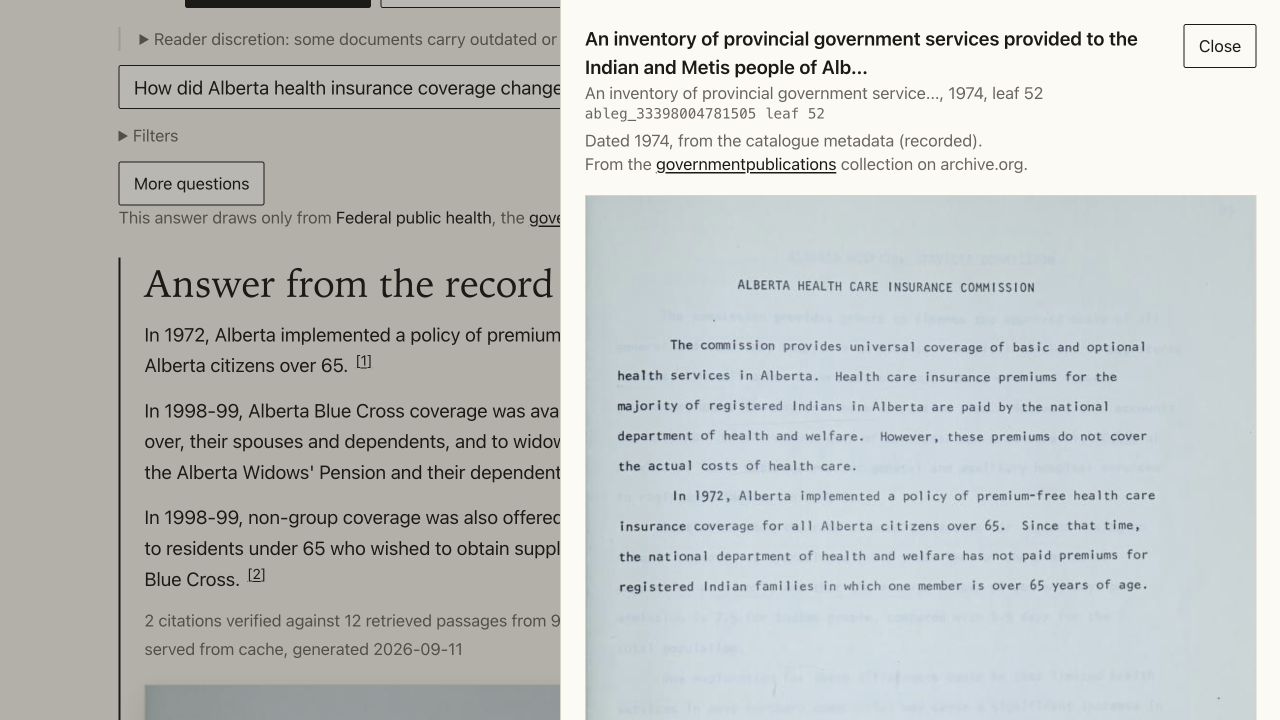
That last step is where I want people to spend some time. A citation that resolves to a recorded page and a sentence that the source supports are different things. The software can check the reference. A reader still needs to examine the wording, who is speaking, and what the surrounding page actually says.
One of Jacob's demonstrations puts a 1974 services inventory beside a 1998–99 statistical supplement. One describes coverage and administration; the other counts enrollment in a particular Blue Cross category. Those pages alone do not establish a policy reversal. The interesting work is being able to inspect the difference without losing the documents behind it.
Jacob has also published the awkward bits. His gap report describes missing dates and a catalogue record dated 1984 whose text discusses the 2009 H1N1 pandemic. The discrepancy stays visible. An unknown date stays unknown. The interface doesn't get to tidy the archive by inventing certainty.
His published pilot audit judged 166 of 178 kept sentences on 35 answerable questions fully supported, eleven partly supported and one unsupported. All 119 cited passages resolved to recorded page references. In a separate set of fifteen questions that should have been declined, ten were declined and five produced off-target answers. Those off-target sentences are outside the 178-sentence count. This was a small, in-sample audit reviewed by the author, with model assistance in proposing labels.
I'm including those results because they make the project more useful to evaluate. We can see what was tested, what worked and where the system still needs attention. If we are going to use AI around public evidence, that is a habit worth supporting.
Try Jacob's public demo, then follow a citation. The repository includes the code, methods, gap reports and evaluation material. Its code is MIT-licensed; the documents keep their own terms.
Daniel Shavit: start with the block you're standing on
Daniel's Tale of a City takes a different route into civic memory. It connects council records, permits, parcels, addresses, streets and building outlines. On Qipu's Vancouver city view, a place becomes a way to begin reading.
That is a powerful invitation. Most of us know a corner, a street or a building long before we know the name of the municipal dataset that might tell us something about it. A map can meet us at the thing we already recognize.
The public fellowship pipeline combines seventeen City of Vancouver datasets with Natural Resources Canada LiDAR. It uses BigQuery and dbt to organize and transform the records, join addresses to parcels, and produce downloadable data. LiDAR surface and terrain measurements help estimate building heights. The resulting city is assembled from several sources, each with its own date and limitations.
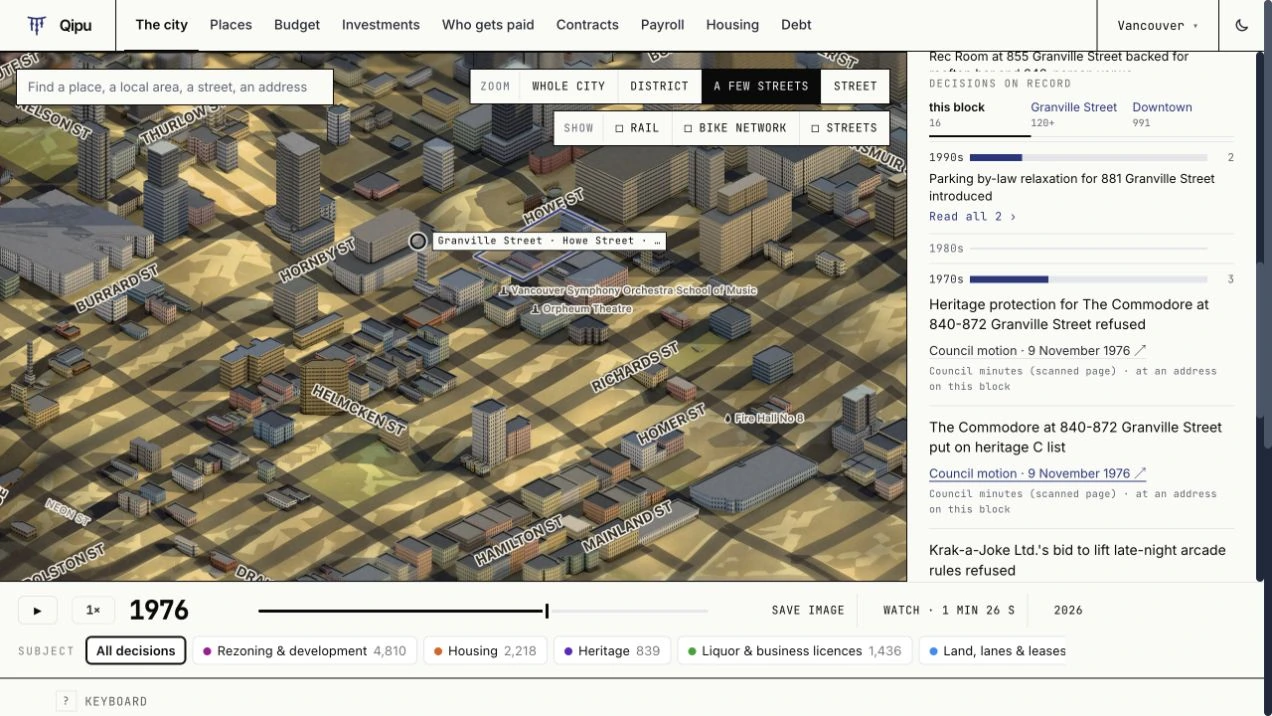
Take the Commodore. The map's records lead to council minutes from November 9, 1976. A motion to designate it a category B heritage building failed to receive the required majority. On the next page, a motion to put it on the Heritage Advisory Committee's category C list carried. You can follow that distinction all the way back to the scanned record. A familiar place becomes a reason to read a forty-nine-year-old document.
There is a lot of judgement inside the join between a sentence and a place. Daniel's data notes document malformed dates, parcels with several parts, and buildings whose height is hard to summarize. Address matching works through explicit rules, including exact numbers, ranges and same-street hundred blocks. Records that cannot be located stay unplaced.
A beautifully rendered map can make a guess look like a fact. Keeping an unmatched record off the map preserves a useful distinction: the decision exists, but these records do not support a location to plot. Some citywide decisions have no single address in the first place.
There are choices about people, too. The pipeline drops permit applicant and contractor fields during processing. Its published council data carries outcomes and vote tallies rather than individual councillor voting records. These are specific decisions about what this tool needs to display.
The Archive enters Daniel's work through time. The current city view's sources include scanned council minutes from 1970–1979, Wayback-preserved minutes from 1995–2016, and modern voting records from 2016 onward. There are gaps between and within those sources. Preservation gives a builder something to connect across them.
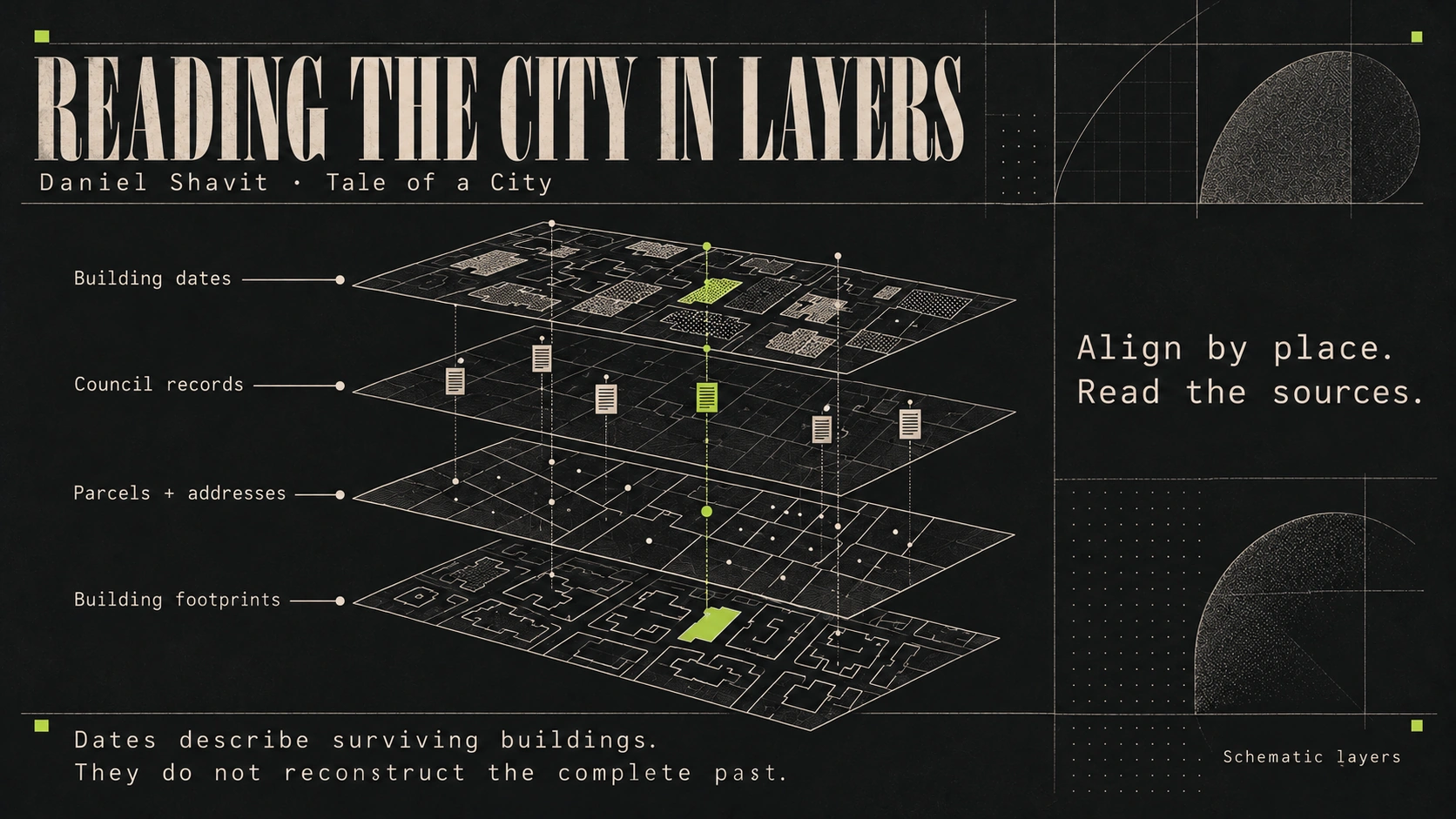
Drag the year control with that in mind. The building geometry comes from 2015 outlines, the heights mostly from 2016 LiDAR, and construction dates from the assessment roll. An early-year view shows surviving buildings assigned those dates. Buildings that disappeared before the source data was made cannot magically reappear. The map's explanation makes that limit part of the experience.
Qipu's current Vancouver site is broader than the fellowship repository's seventeen-dataset pipeline. Its current catalogue lists thirty-six datasets and includes wider work on public finances. Daniel's method page distinguishes the published processing pipeline from website and enrichment code that is not public. The open-source contribution here is the MIT-licensed Tale of a City pipeline. That is substantial on its own, and the distinction helps anyone deciding what they can reuse.
The broader Qipu site also publishes a correction history, so readers can follow changes to its data and explanations.
Explore the city, browse the records, and read the pipeline. Bring a question about a place you know.
What a small nonprofit can help make happen
This is where I get to toot our horn a little.
BC + AI brought a builder community into a partnership with an institution that has spent years caring for public knowledge. Together, we made a brief, put money behind two people, and gave their work a public context. There are now repositories to inspect, interfaces to try, methods to question and problems the next person can pick up.
I'm proud that BC + AI can help make those connections. Our community work gives people places to learn about AI, argue about it, decide where it belongs and make things together. The fellowship puts that approach under a practical test: give builders a real collection, a bounded amount of time and a public purpose, then look carefully at what they produce.
The fellows deserve the credit for their work. Jacob and Daniel made the technical and editorial choices. Andrea and the Internet Archive Canada crew brought the collection and the partnership. Loren brought her expertise to the selection. Martin Montero has been our project manager. Behind all of us are the librarians, archivists, public servants and digitization staff whose work gives these projects something to stand on.
Thank you. I want people following this program to know your names and understand what you contributed.
The next useful thing is a real reader
Six weeks gets a project to an interesting place. Keeping it useful takes more: maintenance, corrections, hosting, documentation, and people willing to tell a builder where the tool failed them. We should be candid about that work when we celebrate a fellowship.
These projects offer two concrete ways to participate. Ask Jacob's tool a question, then open the source and see whether the answer holds up. Choose a place in Daniel's map, then follow the record and see what the connection actually tells you. If you find a problem, describe it precisely enough for somebody to investigate. You can report a problem to Qipu. If the code helps your own project, the repositories are there.
There is also an opportunity to meet the work in person. Internet Archive Canada has announced the fellows at Open by Design: Tools for Participation on October 27, from 5:30 to 8:30 p.m. at its Vancouver headquarters, with Andrea Mills and Brewster Kahle. Follow the event page for the details.
And if you want more projects like this to exist, support BC + AI, get to know Internet Archive Canada, or talk with us about a collection, a builder or a partnership. Useful public work needs people who will keep showing up for it.
The Archive kept a copy. Jacob and Daniel have given us new ways to read it. Go find something worth asking.
Kris Krüg is executive director of the BC + AI Ecosystem Association. Project descriptions and repository findings were checked on October 16, 2026. Diagrams are explanatory illustrations by BC + AI; screenshots show the fellows' applications.