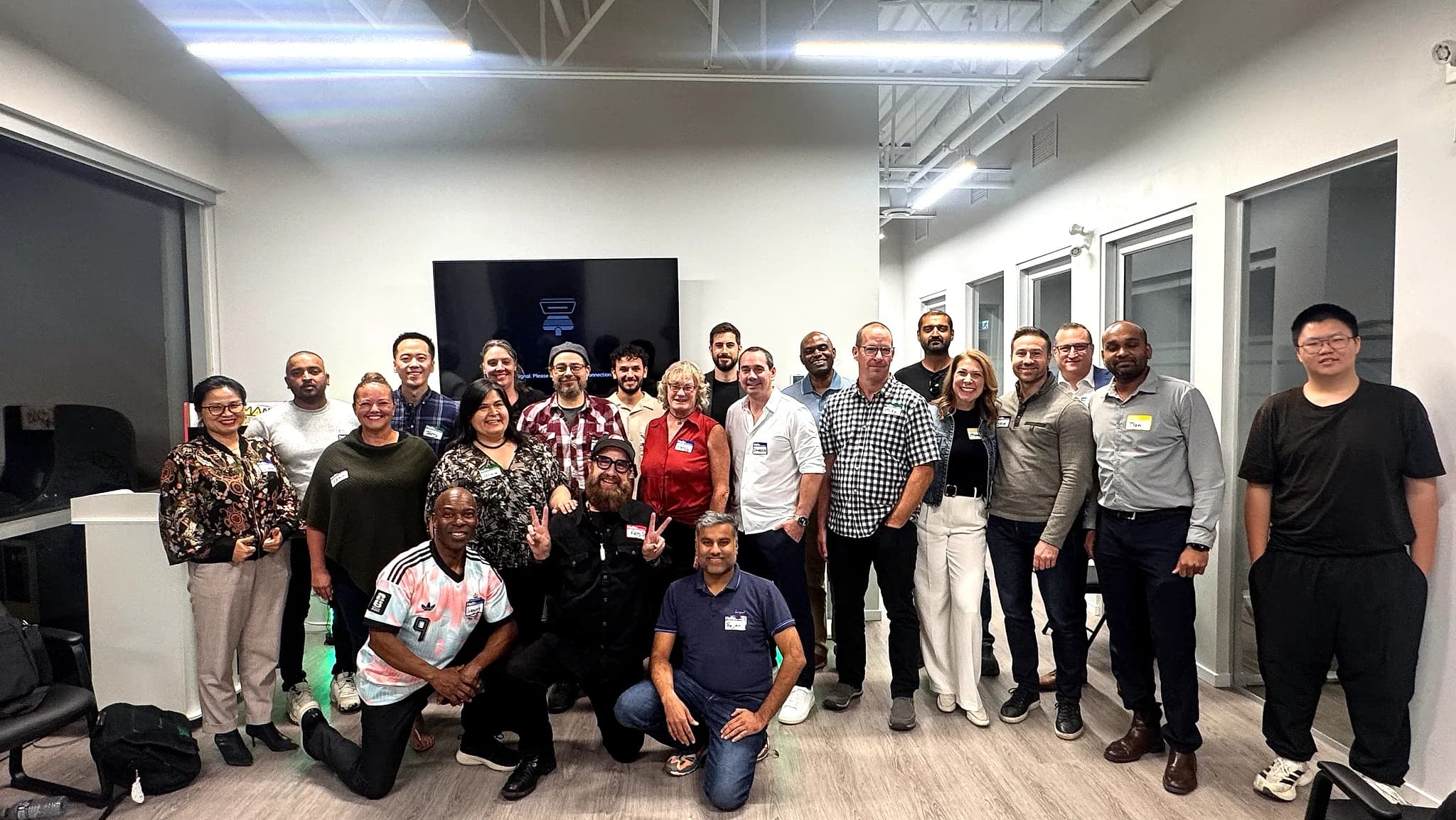
The Fraser Valley has its own room now. About thirty people spent two hours at Coleman Technologies in Langley on September 9, and FV+AI stopped being a plan and became a thing that happened.
The FV+AI launch set
- We Told the Room to Record Everything. An Hour Later, the AI Said the Same Thing. Currently reading.
- FV+AI chapter home
- September 9 event archive, with the full photo gallery
- Original Luma listing
- Next up: Futureproof Festival, October 28 to 30
Twenty minutes of introductions, and that was the point
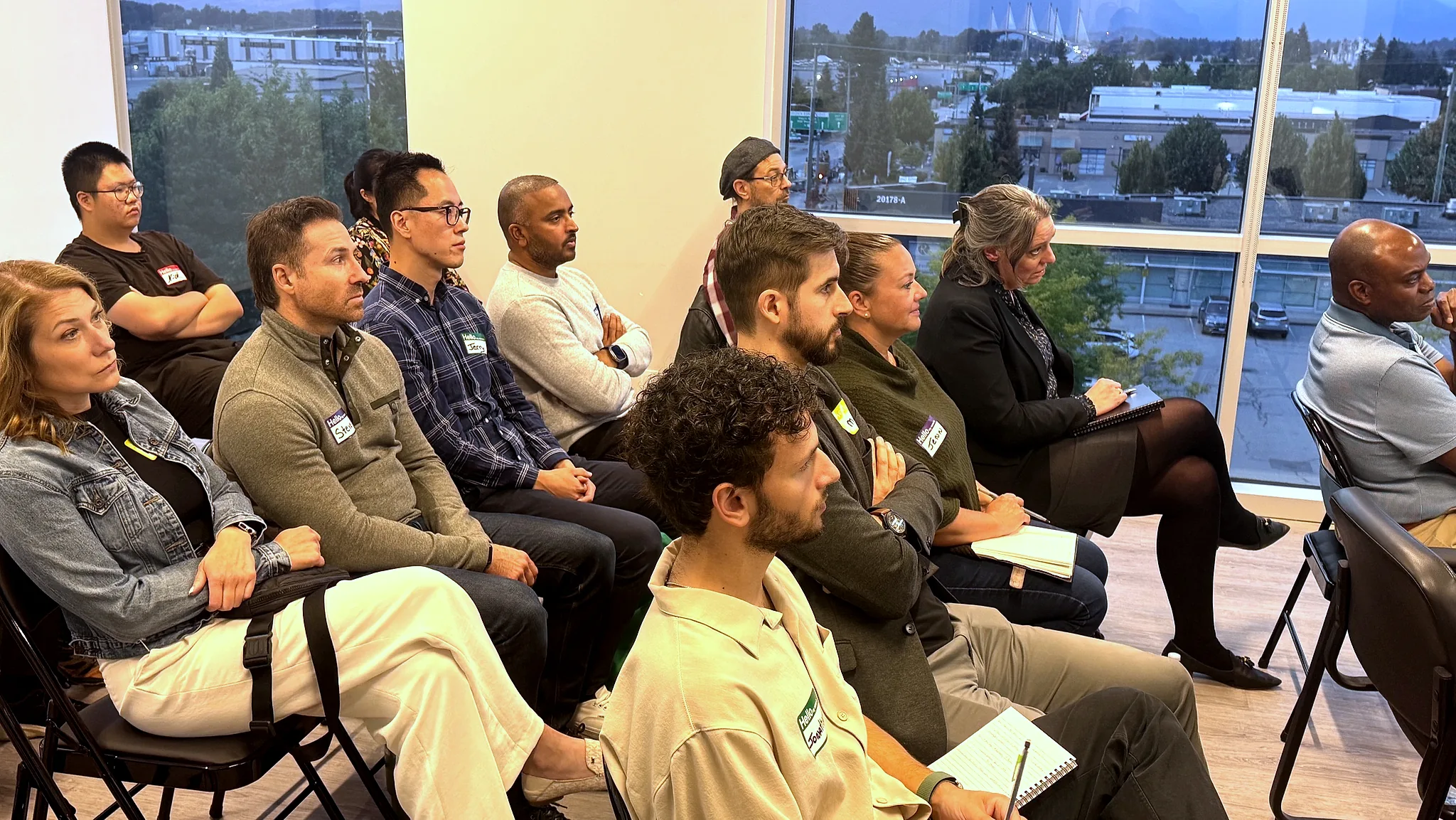
We went around the whole circle before anyone gave a talk. Every person said who they were and how they were showing up. On paper that is a warm-up. In practice it was the most useful part of the night, because of who turned out to be sitting in the chairs.
A professor with a PhD in AI from SFU, who built a lung cancer risk model that BC Cancer adopted. A high school student using ChatGPT to hunt down deals on computer parts. A cybersecurity analyst tracking a European hospital breach that cost the hospital a half-million-euro fine. A financial analyst who does forward-looking modelling and is openly worried about outsourcing his own thinking. An IT professional of eighteen years who refuses every paid subscription on principle and hops between free tiers. A TEDx coach who uses AI to triage two hundred speaker applications down to a shortlist.
That range is the whole argument for doing this in the Valley instead of asking people to drive to Kitsilano. Nobody in that room would have been the target audience for a vendor pitch. Together they were a working group.
Record everything. Seriously, start there.
The opening advice was the least glamorous thing anyone said all night: record your meetings. Not for the small win of getting a summary and a to-do list emailed around. For what it becomes after a few months.
Imagine a quarter of recordings across eight employees, and then asking for the quarterly reports. Imagine asking what you actually worked on last month, and getting a real answer instead of a guess. The institutional knowledge of a small business lives in the comings and goings, the meetings, the half-decisions nobody wrote down. You can start capturing it tomorrow, and if you make no other change to how you work, you are still building something that a better model will be able to read later.
That also happens to be the honest answer to the question the financial analyst raised, which is how you use this stuff without getting dumber. Start with the tasks a human could never have done in the first place. No person can hold a quarter of meeting transcripts in their head and pull out the pattern. Handing that to a machine costs you no cognitive muscle you were ever using. Get comfortable there first, then decide how far into your own thinking you want it to come.
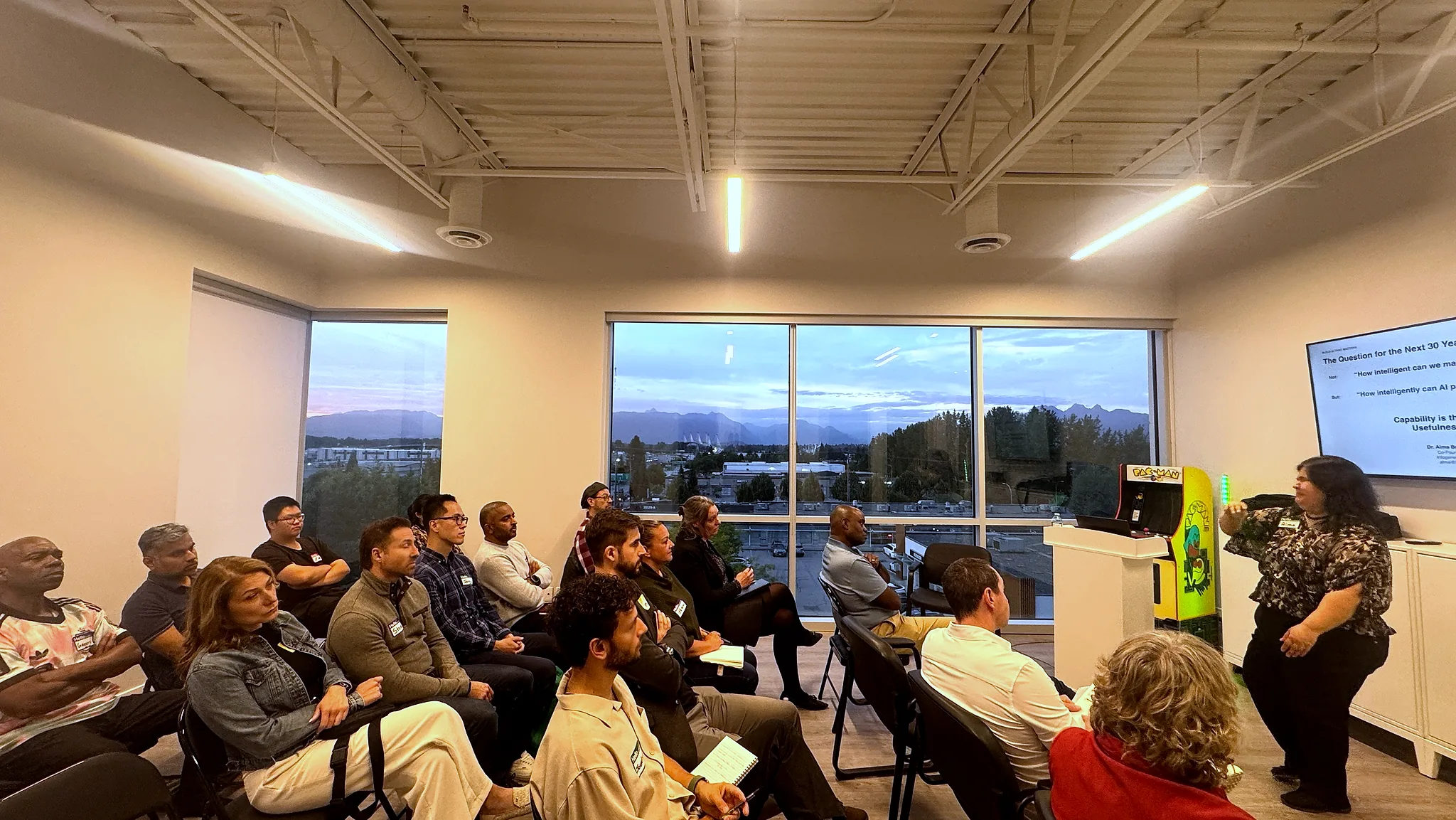
Dr. Alma Barranco-Mendoza has been doing this for thirty years
Dr. Alma Barranco-Mendoza spent part of her birthday giving the first talk at our first Fraser Valley meetup, which is a generous way to spend a birthday.
Her credentials are absurd in the best way. PhD in computing science from SFU with a specialization in AI, back when that was not a career path. An early AI lung cancer risk assessment system that BC Cancer adopted. CIO of the Canadian Space Society. CIO and professor at Trinity Western. Co-founder and CEO/CTO of Infogenetica Solutions Ltd. She also taught Dr. Angelica Lim, the SFU computing science professor whose work on social intelligence and empathy in robots keeps coming up in our rooms.
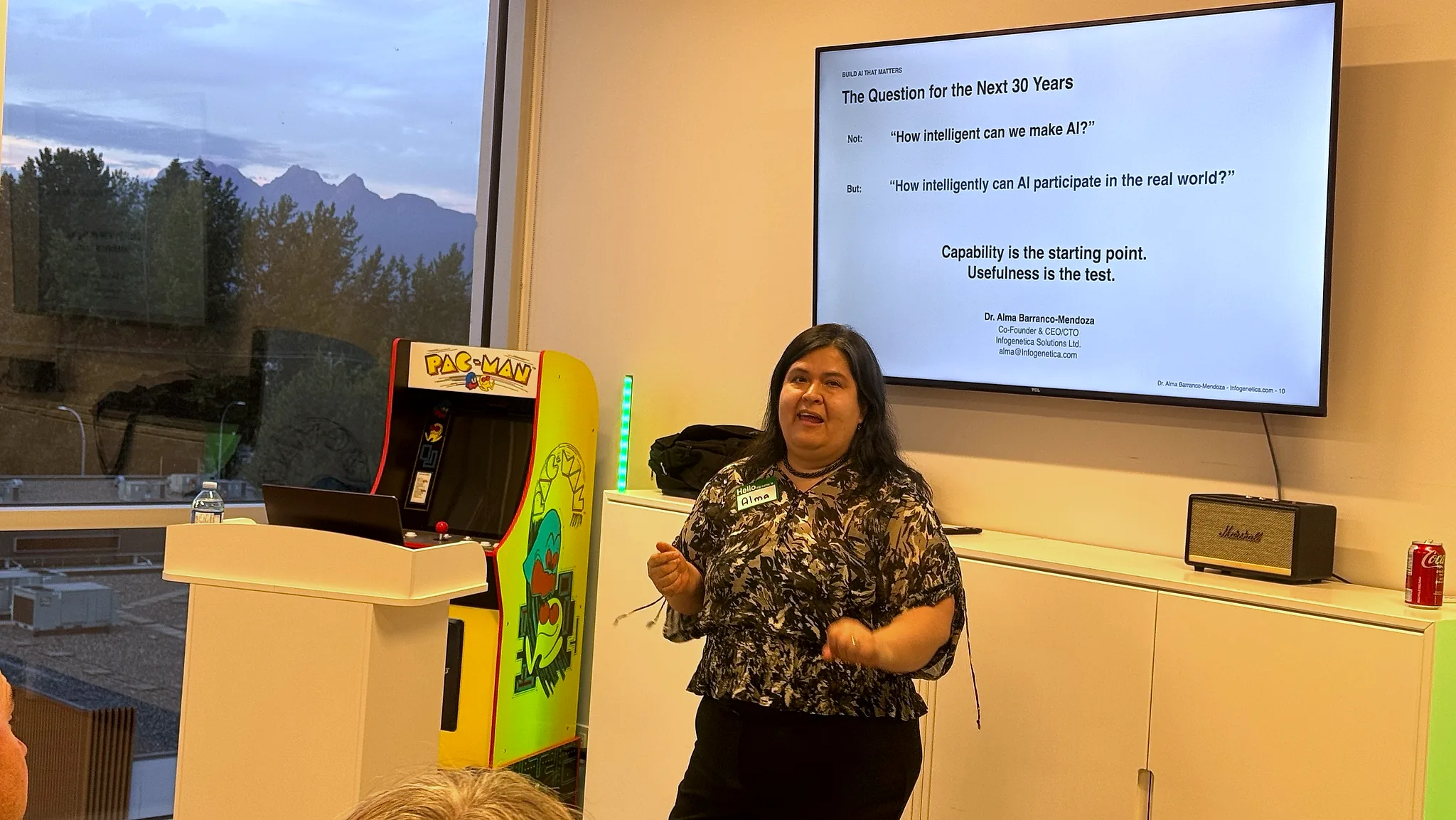
Her talk was called AI before the hype, and the spine of it was that the hard problem has not moved. Data, then knowledge, then reasoning, then a decision, then an action. New vocabulary every few years, new tools, new people, same pipeline. Dirty data at the front means a flawed decision at the back, and no amount of model quality rescues that.
The numbers from her cancer work land hard. Top oncologists were reading those lesions correctly about half the time, and lung cancer treatment is aggressive enough that a wrong call is genuinely dangerous. The AI-assisted approach took that to roughly seventy-five percent. That is what useful looks like, and it took years to reach the clinic.
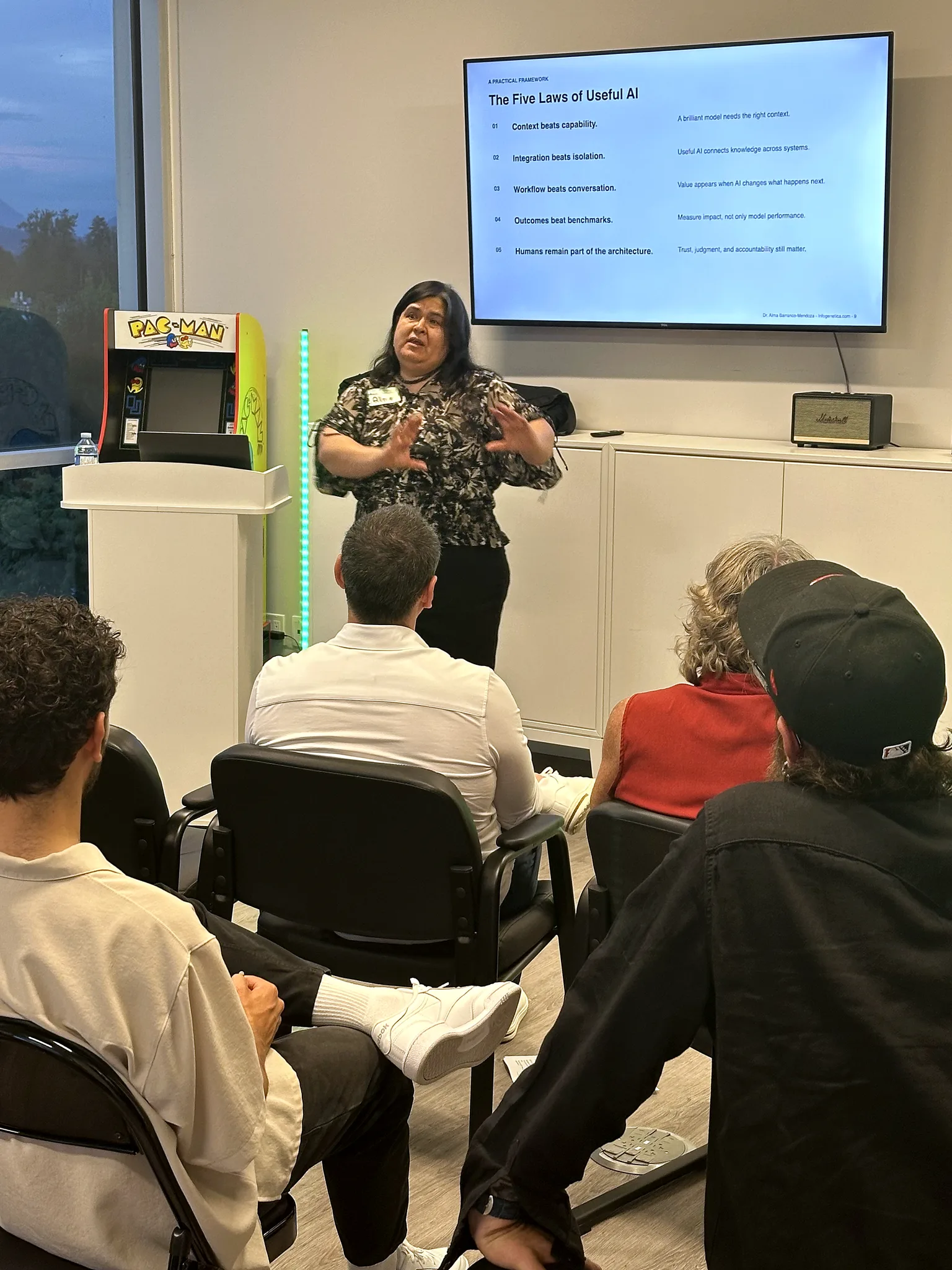
Five laws of useful AI
She teaches these to her students, and they are the cleanest framework anyone has brought into one of our rooms this year:
- Context beats capability. A brilliant model still has to fit what you are building.
- Integration beats isolation. The solution that talks to your other systems wins.
- Workflows beat conversations. Map the workflow and you get a repeatable path, with known steps and known costs.
- Outcomes beat benchmarks. Benchmarks change weekly. Being faster does not matter if the answer is wrong.
- Humans stay in the architecture. Her number one rule. Everything the agents produce is a draft, and she approves it.
She was blunt about the consciousness question. We can emulate it, and there is nothing there. In her words, it is a machine, like your toaster, with more muscles.
She was blunter about bias. Someone in one of her group chats had suggested AI would finally remove bias from diagnostics. Her answer was that AI will make bias worse by default, because the training data is the internet, and by her estimate about seventy percent of the internet was written by North American white men. Adding more data without deliberately adding the missing voices does not average the bias out. It amplifies it.
And she gave the room a warning that only somebody who lived through the last one can give. Her 1990s company, Knowledge Junction Systems, built telecom configuration software that did recommendation and upsell roughly a decade before Amazon made that famous. Investors piled in. Then investors got nervous and pulled out, and the company was forced to sell with solid clients still on the books. Her read on right now: it looks the same, money is being thrown at people, and if you own a company, keep control of it.
Her closing slide is the one worth carrying around:
The question for the next 30 years. Not: "How intelligent can we make AI?" But: "How intelligently can AI participate in the real world?"
Capability is the starting point. Usefulness is the test.
The two percent and the ninety-eight percent
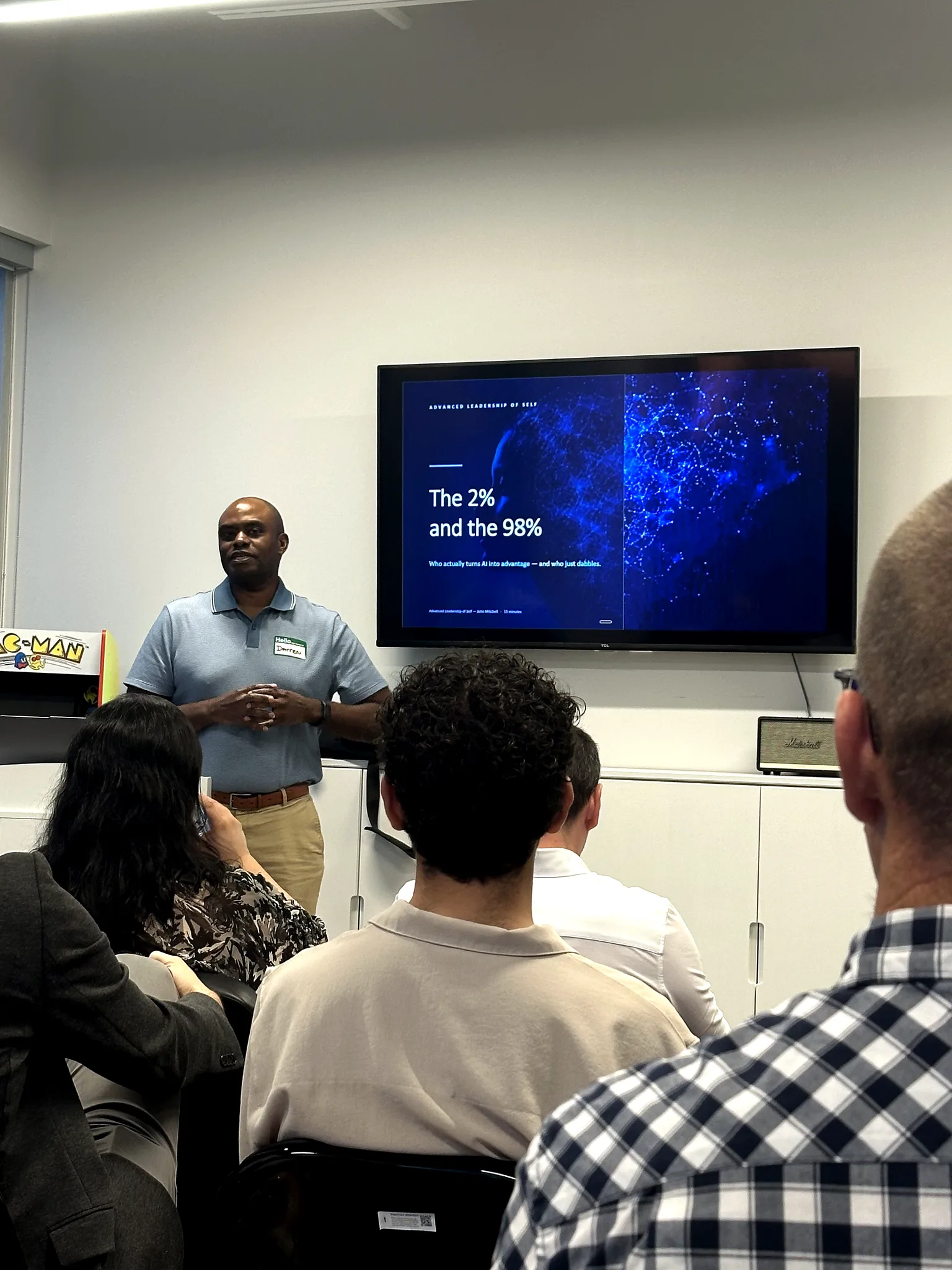
Darren took the second slot and opened with a show of hands. Who is dabbling, using this to rewrite emails and clean up documents? Most of the room. Who is running agents and building with it? A real number of hands, more than you would expect in Langley on a Wednesday.
His argument is that the ninety-eight percent dabble and the two percent collaborate, and the gap between them is not technical skill. It is whether you are willing to have an actual conversation with the thing.
His practice is specific enough to copy. Two thinking sessions a week, on a standing schedule. Ask one real question and talk it through for twenty or thirty minutes by voice. At the end, download the transcript. At the start of the next session, paste it back in. Context compounds, and after a couple of months the sessions are working from a model of your business rather than from scratch.
He walked through what that did to his sales. The first session told him he needed a pipeline, so he built one and started tracking it. What surprised him was not the advice, it was the second-order effect: he started thinking differently about the people in that spreadsheet and approaching them in ways he would not have on his own. He puts it in the thousands of dollars.
His line for it: you cannot improve what you cannot see.
Worth adding, and we said it in the room: once you have ten hours of those sessions, stop reading them one at a time. Run the analysis across all of them. Where have I actually moved since I started, and what have I been avoiding the whole time? Each session is useful in bite-size pieces. The whole buffet is worth more.
Then the machine pitched our own opening back at us
The demo was live, unscripted, and briefly derailed by a VPN and a guest wifi password, which is how you know it was real.
Darren asked ChatGPT in voice mode how to become financially independent. It did the sensible thing and asked what the number was and what independence would let him do. The room, being a room, immediately escalated: one hundred million dollars, in a year.
To its credit the model did not blink. That is not a budgeting goal, it said, that is a hypergrowth goal, roughly 8.3 million a month, and it wanted to know whether we meant revenue, profit, or personal net worth, because those are three different problems. The room said profit. It came back with the twenty percent margin math, about five hundred million in revenue, and asked for an idea to map against.
Its first suggestion, unprompted: an AI institutional memory platform. When people retire or quit or get laid off, the company loses knowledge nobody ever wrote down. So interview your best people, capture how they reason, turn it into something you can query. Sell it to hospitals, universities, government.
Which is exactly the advice the night opened with. We had spent the first ten minutes telling this room to record everything because their institutional knowledge is the asset nobody is capturing, and an hour later the machine independently arrived at the same idea and tried to sell it back to us as a hundred-million-dollar business.
Then it did something better. It handed the frame back:
Don't ask AI for a million dollar idea. Ask AI for a million dollar problem. What's one painful, annoying, expensive thing everyone in that room wishes would just disappear from their week?
The room said taxes. Asked what specifically they hated about taxes, the room said all of the above. The model called that perfect problem scoping, which got a laugh, and then sketched a tax copilot that runs all year instead of once in April and sells through accounting firms rather than trying to replace them.
Nobody is starting that company tomorrow. That was not the point. The point was watching a room of thirty people go from a wish to a scoped problem to a business model in about six minutes, out loud, together.
The thread we did not plan and should follow
Privacy came up all night without anyone putting it on the agenda.
One member described being told, at a mall, that paying for a chat subscription is not what buys you privacy. He had assumed paid meant private. Another described avoiding every subscription he can, which turned into a genuinely useful exchange: you can buy prepaid gift cards instead of handing over a card that renews forever, and for most of these tools there is an open-source equivalent on GitHub if you are technical enough to run it yourself.
And Alma's version was the design-level one. Segregate confidential data before you build, not after. Keep personal and business contexts in separate projects, because what you feed it on the personal side will surface on the business side, and because you are paying for every token of context you drag along.
That is a whole session. We will book it.
Where this came from, and where it goes
Three years ago these started in a Vancouver studio because the AI events on offer were either hierarchical programmer circles or get-rich-quick seminars, and neither one was the honest conversation. That studio maxed out in nine months. The H.R. MacMillan Space Centre took us in about two and a half years ago.
Since then the format has travelled on its own. Rooms in Surrey, Squamish, and the Comox Valley, one forming in Kelowna, and interest groups that organized themselves around life sciences, education, startups, and a film club for the people whose industries are being rearranged fastest. A year ago it all became the BC + AI Ecosystem Association, a registered nonprofit, which as of the night of the launch has 310 paid annual members.
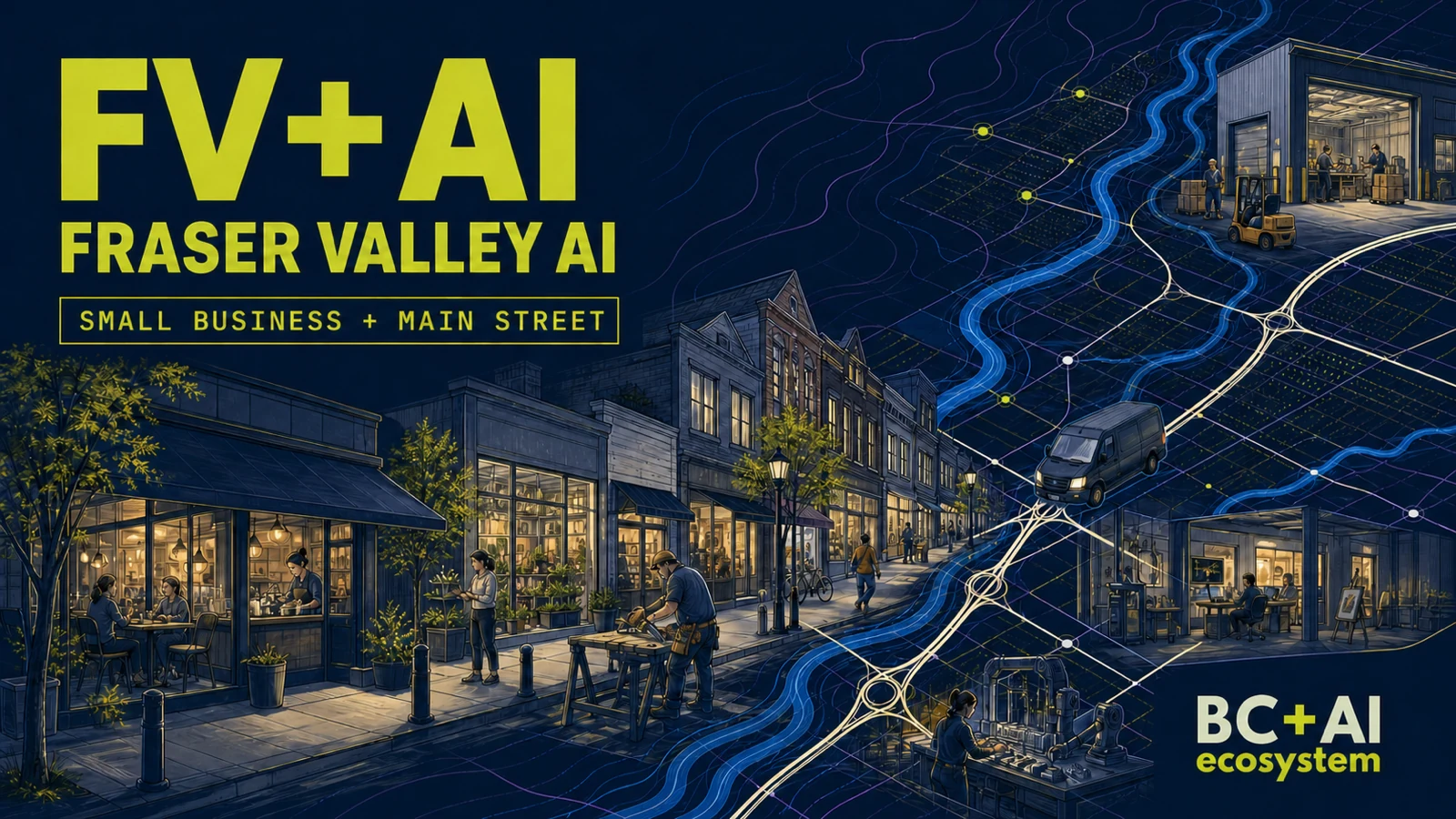
FV+AI is the Fraser Valley entry in that map, led locally by Darren Coleman, and it grew directly out of the Surrey AI meetups and the people who kept showing up to them. Alma put the reason for the whole thing better than we have:
I've been part of many AI organizations. Most of them are only technology. This is the first, and I think the only one, that is so incredibly eclectic. For many years it was only us tech people working on AI. But really, we need the voices of everybody.
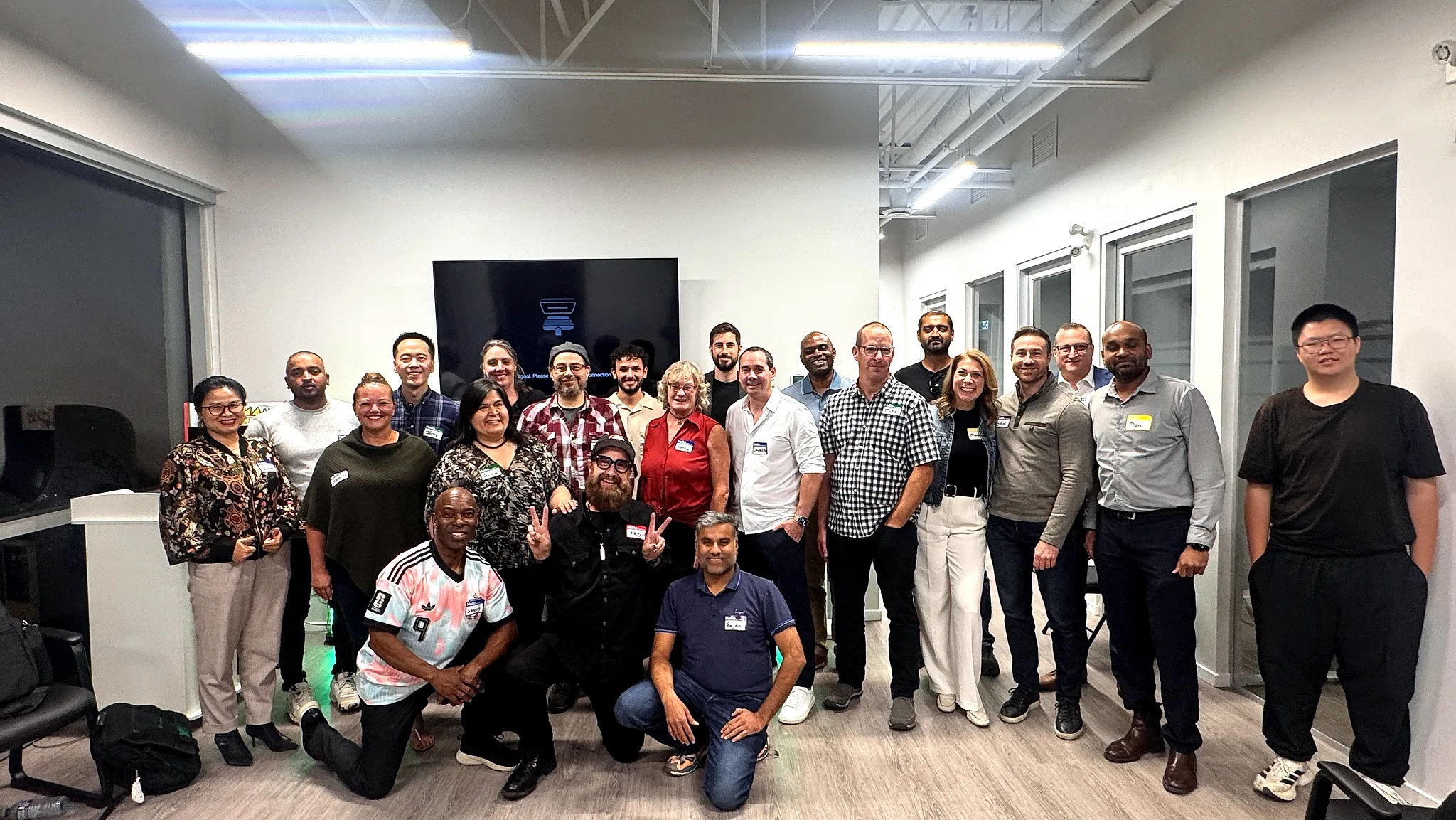
We took a group photo at the end. Everybody said Star Trek instead of cheese.
Come to the next one
FV+AI meets the second Wednesday of every month in Langley. Same format: real introductions, two short practical contributions, food, and enough room for everyone to actually talk.
- Follow the FV+AI chapter for the next date and location
- Join BC + AI and back the whole provincial network
- Futureproof Festival, October 28 to 30 at the Space Centre, with speakers from Washington, San Francisco, and Toronto alongside the BC crew
Bring a question, a demo, or plain curiosity. You do not need to be an expert. Most of the best people in that room were not.