An AI vendor promises to save your team ten hours a week. If you work in HR, you need to know whose ten hours those are.
Kerris Hougardy, a people-strategy leader, brought that problem to our Responsible AI Professional course. For her capstone she built a navigator that connects tasks at risk of automation to skills a person could develop next. You can watch her work through it in six minutes. Kerris’s reskilling navigator.
Now put yourself on the other side of that purchase. You’re the CEO who has to approve the renewal. Did those ten hours materialize? What did training cost? Did the people doing the job get a say in what counted as an improvement? Being able to walk into a board meeting with answers to those questions is a good reason to get certified. Being the HR lead who knows which questions the board forgot to ask is another.
BC + AI and TheUpgrade built the Responsible AI Professional certification (RAP) for people who already own a piece of an AI decision. In our first year, 40 people earned cohort credentials. The most interesting part is how differently they used the same four assignments.
A founder’s AI policy and a sales leader’s second look
Brittney Ashley had already studied AI when she joined the spring cohort. As the founder of Creative Dynamics, she wanted something she could put in front of her own team. For Using AI With Intention, she wrote the company’s AI use policy, made slides to explain it and built a Claude skill to help her team apply it. A colleague can read what the company expects, then bring a specific use back to the policy. “It changed how I think about my work, and I left feeling proud of how I show up with AI,” Brittney wrote. See what went into the Creative Dynamics policy.
Bruce Ratzlaff came from industrial sales and operations. He knew what he wanted an AI system to do for the sales team. Here’s the assumption he brought into the room. “Thought that as long as we had an enterprise account and our IT dept signed off on it we were good for security.” His capstone was an evaluation matrix for an AI tool that prioritizes sales. An IT sign-off can tell you whether you’re allowed to use the tool. Bruce’s matrix gives the sales team a way to judge its recommendations. Imagine asking why a longtime customer suddenly ranks last on the call list. Who could explain the ranking? What evidence would change it? Bruce walks through his matrix in three minutes.
What you have in hand after four sessions
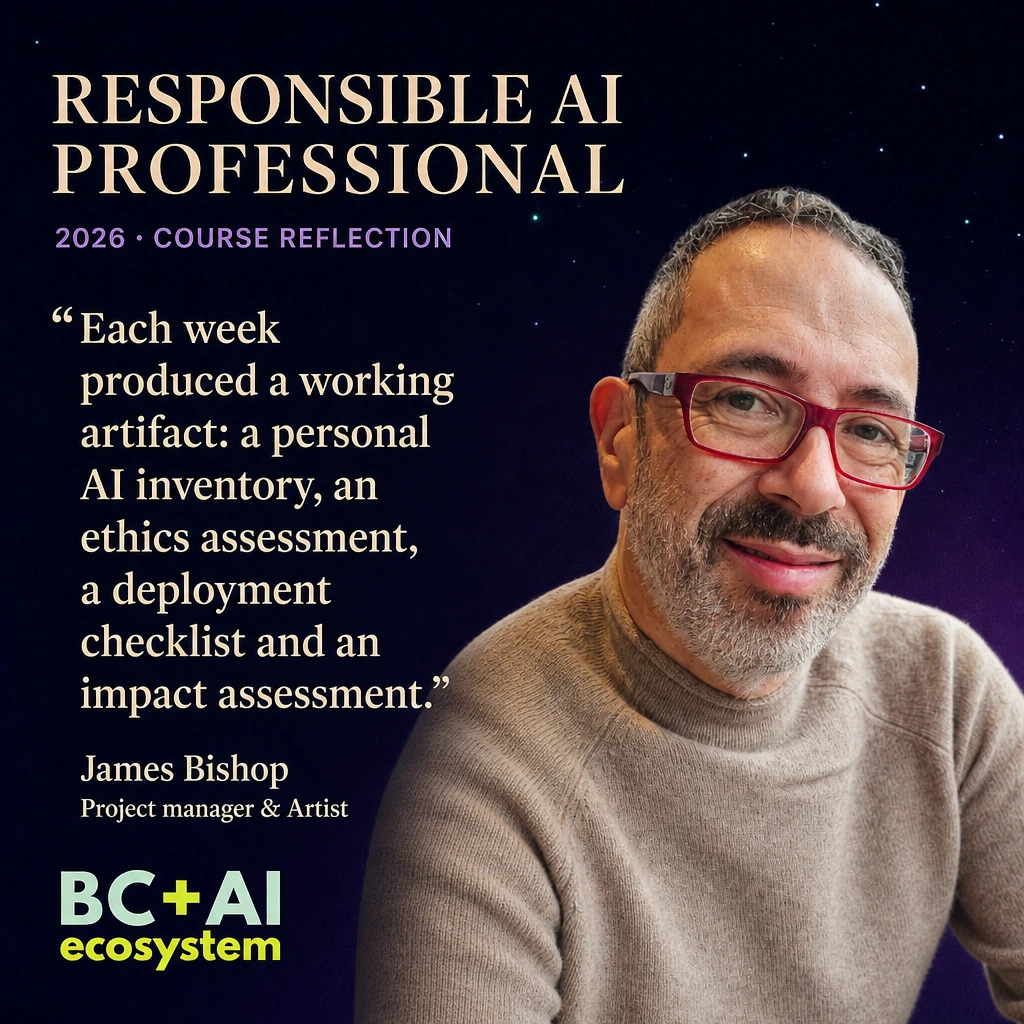
Project manager and artist James Bishop put it plainly. “Each week produced a working artifact: a personal AI inventory, an ethics assessment, a deployment checklist and an impact assessment.” James built a Responsible AI Initiative Map for the proposal stage, when a project manager still has a chance to get the right people in the room.
Suppose your organization wants to use AI to summarize client interviews. Here’s how the four assignments could earn their keep on that one project.
- Personal AI Inventory. Trace where the interview goes, from the recording app to the summary in your client file. Include the transcription feature somebody switched on three months ago. That counts too.
- Ethics Assessment. Look at whose words the system gets wrong. What happens to a client if a summary drops the word “never”? Decide whose input you need and what evidence would justify using the tool.
- Deployment Checklist. Give the next colleague instructions they can follow. Who asks for permission? Who checks the summary against the recording? Where does a correction go?
- Ethics Impact Assessment. Decide how you’ll find out whether the summaries help. Pick something to check after launch, name the person who will check it and give clients a way to flag an error.
Online, you do this work across four live 90-minute sessions, with reading and exercises in between. You bring your decisions back to instructors and peers, pass the quizzes and complete the assessed work. For your capstone, you use those materials to build an Ethics Practice Assistant with instructions and references you can keep refining. You leave with the four documents, the assistant, a certificate and access to the alumni network. When a colleague asks how you reached a decision, you have work you can show them. Inside the four modules.
Two ways to get your bearings
Learning-experience designer Daniel Bashaw described RAP as “a zoomable drone's-eye view of the entire AI ethics and governance landscape.” I like the second half of his observation, about being “down in the weeds of a specific project.” You can try that change of scale yourself. Open the Open Data Institute’s Data Ethics Canvas, a Week 2 reading, and fill in the part about people who could be adversely affected. See how far you get before you need to talk to one of them.
Mark Busse said he gained “practical tools, greater confidence, and a stronger voice.” In his project, Know Me, Don’t Become Me, he asks a personalized AI to challenge his assumptions and show him its sources. If you’ve ever had a chatbot enthusiastically endorse two incompatible ideas of yours in the same afternoon, you’ll appreciate the ambition. Mark’s walkthrough · The graduate capstone library.
If you write policy, start with instructor Sarah Downey’s Policy Design in the AI Era. It separates principles a board can stand behind from tool instructions a team may need to revise next Tuesday. If you buy technology, take the NIST AI Risk Management Framework to your next vendor conversation. Our AI ethics reading list and free reading shelf are open to everyone.
The year a graduate came back to teach
At Vancouver’s H.R. MacMillan Space Centre in October 2025, I watched nearly every hand in a room of about 250 go up when a speaker asked who was deploying AI. When the question turned to who had a framework for doing it, I counted maybe a dozen. In the spring, Martin Lopatka built the curriculum and assessments, Sarah brought the governance practice, and I brought problems people were raising at our meetups. Alex Salvador Lopez got us around the table. On May 22, the first cohort met. How the program began · The original invitation.

Kerris finished that first cohort and came back to teach with Sarah and Martin in September. In October, Sarah led our first two-day intensive at 1000 Parker Street in Vancouver. Kerris taught the first morning and high school psychology teacher Christabel Shaler helped facilitate both days. By November 20, 22 people had earned cohort credentials in spring, 12 in September and six in October. With three founding instructors, that makes 43 credential holders. Meet the people who teach RAP.
Bring one decision to the 2027 cohort
If you’re paying for your own seat, start with a project you already owe somebody. It might be the AI policy you promised a client, a staffing proposal your team will feel, or a purchasing recommendation due at the next board meeting. Pick one you know well enough to let classmates ask awkward questions. That’s where you’ll get your money’s worth.
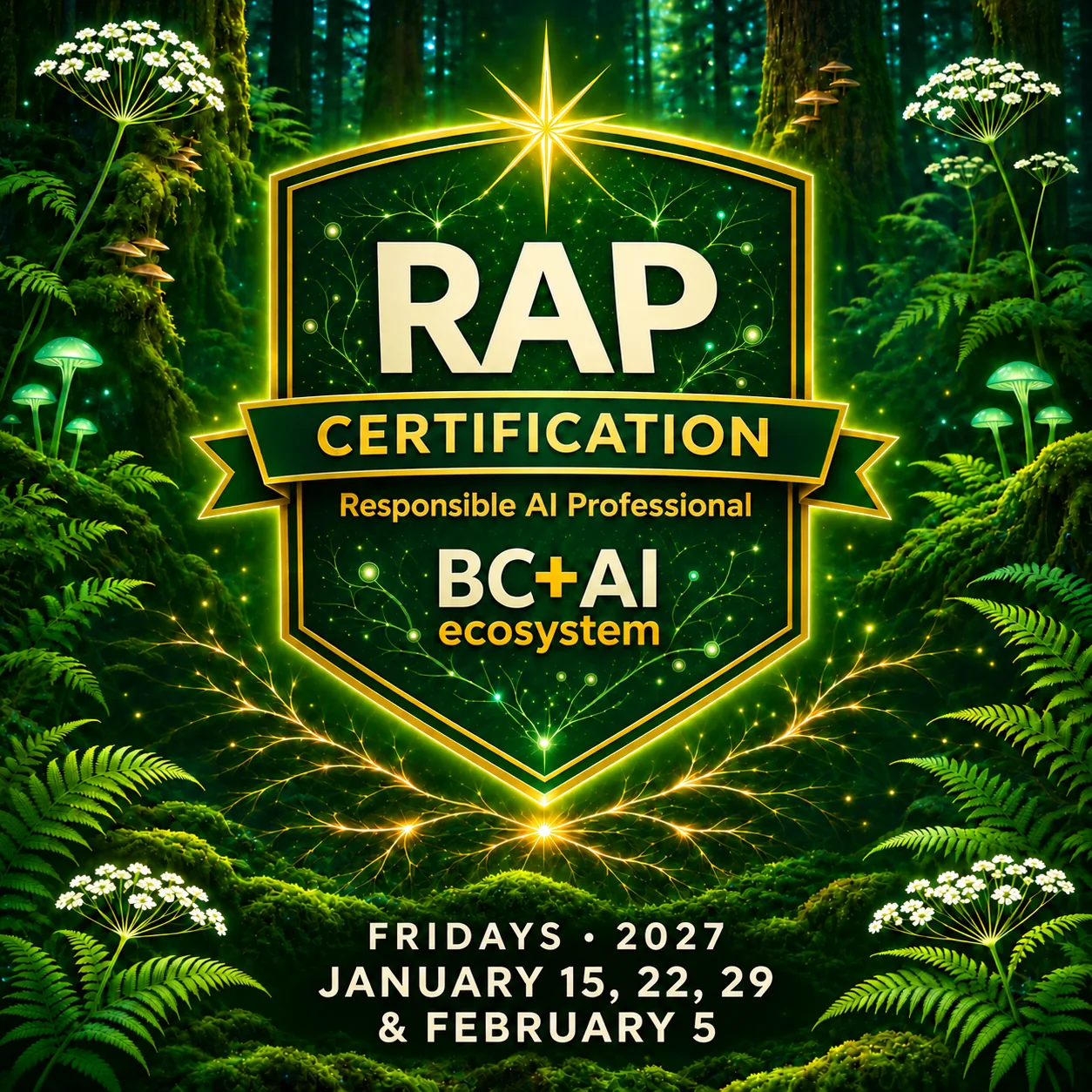
The January cohort meets from 3:00 to 4:30 p.m. Pacific on January 15, 22, 29 and February 5. The Earlyworm price is C$1,200 through January 1. Standard registration is C$1,500. The C$750 BC + AI member ticket requires membership verification and approval. Prices are per person, before any applicable taxes and fees.
Three later cohorts meet at the same time of day. June runs on Wednesdays, June 2, 9, 16 and 23. September runs on Fridays, September 10, 17, 24 and October 1. November runs on Fridays, November 12, 19, 26 and December 3. Two in-person editions are in planning, April 29 and 30 on Denman Island and November 2 and 3 for the festival. Choose your cohort.