The prompt era is over.
Prompts still matter. They just stopped being the job.
Anybody can keep rolling a model until a beautiful five-second shot falls out. That part is getting cheaper by the week. A film starts when the next shot has to match. The same character has to walk into the same room with the same face, carrying the same emotional weather, and do something an audience cares about.
That is where the demo ends and directing begins.
I have watched enough AI animation reels to know the move. Pick the six prettiest generations. Cut them to an expensive-sounding track. Hide the broken hands, dead eyes, continuity failures, and forty-seven discarded shots. Post it with a caption about the future of creativity.
Fine. The internet can have another reel.
What I want to see is the film.
For the last few months, BC + AI has been running the AI Animation and Filmmaking Accelerator with Luke Minaker and Mayumi Rollings from Tiny Ghost Studios. Two cohorts have now gone through the room. People arrived with different levels of craft, different levels of fear, and wildly different relationships with AI. They left with finished or nearly finished shorts, production scars, stronger opinions, and a much clearer view of what this work actually demands.
We now have four student films, shared with permission, in the Animation Accelerator student showcase playlist.
Watch them before you decide what AI animation is.
A beautiful shot is easy. A coherent film is hard.
Luke has been making animation professionally since he was 17 and directing since he was 21. He has worked across film, television, games, major toy franchises, and more than a billion views worth of animation. Then the industry shifted under his feet. He got laid off.
Luke and Mayumi spent two years building Tiny Ghost Studios with no revenue, testing every unstable tool they could get their hands on, and trying to turn model output into an actual production pipeline. Their original IP, Blood and Glitter, got greenlit. Paying client work followed.
That history matters because they are not teaching a button. They are teaching what survives when the buttons change. It is the lesson underneath our first Animation Accelerator dispatch, now sharpened by another cohort and four finished films.
Luke's frame for the whole shift is simple:
"There's like the 20% creative and there's the 80% grind. And I think that with AI now, it's flipped it on its head. There's the 80% creative and the 20% grind."
People hear that and assume the work became easy.
It did not.
The bottleneck moved.
Traditional production made you pay dearly for execution. Frames, tweening, cleanup, rendering, revisions, render farms, and all the human coordination required to keep the machine moving. AI can chew through parts of that grind at ridiculous speed.
Now you pay in decisions.
Which premise deserves three weeks of your life? Which character design can survive multiple angles? Which reference image is stable enough to become an anchor? Which performance has a pulse? Which model mistake is a gift? Which one destroys the scene? When do you spend another twenty dollars chasing a shot, and when do you change the shot?
The model has no skin in the game. You do.
Your new crew is fast, cheap, and completely unhinged
The current generation of tools feels less like software and more like a crew of extremely talented collaborators who did not read the brief, do not remember yesterday, and may quietly replace your lead actor halfway through the scene.
They can give you magic. They can also give you six fingers and a new wardrobe for no reason.
That changes the director's job.
You need story beats before you start burning credits. You need character sheets, world references, shot lists, voice and performance decisions, and a clear idea of the smallest version of the film that still works. You need to separate characters when the model cannot hold a group composition. You need to know enough Photoshop, compositing, editing, and sound to repair what generation cannot.
Most of all, you need taste.
Polish used to hide a lot of weak ideas because polish was expensive. Now a solo creator can generate a gorgeous image before lunch. Looking expensive is losing its power as a moat.
Story is coming back with a baseball bat.
What does the character want? Why this shot? Why this cut? Why this voice? Is there an emotional turn, or did you accept the first haunted mannequin the machine handed you at 1:13 in the morning?
These questions are old. Good. The instruments got stranger. The work still has an old soul.
Four films. Four different answers.
Student quotes below are lightly edited for punctuation only.
The strongest evidence from the accelerator is the work itself. These four projects do not look like one house style or one model's demo reel. They carry the choices of the people who made them.
Robin Puga: Lil' Bites - Taste the Fresh
Robin came into the cohort with a values-led technology background and built a sharp, strange little commercial for an imaginary restaurant. It has appetite, comic timing, and the feeling that the brand mascot might eat the customer if the customer does not move fast enough.
Robin gave the accelerator a 9 out of 10 for overall value and recommendation. His description is better than anything I could put in a brochure:
"If you want to understand how experienced industry people are navigating the shift to AI film making, this is an excellent opportunity to learn from fantastic team. It's a wild ride!"
It was a wild ride. Robin also told us he spent about $50 to $60 on accounts while making the piece and sometimes felt like he got lucky. That is useful truth. Generation still involves probability, cost, and a lot of judgment about which accidents to keep.
Robin has continued building the Lil' Bites series. See the rest of it and give him his flowers on Robin Puga's YouTube channel.
Anna Havrylyukh: a student film and the value of a real mentor
Anna's film took a different route. Her strongest takeaways were prompt-to-storyboard thinking, voice and performance, and confidence with the production stack.
Her feedback gets directly to the human value of the room:
"The biggest value for me was Luke's guidance. It felt like having an experienced mentor who was always there to answer questions, provide honest feedback, and point you in the right direction. That kind of support really helped me improve much faster than I would have on my own."
You can learn tool features from a tutorial. A tutorial cannot look at your rough cut, understand what you were trying to do, and tell you which problem actually matters.
That is mentorship. It did not become obsolete when the models got better.
Jennifer Li: Grub's Cantina
Jennifer was part of what she called the experiment batch. Her project, Grub's Cantina, grew out of a prompt-guided monthly challenge and became a compact world with its own odd little gravity.
Jennifer said the accelerator can work for somebody arriving fresh and still give experienced experimenters useful process details:
"If you're a beginner/fresh to AI filmmaking/animation it will be very beneficial! If you have some experience from experimenting on your own it will still be helpful to learn tips and little things that can assist in your process. ESP being able to ask questions for live instructor feedback, and from listening to feedback for the cohorts."
That last part matters. You learn from your own notes. You also learn from watching somebody else's shot fall apart and seeing how they repair it.
The room multiplies the reps.
Felipe Ruiz Reyes: 雨宿りの常連 (The Rain-Shelter Regulars)
Felipe's film is quiet in the best possible way. Rain outside. A small shop. A bright drink on the counter. A memory that may still be sitting in the room.
The title card also credits Mai Masutani. The production used Krita, LTX 2.3, and Suno. The result is a good reminder that these tools do not have to make louder work. They can make more specific work when the person driving them knows what feeling they are after.
Felipe also gave us the clearest warning about production economics:
"Because fine-tuning AI video requires massive amounts of trial and error, those credit costs can drain your budget incredibly fast."
That critique belongs in the article because it belongs in the craft. Every re-roll has a cost. Every platform has a burn rate. A professional workflow includes knowing when to work at low resolution, when to test locally, when to move to a paid model, and when to stop feeding money into a shot that should be redesigned.
The fantasy says AI makes production free. The invoice says otherwise.
You can watch the four films together in the complete Animation Accelerator showcase playlist, then browse more experiments, talks, and screenings in the BC + AI video archive.
What the students changed
We did not run two cohorts and declare the curriculum sacred.
The first version was too compressed. Students needed a clearer map, more production time, more structure around the live sessions, better guidance on credit budgeting, and more chances to see successful short films broken down shot by shot.
So the course changed.
The current version has three live sessions with a visible production arc:
- Story, scope, and asset lock-in.
- Production mechanics and performance control.
- Work-in-progress review and the smallest shippable path.
We also built a public AI Animation Accelerator Field Guide. It includes a production map, credit reality check, voice performance planner, reference pool builder, work-in-progress triage, rights and release context, a reading list, and a 34-term glossary.
That guide exists because the stack is weather. Models change. Prices change. Platform rules change. The durable layer is how you think through a production when everything underneath it is moving.
Traditional craft just got more valuable
Working animators and filmmakers already have many of the scarce skills.
Composition. Timing. Character. Performance. Editing. Sound. Production design. Knowing when a scene is lying. Knowing when a cut is late. Knowing when a pretty image is carrying absolutely no weight.
The industry has spent two years asking whether AI will replace artists. That question has generated a lot of heat and very little useful direction for the person staring at a shrinking job board. Creative workers are already living through that collision, which is why I keep returning to the argument in Both Hands Full.
A sharper question is available now: what happens when an artist learns to command these systems without handing over the creative decisions?
I do not know where every job lands. Nobody honest does. I do know that waiting for the tools to settle is not a strategy. They will not settle. The names will change, the interfaces will mutate, and the credit pricing will keep doing weird little capitalism in the corner.
Your craft is the part you carry across the churn.
Learn the systems. Keep your taste. Protect your collaborators. Check your rights. Make the smallest finished thing that proves what you can do.
Then make another one.
Stop watching AI reels. Make one.
Cohort 3 of the AI Animation and Filmmaking Accelerator ran online on July 27, August 4 and August 10, 2026. That production room is complete and now part of the program archive.
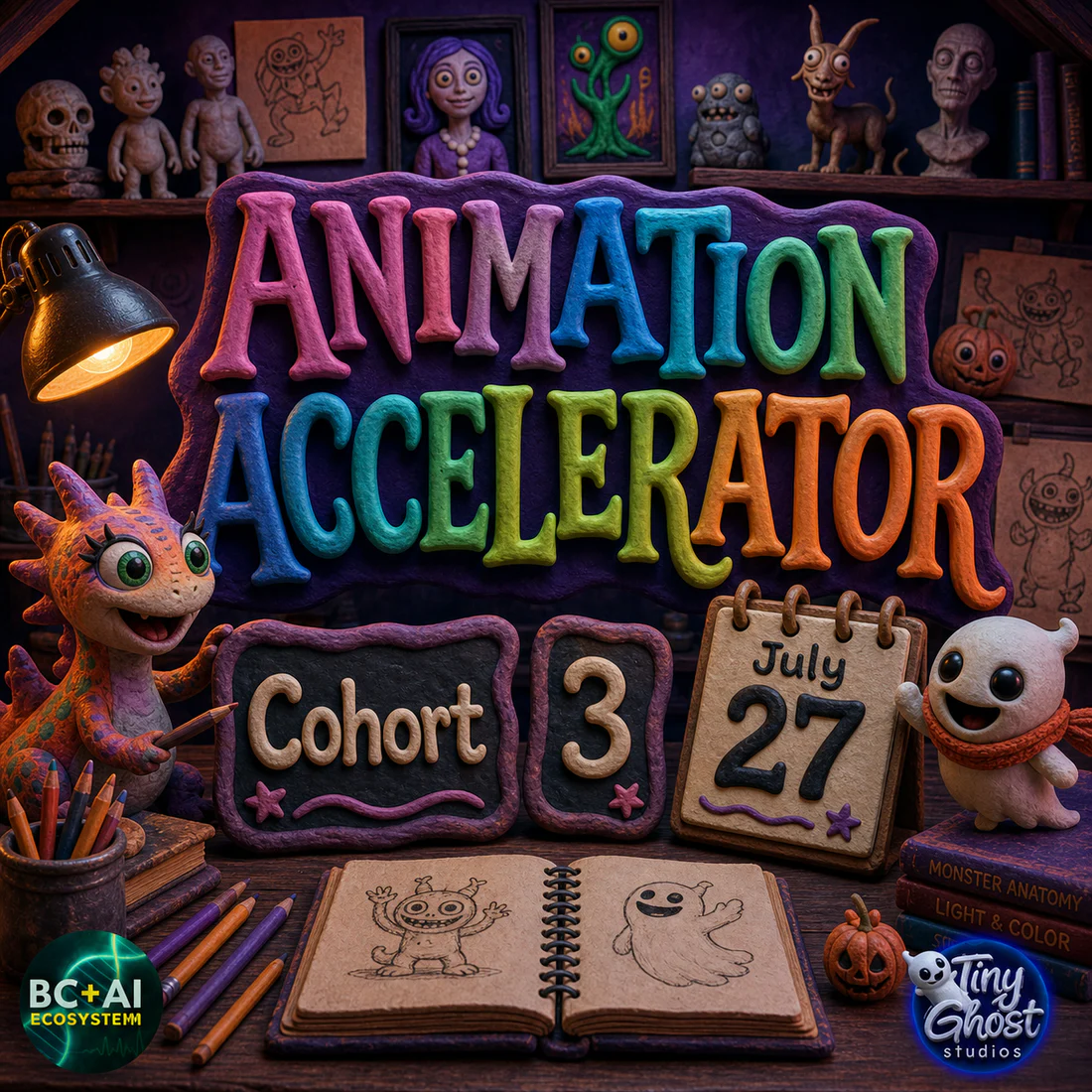
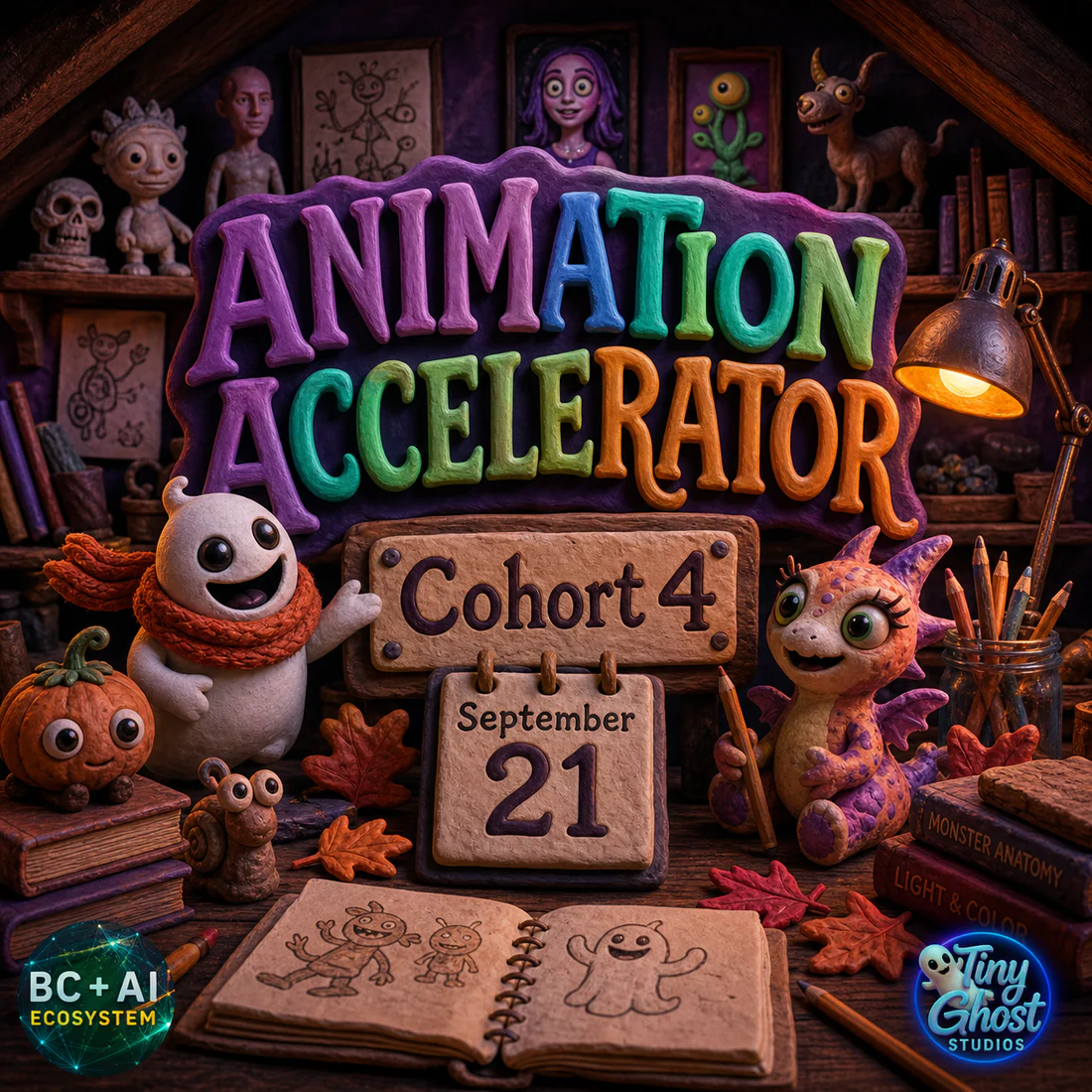
Two fall production rooms follow it. Cohort 4 is a three-session online studio on September 21, September 28 and October 5, built around a finished 30–40 second short. Cohort 5 is a one-day Vancouver intensive at Multimodal Media Lab on October 31, built around a finished 10–15 second micro-short.
Compare the online and Vancouver formats, current prices and registration windows
You will spend 10 to 16 hours building between sessions. You will burn some credits. Your characters will mutate. A shot you love will refuse to match the next one. Luke and Mayumi will tell you where the work is weak. The cohort will watch you fix it.
At the end, you will have a 30-to-40-second animated short, a reusable production map, and a much more informed opinion about where this industry is going. Strong work can also find an audience through the BC + AI Film Club.
If you want to argue about AI animation forever, the internet is open all night.
If you want to direct, come make a film.
Kris
Kris Krüg is Executive Director of BC + AI Ecosystem Association and program lead for the AI Animation and Filmmaking Accelerator. BC + AI runs practical AI programs, community labs, meetups, and Film Club screenings across British Columbia.