BC + AI Film Club
AI Film Club: 08/13
- Date
- August 13, 2026
- Photos
- 0

August's BC + AI Film Club filled Multimodal Media Lab in Gastown for the payoff night of the Space Opera prompt challenge. The format was the usual three parts: a run through everything that shipped in the last few weeks, every challenge submission screened back to back with the makers explaining how they pulled it off, and a feature to close.
What made this one different was the questions. A high school student in the room asked how you make an AI film about a specific culture without reinforcing the stereotypes the models trained on, and a working filmmaker asked how you establish chain of title on a generated character. Neither has a settled answer yet. Both took over the room.
More from this event
What a Film Club night looks like
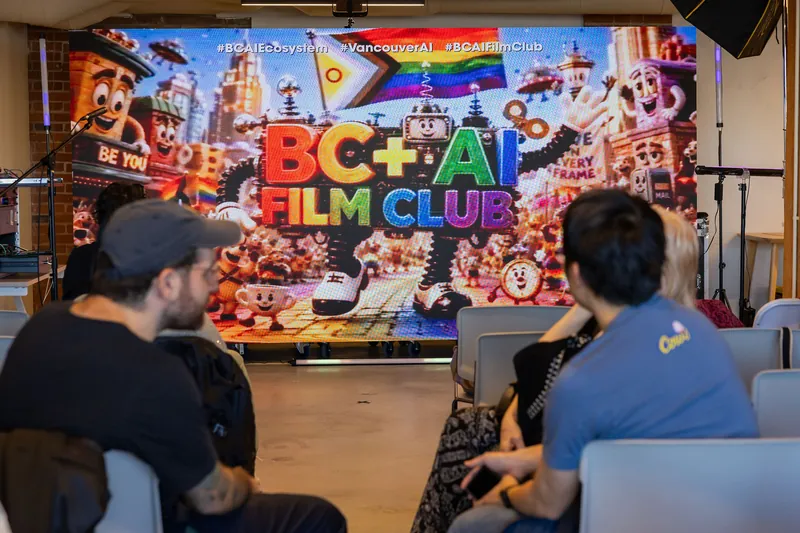
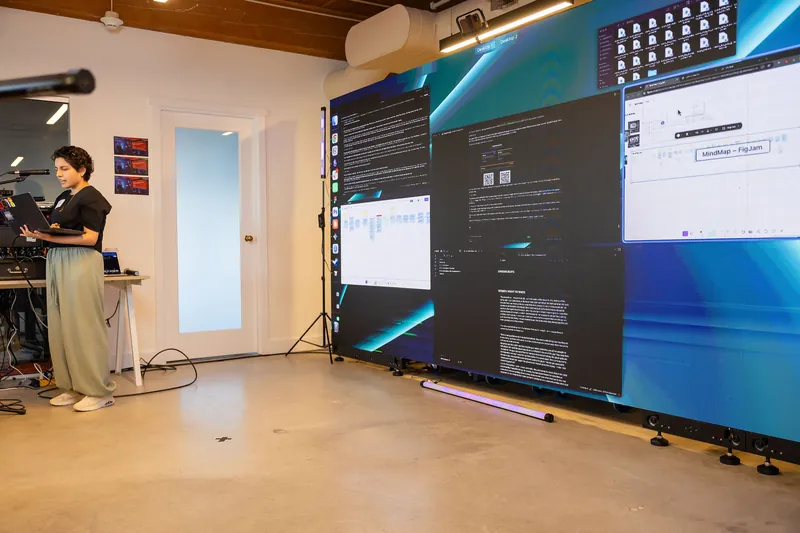
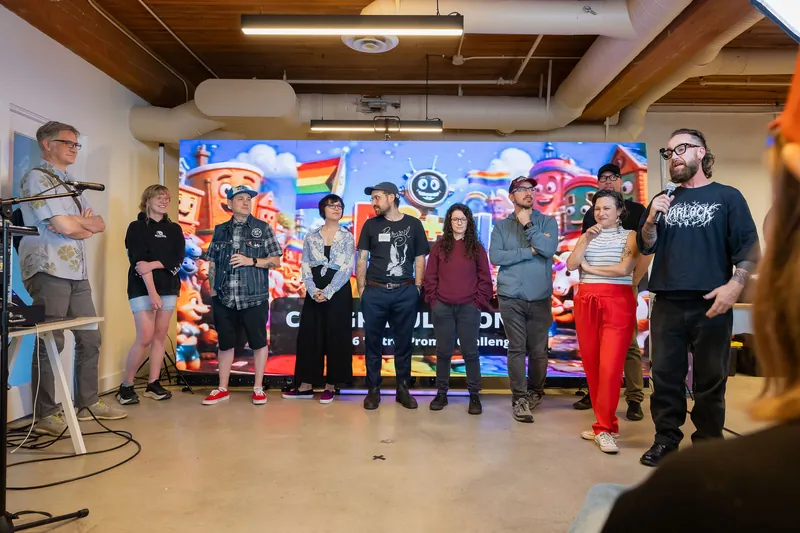
Nobody photographed the August meetup, so the pictures below are from an earlier night in the same room. The shape of the evening is the same one described here: the big Clear LED wall, a maker walking the room through a workflow, and everyone who entered the prompt challenge lined up at the front to talk about how they made their film. The full set is on the June Film Club page.
Five model releases, four of them open
Kevin Friel opened with the shortest version of a busy few weeks: five significant model releases, four of them open weight or heading that way. Minimax H3 was the headline, with people getting usable output on a twelve gigabyte card, which moves local generation out of enthusiast territory. LTX 2.5 had landed two days earlier and had pivoted from a video model into a world model, a shift driven partly by demand from robotics teams who would rather let a machine fall over inside a simulation than in a warehouse. Flux 3 was moving toward taking video, stills and audio together as reference. Seedance 2.5 was holding character consistency through large camera moves that were not practical a fortnight before.
The counterweight was hardware. Prices are going the wrong way, with the Blackwell RTX Pro 6000 roughly doubling since launch and Apple raising prices across the line, both driven by a global memory shortage. The usual bargain, more speed for less money every year, has inverted. That is the argument for open weights and owned machines, and it is not a hobbyist argument any more.
ComfyUI is the part that lasts
The most practical takeaway of the night was that the models keep changing and ComfyUI does not. A workflow built around your own purpose survives every swap underneath it, and LoRAs let you pin one exact look after the base model runs. Kevin's read, repeated the next morning at office hours, is that ComfyUI has become the de facto standard in VFX and animation, to the point that job postings now name it.
Space Opera, and the challenge as the actual engine
The prompt challenge started in January almost as a joke, a sixty second toilet paper ad. It has run every month since, through zombies and ASMR, and August was the Space Opera payoff. Submissions have grown enough that the entries screened on the main Vancouver AI Meetup stage the month before.
The range in the room was the point. One entry pushed a model toward telenovela-scale facial expression. One held on a single face long enough to build a character rather than a montage. One choreographed fight scenes by referencing real film clips, because the models still do not understand physics. One was cut entirely by agents, with no editing timeline touched at any point, using likenesses trained from community photos. Several makers were candid about cost, including one who spent about a hundred dollars in cloud credits on a ninety second piece, which is its own argument for learning to run things locally.
The organizers' observation was sharper than any single film: the people making the most interesting work often have no film background. They never learned the prescriptive way to tell a visual story, so they are inventing formats that trained practitioners would not reach for. September's challenge is Neon Gods. The brief is deliberately loose.
The two questions nobody could fully answer
A high school student asked how you make an animation about a specific community, Indigenous or Black or anything with a living culture behind it, without producing something more stereotyped than what came before. The answer that landed had three parts. Generative models hand you the tourist version of a culture. Some stories are not yours to tell. And where you do need cultural oversight, you collaborate with people from that culture rather than approximating them. A fourth point was offered as the unpopular one: the more you put yourself into the machine, the more you move what it produces, because your own perspective is an input too.
That connected straight to infrastructure. If you want models that are not built entirely from someone else's defaults, you need compute you control, whether that is a card under your desk or a community facility. It is the same argument BC + AI is making through its public compute work, arrived at from a completely different direction.
The second question came from working filmmakers with a live production problem. A prompt is an idea, and you cannot copyright an idea, so a character that originated in a prompt has no clean path to chain of title. The practical split offered was this: if you are aiming at broadcast or streaming distribution you need a hybrid approach and a demonstrably human-made character to start from, and if you are in the creator economy you can largely route around the problem. One participant went further and said she actively wants fan fiction, because the value is in the community that forms around the work rather than in selling the rights to it. The room agreed on one thing: this deserves its own night. An IP and law session is going on the calendar.
New roles with no name yet
Running underneath both questions was a jobs conversation. There is an emerging role sitting between creative direction, production and technical AI work, closest current label being orchestrator or systems architect: someone who can take creative, story and audience intent, match it to a set of tools, and hold the client relationship. Nobody has settled on a title. That is the opportunity. The work is being posted before the job description exists, which means the people doing it now get to define it.
Screenings
Multimodal Media Lab showed a work in progress, a twenty two minute documentary assembled from extensive interviews and fifty years of physical archive material. The night closed on Zach London's thirty minute AI film Pomegranate, from the Gossip Goblin channel, which Kevin called a new high watermark for the form: a grotesque take on the human condition turned into something genuinely beautiful. Thanks as always to Clear LED for the screen the club uses every month.
Where this goes
BC + AI passed three hundred paid members the week of this meetup. Film Club runs the second Thursday of every month at Multimodal Media Lab, and there is a WhatsApp channel where most of the between-meetup work actually happens. If you want in on Neon Gods, or you just want to watch and vote, the door is open and no film is required.
RSVP to the next Film Club · Become a member · Futureproof Festival
No photographer covered this meetup, so this page has no gallery. If you shot photos or video that night, get in touch and we will add them.
What this is
AI Film Club: 08/13 is a BC + AI community event recap with photos, recordings, and details from the Vancouver AI ecosystem.
Who it is for
AI builders, researchers, policy people, creatives, educators, students, and citizens looking for practical local AI community.
When and where
Thursday, August 13, 2026, 6:30 PM – 10:00 PM PDT at 375 Water St, Vancouver, BC V6B 5C6, Canada.
How to join
Browse upcoming Vancouver AI events, RSVP on Luma, or become a BC + AI member to support the association behind the gatherings.
See upcoming eventsLatest Luma Details
- Event:
- AI Film Club: 08/13
- Date:
- Thursday, August 13, 2026
- Time:
- 6:30 PM – 10:00 PM PDT
- Location:
- 375 Water St, Vancouver, BC V6B 5C6, Canada
- Organizer:
- BC + AI Ecosystem Association
- Status:
- Completed
- Attendance:
- In person