
Picture a house of cards built atop a pyramid of champagne, flutes. Beautiful. Intricate. And terrifyingly fragile.
That's our digital economy right now. Not because it's weak, but because it's intricate. Every card supports another, every level enables the next. We built this masterpiece deliberately, carefully, over decades. Tax credits that drew studios. Schools that trained talent. A virtuous cycle of creativity and innovation.
Reality Check: Those jobs powering our creative economy?
They didn't exist when Friends was still on air. We built
this. All of it. And now AI is sitting on our couch,
raiding our fridge, and rewriting our house rules.
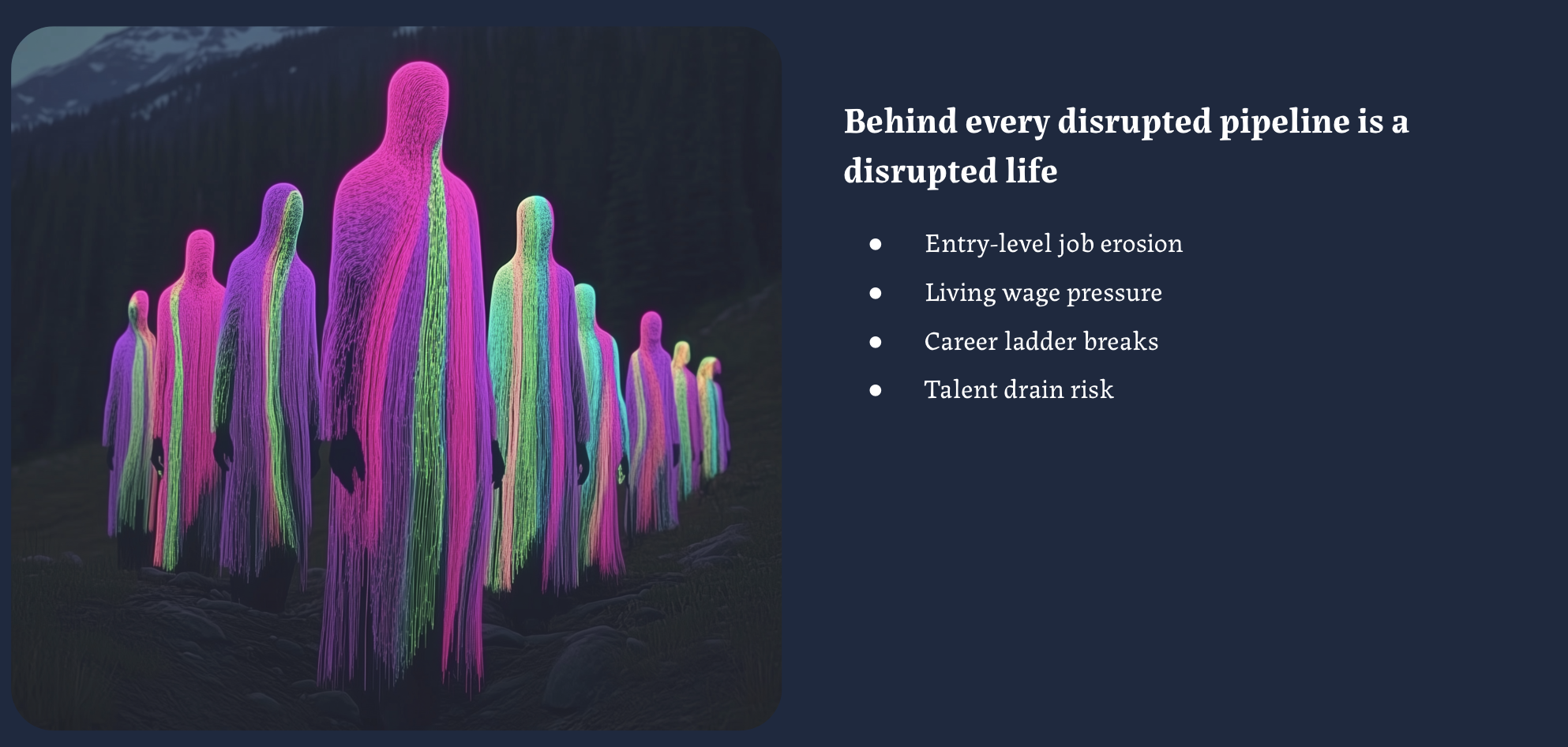
Here's the hard truth: The entry points that built our industry are disappearing first. Junior artists, entry-level developers, and support roles, the jobs we used to use as stepping stones, are becoming stepping stones to nowhere.
But this isn't a story about loss. It's a story about opportunity, if we're brave enough to seize it.
Scene: Last week, I watched a junior artist who used to
spend weeks modeling environments do it in minutes with AI.
But instead of being replaced, they're now art directing
the AI, pushing it to create things no one has ever seen
before. That's the future we need to build toward.
We need to double down in three critical areas:
First: Community and Creativity
Our greatest strength isn't our technology. It's our people, the connections between them, and the crazy ideas that spark over coffee and become companies. We need to invest in these spaces, these moments, these possibilities.
Second: Education Evolution
We can't keep training people for jobs that won't exist. We need to prepare them for jobs we haven't imagined yet. That means reinventing our educational pipeline, building AI literacy, and creating new pathways to success.
Education Story: An Emily Carr graduate told me recently,
"I'm not learning tools anymore. I'm learning how to learn
tools." That's the mindset we need to cultivate.
Third: Infrastructure Investment
The tax credits that built our industry? They need to evolve. The support systems that grew our companies? They need to adapt. We need to build for tomorrow while preserving what works today.
But here's the real opportunity: We can build something better than what we had before.
Vision: Imagine an ecosystem where AI amplifies creativity
instead of replacing it. Where technology serves humanity,
not the other way around. Where we're not just keeping up
with the future. We're defining it.
This isn't just about survival. It's about leadership. While the rest of the world debates AI's impact, we can show them how to embrace it without losing our soul.
Here's what we need from everyone:
- Creators: Embrace AI as a collaborator. Document your journey. Share your learnings. Build in public.
- Companies: Invest in talent development. Support community initiatives. Think beyond the next quarter.
- Community: Strengthen connections. Mentor newcomers. Share resources. Build together.
- Government: Update support programs. Fund innovation. Enable experimentation. Protect what works.
Closing Beat: The next chapter of BC's creative technology
story isn't being written in Silicon Valley boardrooms or
government offices. It's being written right now, in coffee
shops and community spaces across our province. By people
like you, making choices about what to protect, what to
evolve, and what to build.