29 Months, 200 Pounds of Meat, and the AI Commons
You had to be there. But if you weren’t, here’s the room.
Start with the May 27 recap set
This article is part of the Vancouver AI Meetup #29 recap package: the event archive, the speaker-focused recaps, and the full Michelle Diamond photo gallery.
- 29 Months, 200 Pounds of Meat, and the AI Commons — currently reading
- A Trillion Pages and a $5K Summer
- Tofu Isn't Failed Meat: Rachel Horst's Anti-Slop Machine
- May 27 Vancouver AI Meetup event archive
- Original May 27 Luma listing
- Michelle Diamond photo gallery
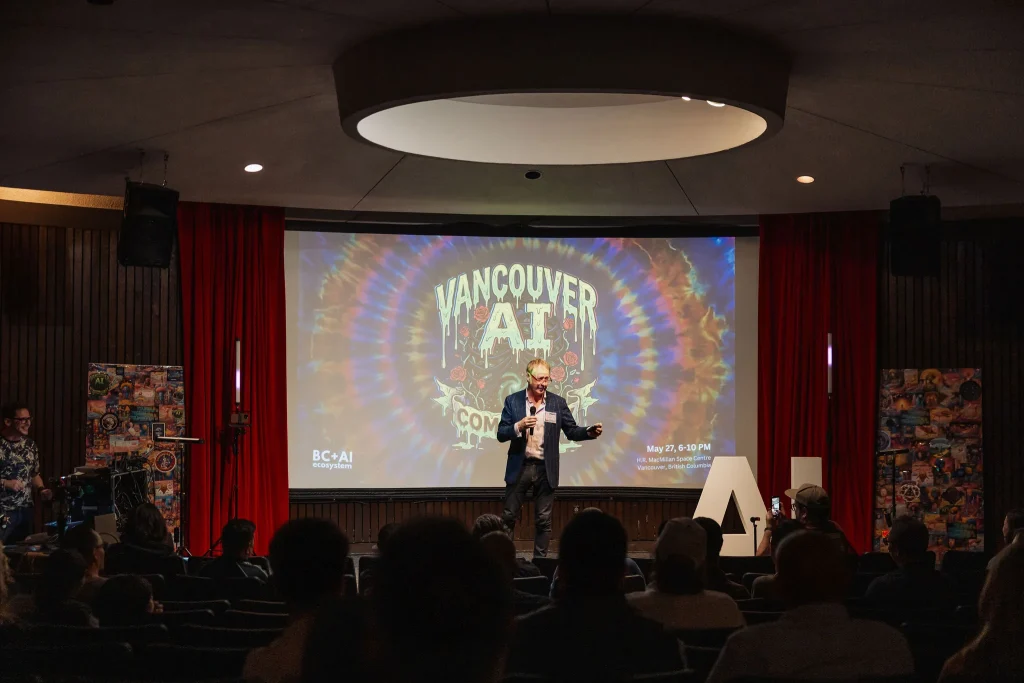
Twenty-nine months in a row now. Same crew in the second row with their names basically carved into the seats. About two hundred pounds of barbecue in the lobby. And on the screens behind me, a theme I’ve been chewing on all month: Building the AI Commons. Not open source as a vibe. The commons as a strategy. The shared layer of tools, archives, models, stories, and institutions that should not get fenced off by a handful of platforms.
The wild part of the night is that the two keynotes never rehearsed together and said the same thing in two different languages. An archivist and a fiction engineer, both telling us the same truth about what’s worth keeping.
Let me walk you through it.
We opened on the protest, and on the land
A few days before, a bunch of us walked in the anti-data-centre demonstration. Good job Finn for being out there. There was a $1 billion federal announcement for data centres in Vancouver with barely any consultation, and a lot of people are angry about it for good reasons. I went down with signs, not to perform, but to listen and build some bridges with people who feel pissed off about this tech.
Here’s where I land, same as I’ve said from that stage before: the protestors were as wrong as the hypers and the boosters. The real answer is to hold the contradiction.
“I’m more creative, productive, and powerful than I’ve ever been in my whole life. But also these things are trained on the stolen works of mankind, full of misogyny, homophobia, and racism, grossly inefficient with their use of water and power. Both those things can be true at the same time.”
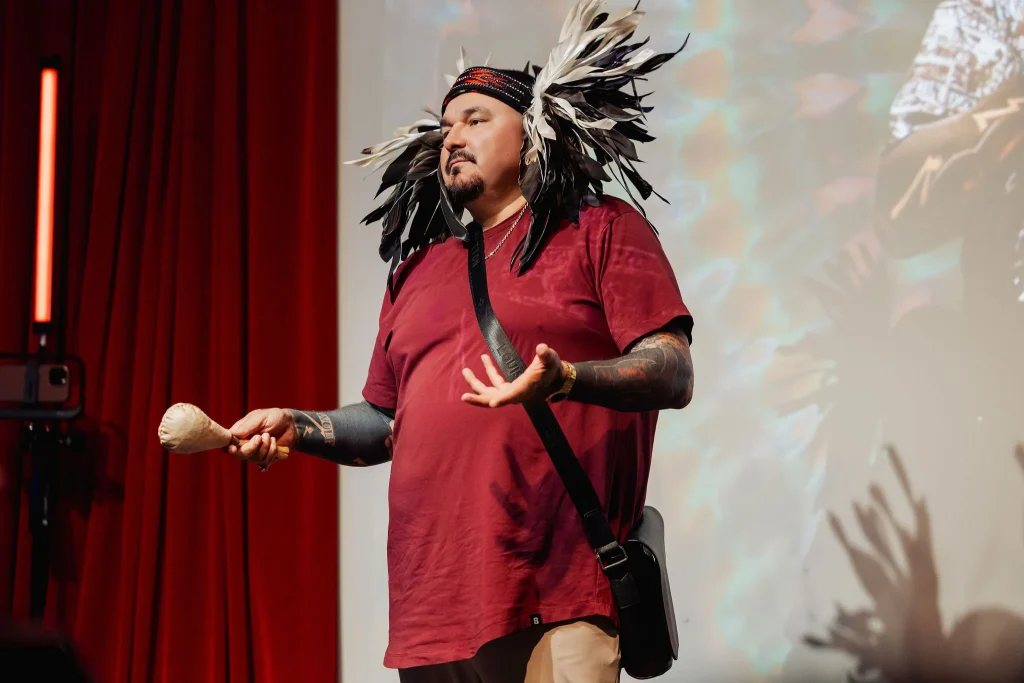
Then I did what matters more than a land acknowledgement. I invited my friend Gabriel George of the Tsleil-Waututh Nation to open us. Gabriel shared a prayer and an eagle song, and he told us about his great-great-grandmother, who lived at this very village before her family was forced out by barge to the reserve where he’s registered now. Hosting him back on this land is part of the reconciliation work.
And then he gave us the through-line for the whole night without knowing it:
“There was a prophecy from the Hopi people that one day a web was gonna cover the earth. And they said that in this web, our Indigenous people would play an important role. Many of us now look at that as the internet.”
The Sḵwx̱wú7mesh towers at Sen̓áḵw are the longhouses going up into the sky. The web is here. The question is who it actually serves.
Rachel Horst built an anti-slop machine, and it was my favorite talk in 29 months
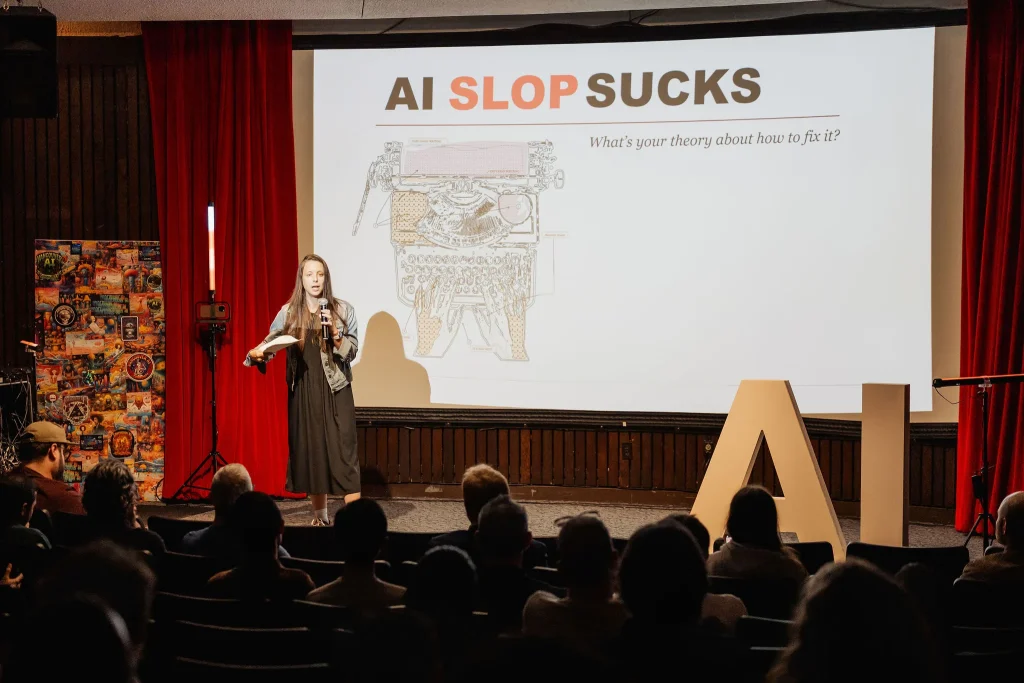
I met Rachel Horst in a different lifetime, when I was a rock and roll photographer and she was a rock star out on the Sunshine Coast. She came back into our world with a PhD and a serious interest in creative AI, and on this stage she delivered Building an Anti-Slop Machine.
We broke the full breakdown out into its own post, because it deserves one. The short version: slop isn’t bad writing. Bad writing has a human reaching for something and missing, and as an educator she actually wants bad. Slop is worse than bad because it’s interchangeable. It gives you the shape of meaning without the meaning. “Death by fine.”
Her fix is to move authorship upstream into the system: eight agents, real constraints, tweet-length seeds, three visible drafts per story, full markdown traces you can inspect. And the line that landed hardest:
Tofu is not failed meat. LLMs are not failed humans.
Rachel Horst
Stop dressing the model up like a turkey. Cook with what it’s actually good at.
When she finished I told the room the truth: that was my favorite Vancouver AI talk in 29 months, and we’ve had some bad-asses up here. Read the Rachel keynote recap.
The community runway
Between the keynotes, the room did what it does. People stood up and shared real work.
Simon Hayward read a life sciences poem and pitched his home dinners for the life sciences crew (Intellomx, our monthly sponsor, is his). He also walked us through a custom-GPT automation that did not go the way he planned, live, which turned into an accidental masterclass on prompting.
Nessa got a shout for quietly co-organizing the AI and education subgroup over at Ethọ́s Lab. She’s shy about it. She shouldn’t be. That subgroup is real infrastructure.
Kevin runs our AI Film Club and reported back from the fifth one, featuring Vancouver AI artist Dorothy Pang, who keeps landing on top-50-women-in-AI lists and getting flown to SXSW. Next Film Club is June 11, with a guest who’s 99% across the finish line (look up the GTA-V-rendition-of-Vancouver clip that just went viral).
Andrea Mills brought the institutional commons, and a fellowship
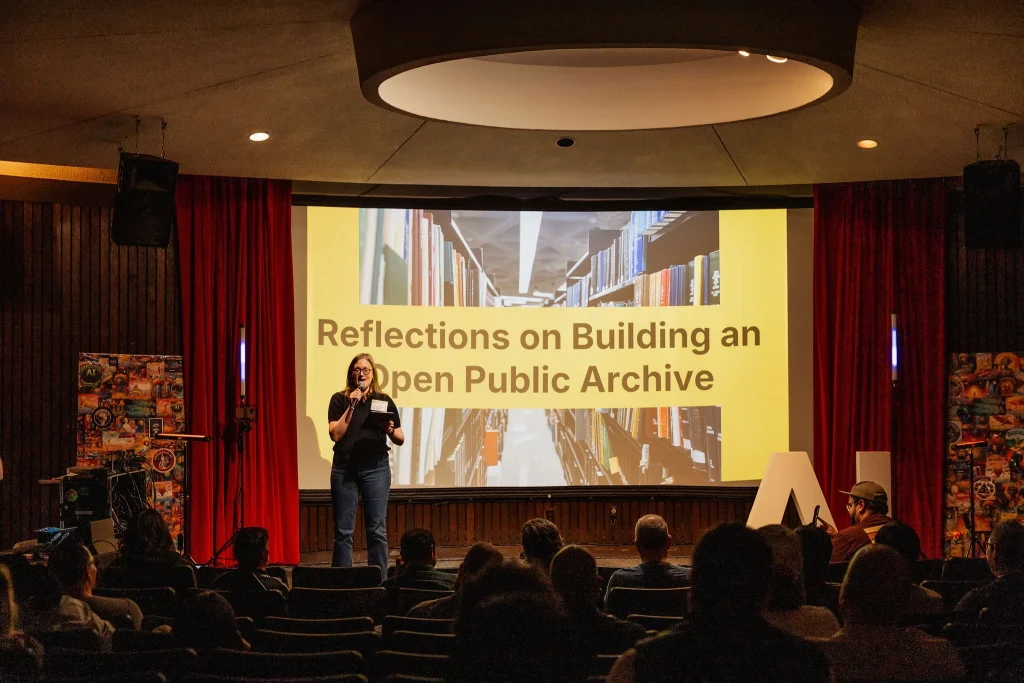
Then Andrea Mills, Executive Director of Internet Archive Canada, gave us the long memory.
Thirty years of preserving the web. Over 200 petabytes. A trillion pages in the Wayback Machine, which she rightly called the intellectual output of millions of people. Roughly 25% of any link saved online eventually moves or disappears, so this is not a backup plan, it’s a public good.
“A cloud is just someone else’s computer, and you better really, really trust that person.”
She didn’t flinch on the hard part either. AI scraping is a DDoS attack by another name. Publishers are pulling digitized holdings they no longer even own the originals of, locking them up behind exclusive AI deals, sometimes forcing the Archive to take down the only surviving copy. Same playbook as Google Books and the newspaper paywalls. And her genuinely controversial librarian take: even AI slop belongs in the archive, because people are making real decisions based on it and it’s the record of the moment we’re living in.
“We don’t have the concept of done.”
Two things to act on. First, go do your homework: there’s a .ca web archive kiosk on the fourth floor of the Vancouver Public Library downtown, open from the end of this week. Big screen, a gamepad with a microphone, no keyboard, semantically organized by subject. Built by Internet Archive Europe and Switzerland and landed here in Vancouver.
Second, the thing she slipped in like a true Canadian: Internet Archive Canada and BC + AI are running a $5,000 summer fellowship, the AI Builders Fellowship, for a data scientist, ML person, or storyteller to build real tools, visualizations, and data storytelling on top of the archive. As Andrea put it, she wants the servers stressed because people are using them, not just scraped again. This is the most legit dataset in the world. More on how to throw your hat in below.
Announcements, rapid fire
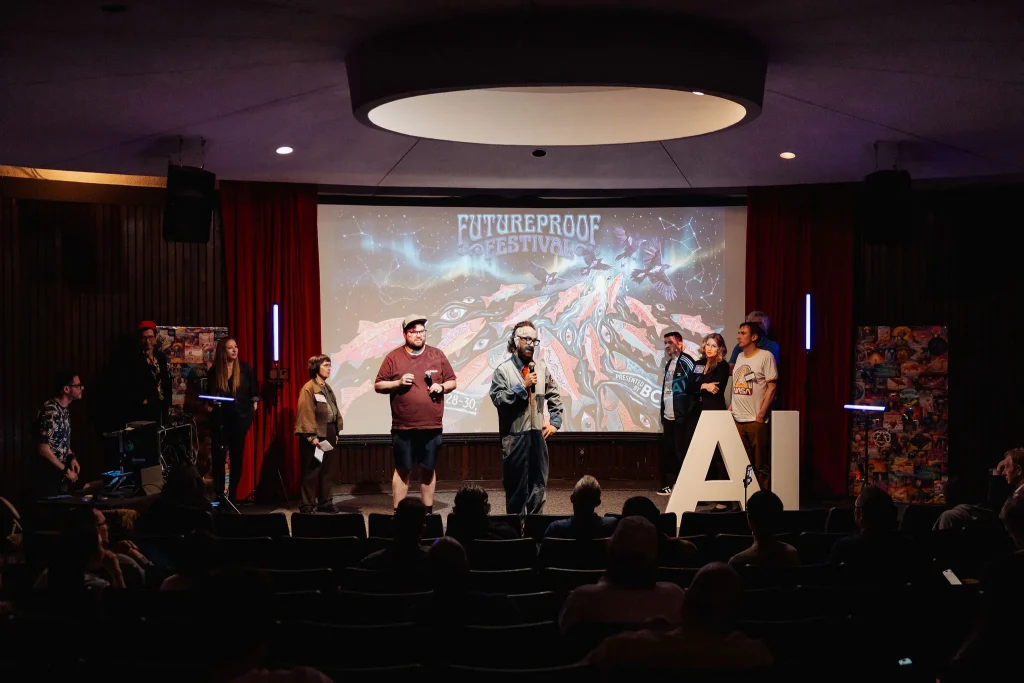
We packed everyone into the light for photos and ran the runway:
| Who | What |
|---|---|
| Kris | Future Proof Festival, a three-day conference October 28-30 at the Space Centre: films, performances, keynotes, demos, robot wars. Darby is the social lead. |
| David | The demo pit returns at the June 25 meetup. Quirky works-in-progress in the lobby during networking. Sign up on the Notion. |
| Darby | BC + AI social rollout (disposable cameras, the listicle is live). Our YouTube is about to crack 1,000 as the keynote videos drop. |
| Gord | Data for Good has 1,600 data volunteers looking for nonprofits to help. New AI-mentoring track Martin named “Data Foundations.” Free for nonprofits. |
| Philippe Pasquier | DFR with Meta Creation Lab at Future Proof. Also: he got knighted by France for his creative AI lab. He’s officially a chevalier. |
| Erica | Ministry of Next, and a hard story about getting dogpiled online for using generative models in her art stack. A community member also told us she found us by Googling “AI positive community in Vancouver.” That one made my night. |
| Finn (with Aaron and Ali) | Their high school robotics team came back from Houston rated #1 in Canada and has put in a bid to be Team Canada, competing against teams with ten times their budget. Donate through the BC + AI nonprofit. |
| Tanya | MAC (Mind, AI and Consciousness) deep dive June 18 (already full), plus the new MAC Lab in July: “Minimal Viable Consciousness.” |
| Matt | Released Swarm on GitHub this week: a loop-based creativity tool that inserts pauses for human judgment. Plug it into your agent. swarmloop.xyz. |
| Brenda | Two free founder pitch workshops, June 10 at 4pm and June 25 at 8am. |
We close how we always do
The Space Centre tapped me on the shoulder to say it seemed awesome but it was about time to go, and I reminded him we’ve got the room till 10:30. We earn that trust by cleaning up after ourselves. Keep it going.
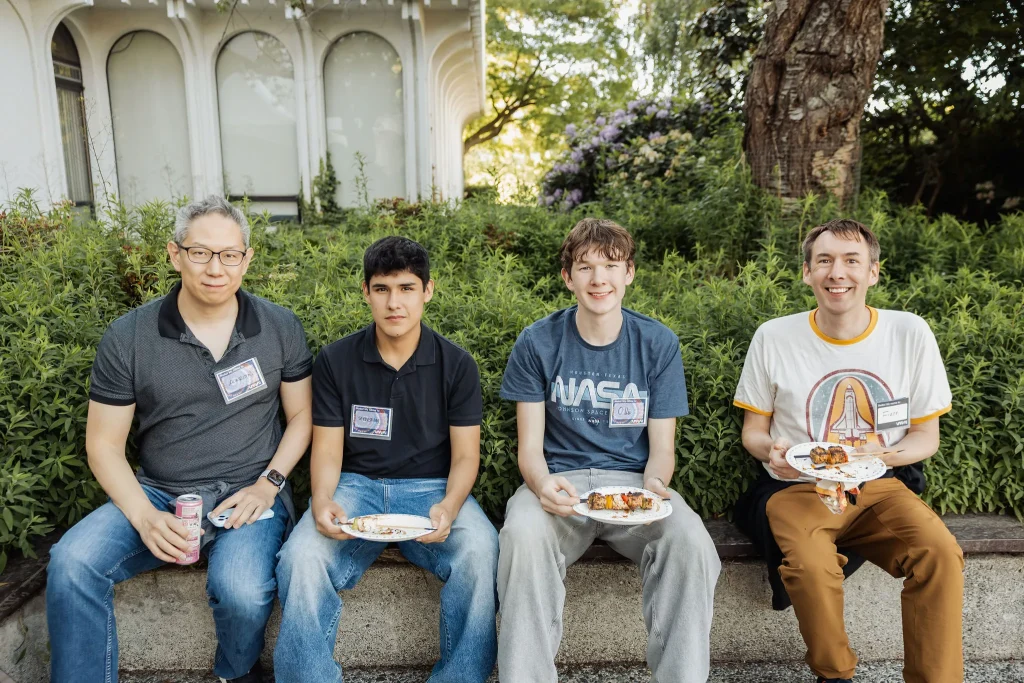
And the cookies. Eliza Schwarzman and Noah Eski just graduated high school this week, they’re members of this community, and they’ve got a cookie business. We ordered $500 worth for everybody. That’s the whole thing in one gesture: the people who’ll build the next decade of this are already here, already shipping, and we feed them.
Thank you
To the people who make it a room and not just an event: Victor (Pixel Wizard), Alex, the second-row regulars, Kush, Camp, Matthew, William, Wayne, Crystal, and everyone who grabbed a mic and shared real work.
To our keynotes, Rachel Horst and Andrea Mills, two heavy hitters who were generous with their time.
To Gabriel George for opening us on his ancestors’ land.
And to our sponsors and partners, who put their money where their mouth is: Internet Archive Canada, Rival Technologies, Intellomx, TheUpgrade.ai, the H.R. MacMillan Space Centre, Ethọ́s Lab, and the Meta Creation Lab at SFU.
What’s next
- June 11: AI Film Club
- June 18: MAC deep dive (full)
- June 25: Vancouver AI Meetup #30 + demo pit returns
- July: MAC Lab: Minimal Viable Consciousness
- October 28-30: Future Proof Festival
Join us through the BC + AI Luma calendar, plus the BC + AI WhatsApp, Discord, YouTube, LinkedIn, and Instagram. If you build with data, story, or visualization, watch this space for the AI Builders Fellowship. And if you’ve never come before: yes, we are an AI positive community in Vancouver. Somebody Googled exactly that and found us. Come say hi.
The commons doesn’t build itself. We do.