Tofu Isn’t Failed Meat: Rachel Horst’s Anti-Slop Machine
I met Rachel Horst in a different lifetime. I was a rock and roll photographer, she was a rock star, and her label flew me up to the Sunshine Coast to make some film photos with her. I thought she was the coolest person in the room then. Living on the coast, living on the reservation, teaching music, raising a family. So when she came back into our world a couple years later with a PhD in Language and Literacy Education and a real interest in creative AI, I was all ears.
Start with the May 27 recap set
This article is part of the Vancouver AI Meetup #29 recap package: the event archive, the speaker-focused recaps, and the full Michelle Diamond photo gallery.
- 29 Months, 200 Pounds of Meat, and the AI Commons
- A Trillion Pages and a $5K Summer
- Tofu Isn't Failed Meat: Rachel Horst's Anti-Slop Machine — currently reading
- May 27 Vancouver AI Meetup event archive
- Original May 27 Luma listing
- Michelle Diamond photo gallery
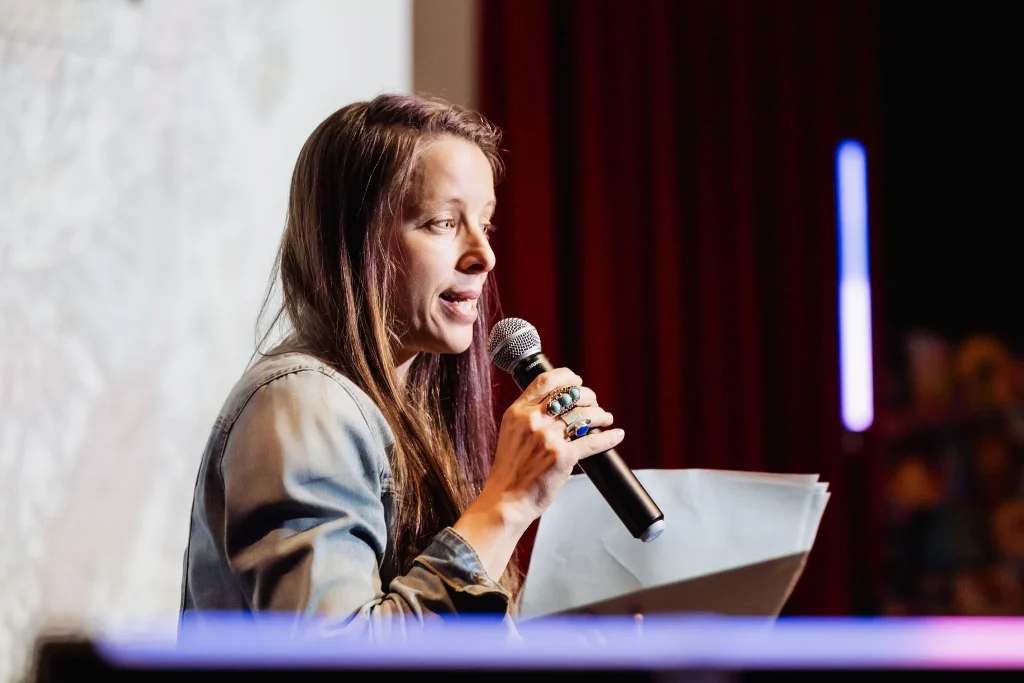
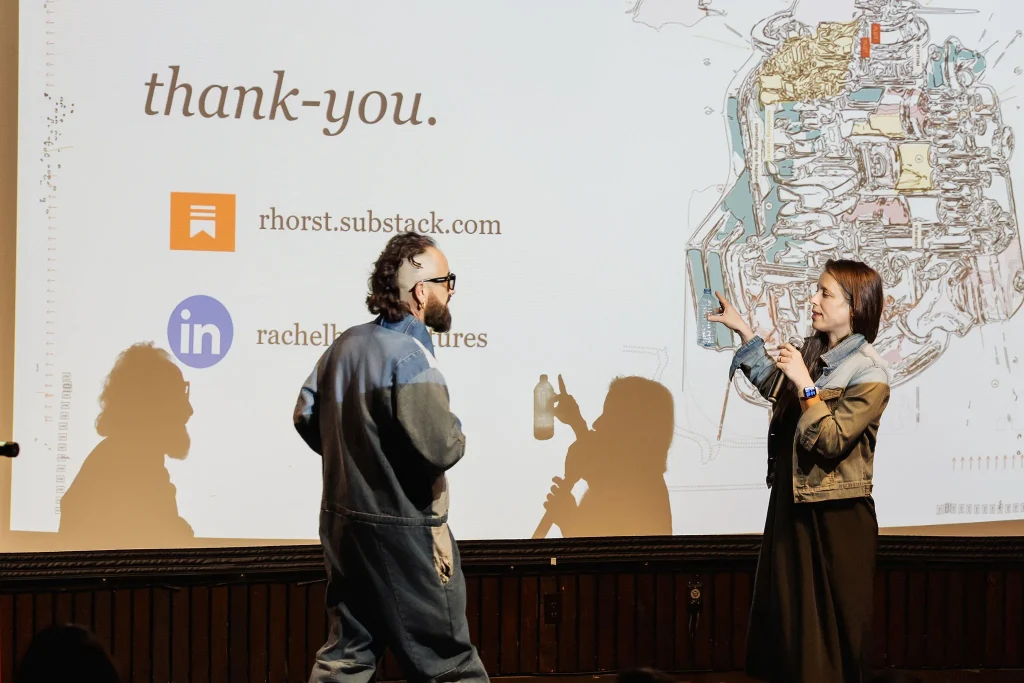
At Vancouver AI Meetup #29 she got up at the Space Centre and gave a talk called Building an Anti-Slop Machine. When she finished I told the room the truth: that was my favorite Vancouver AI talk in 29 months, and we have had some bad-asses up here.
Not because it was anti-AI. Because it was pro-human process, in public, with the receipts showing.
Here’s what she actually said.
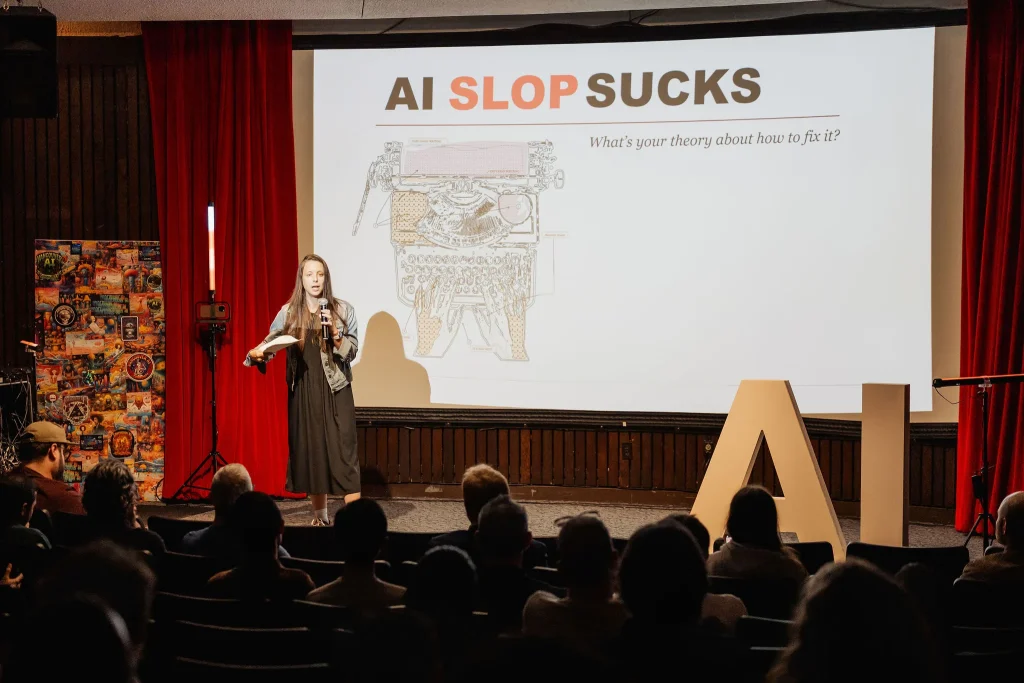
The provocation: “AI fiction sucks. What’s your theory to fix it?”
It started with a contest run by a company called Hypers. The provocation was blunt: AI fiction sucks, what is your theory of how to fix it? You submitted an essay with your theory. If they picked you, they handed you $280 Canadian of compute to go build and test your system.
Rachel reframed the question on the way in. This isn’t really about fiction, she said, and it’s barely about AI. It’s about how we keep making things that mean and matter in a world drowning in endless, meaningless, interchangeable stuff. Everyone in that room uses AI in their work. Everyone is already pushing against the slop.
The name Hypers is itself the lesson. It’s hype plus superstition, and it names something Rachel studied in her doctorate: hyperstition, the loop where certain fictions get repeated so often they start organizing behavior, insert themselves into the real, and become real. We train AI on our stories, the AI trains behavior, the behavior produces output, the output gets reinserted into the real. Fiction trains models trains culture trains fiction.
Slop isn’t bad. That’s the whole problem.
Here’s the move that made the talk. Rachel’s answer to “why does AI fiction suck” is that it doesn’t. It’s fine.
“It’s death by fine.”
It has structure, style, imagery, emotional beats. It works. And that’s exactly what’s wrong with it. So she drew a distinction every educator in the room felt in their bones: the difference between something that is bad and something that is slop.
Bad is awkward, strained, embarrassing, overdone or underdone. But bad has a human pressure in it. Bad tells you what the person wanted to do and couldn’t quite pull off. As teachers, she said, we want bad in the submissions. We can work with bad.
Slop is offensive because it lacks intentionality. It's too easy. It works. It gives you the shape of meaning without the necessity of meaning.
Rachel Horst
The secret heart of slop is fungibility. Swappability. Nothing in it has to be there. (Her one beloved exception: Shrimp Jesus, which she’ll defend as favorite slop forever.)
The machine: eight agents and a paper trail
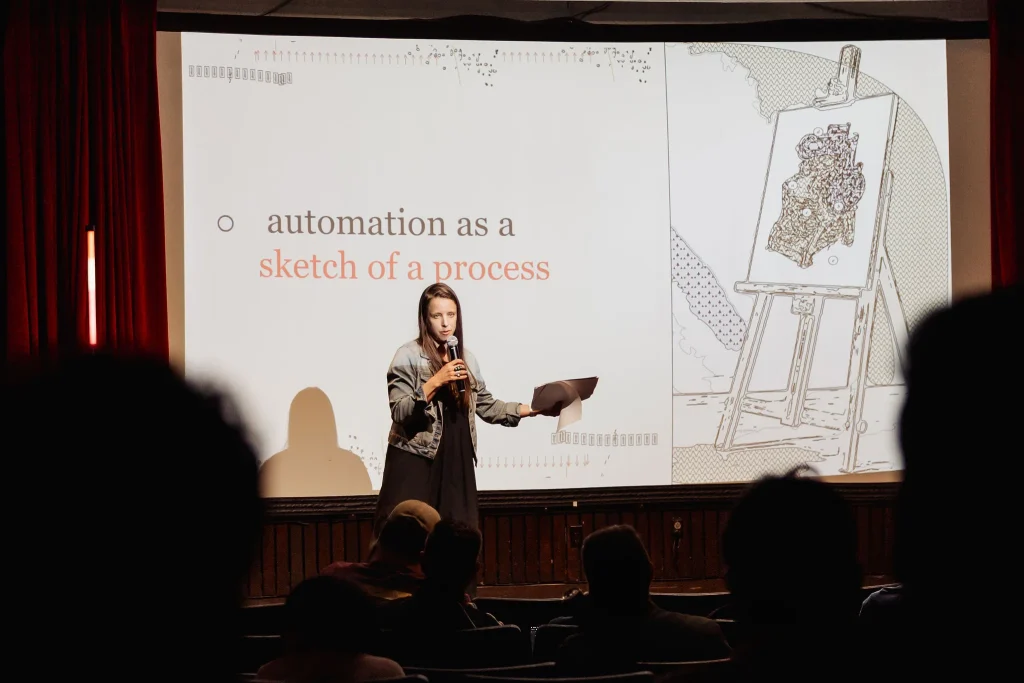
So she built a fix. An end-to-end fiction system, and there are eight agents in it.
A few of the parts she walked us through:
- A character agent named Francis (the name matters to her) that’s multimodal. It pulls three images at random from a bank of 67 portraits she sourced from Unsplash, all openly licensed, with the photographer credits and metadata retained.
- A theory agent that pulls real papers into the process.
- Tweet-length story seeds as the only human input.
- Three drafts and a final PDF per story, plus a file structure you can open up: the drafts, the characters, the notes, the letters, the theory deposits, the faces. You can watch the story emerge.
The contest rules forbid human touch-up of the output. So all the authorship has to live upstream, in the constraints and the agents and the traceable files, not in a final human polish. That’s the thesis made into software: when you can’t fix the paragraph by hand, you have to relocate your craft into the system that produces it.
Margie the archivist (and the bridge to Andrea)
Then she told us a story the machine wrote, called The Hand That Will Not Lift.
The seed: the custodian of a regional archive is told the AI will preserve everything. She begins quietly misfiling documents, testing what counts as preservation when nothing can ever be lost.
The character is Margie, custodian of an almost magic-realist regional archive holding all the paper of a community: the parking tickets, the personal letters, the pins, all of it. Rachel never told the system to make it magic-realist. It just came out that way. Margie helps bring in an AI system meant to preserve and retrieve everything and, essentially, to automate her job. The story ends with her suspended between action and inaction, her father on the phone, unsure whether to answer with the truth, her hand still refusing to lift.
It’s a story about preservation versus protection. The archive as an ethical practice, which is a deeply human thing, set against AI as the end of forgetting.
If that rhymes with something, it should. An hour later Andrea Mills of Internet Archive Canada stood on the same stage and talked about real takedown requests, real publishers locking up real digitized books, and the actual ethics of what a public archive chooses to keep. Same ethical knife, two different domains. Rachel’s fiction and Andrea’s institution are asking the same question from opposite ends.
Tofu is not failed meat
Here’s the metaphor people are going to quote.
Rachel said the system got boring when she forced it to imitate literature. All convention, no intention. It sounded like writing without being about anything. It got interesting the moment she stopped making it pretend to be human and let it do what it’s actually good at: precision, specificity, unexpected adjacencies. It could make a mother speak Romanian to her child. It knows every side street in Sudbury, Ontario.
So she thought about cooking.
“Tofu is not failed meat. LLMs are not failed humans.”
When you dress tofu up like a turkey and call it bacon, it fails, because you taste for the thing it’s pretending to be and you always find the lack. The icky feeling you get reading LLM output is you reading it for a human voice. But it’s computational, not human, and that’s its strength. The question isn’t how to hide the machine. It’s how to cook with the medium that is the LLM and create the conditions for its strange, specific, non-human capacities to come through, carried by human care and intention.
Three takeaways
- Slop is diagnostic. When the output is slop, it’s showing you exactly where your process got too generic, too smooth, too automated. Look at it harder.
- Move authorship upstream. If you can’t fix it in the paragraph, fix it in the system: the constraints, the agents, the seeds, the traces.
- LLMs are not failed humans. Stop grading the medium against a thing it isn’t. Cook with what it is.
And the line that ties it to every builder in the room:
“You can’t automate a process you don’t understand.”
I said it back to her on stage and she nodded: to automate something, you have to have a theory of the thing. That’s the assignment.
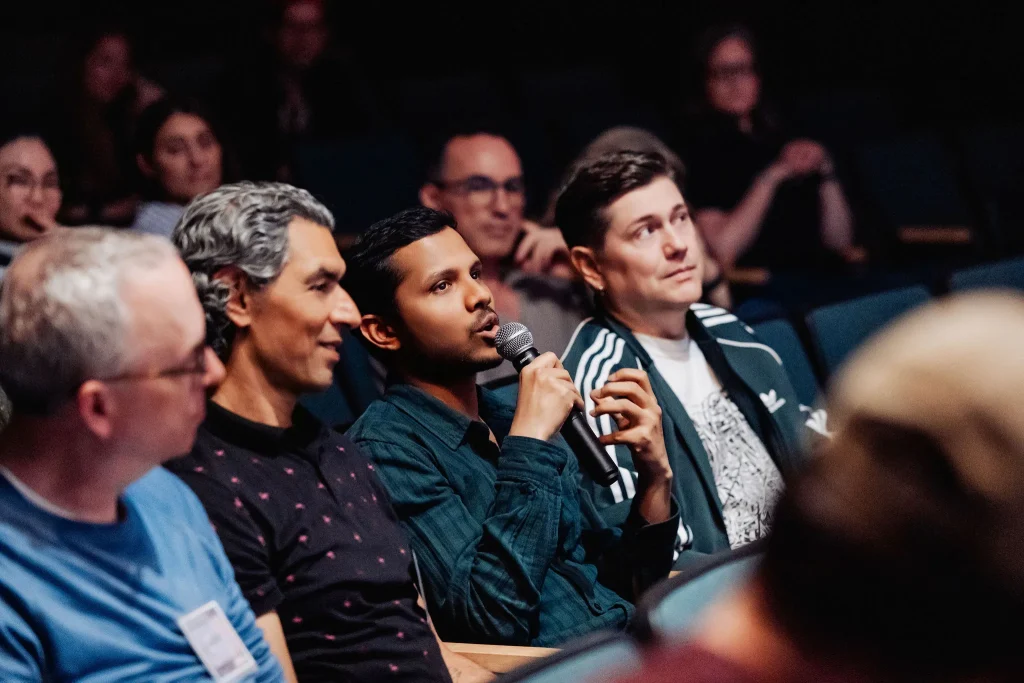
The Q&A was its own talk
We kept her up there and the room came alive. Kush pushed on taste and where it comes from. Philippe got into meta-creation. Finn drew the line to a card game as an analog language model. And Kevin, who just spent six months in Hollywood working with a company building agentic movie-writing tools, pointed out how much of this overlaps with where screenwriting is quietly heading. Somebody raised shame, and Rachel reframed student work as a transition-period artifact rather than something to be ashamed of.
That bridged into a line I keep coming back to:
“Experts agree coding has been solved. What hasn’t been solved is the qualitative stuff.”
The qualitative stuff is the whole game now. Rachel just showed us one way to engineer for it instead of pretending it’ll show up on its own.
What’s next
She left us a gift: every diagram in the talk was made with a vibe-coded diagramming platform she’s been building, with no AI in the diagrams themselves, AI only used to build the tool. Nessa talked her into putting up a tutorial. She’s still waiting on the contest adjudication for her favorite story, and she’s weighing whether to publish the whole anti-slop system on GitHub so others can run it, fork it, and reseed it.
If she does, fork it. Build your own. Then come show us at a Vancouver AI meetup or in the AI and education subgroup over at Ethọ́s Lab, where this work has a home (thank you, Nessa, for co-organizing it). The next monthly is June 25.
Thank you, Rachel. Tag @UBC MET and Hypers if you’re sharing this. And tell us what you cook.