A READING ROOM FOR THE PUBLIC RECORD
Look closer.
Follow the source.
A page can become a question.
A place can become a way in.
Three companions to Jacob Ortiz’s and Daniel Shavit’s fellowship projects. Pick something up and see what it tells you.
01 / JACOB ORTIZ · THE ARCHIVE ARGUES WITH ITSELF
Two pages.
A better question.
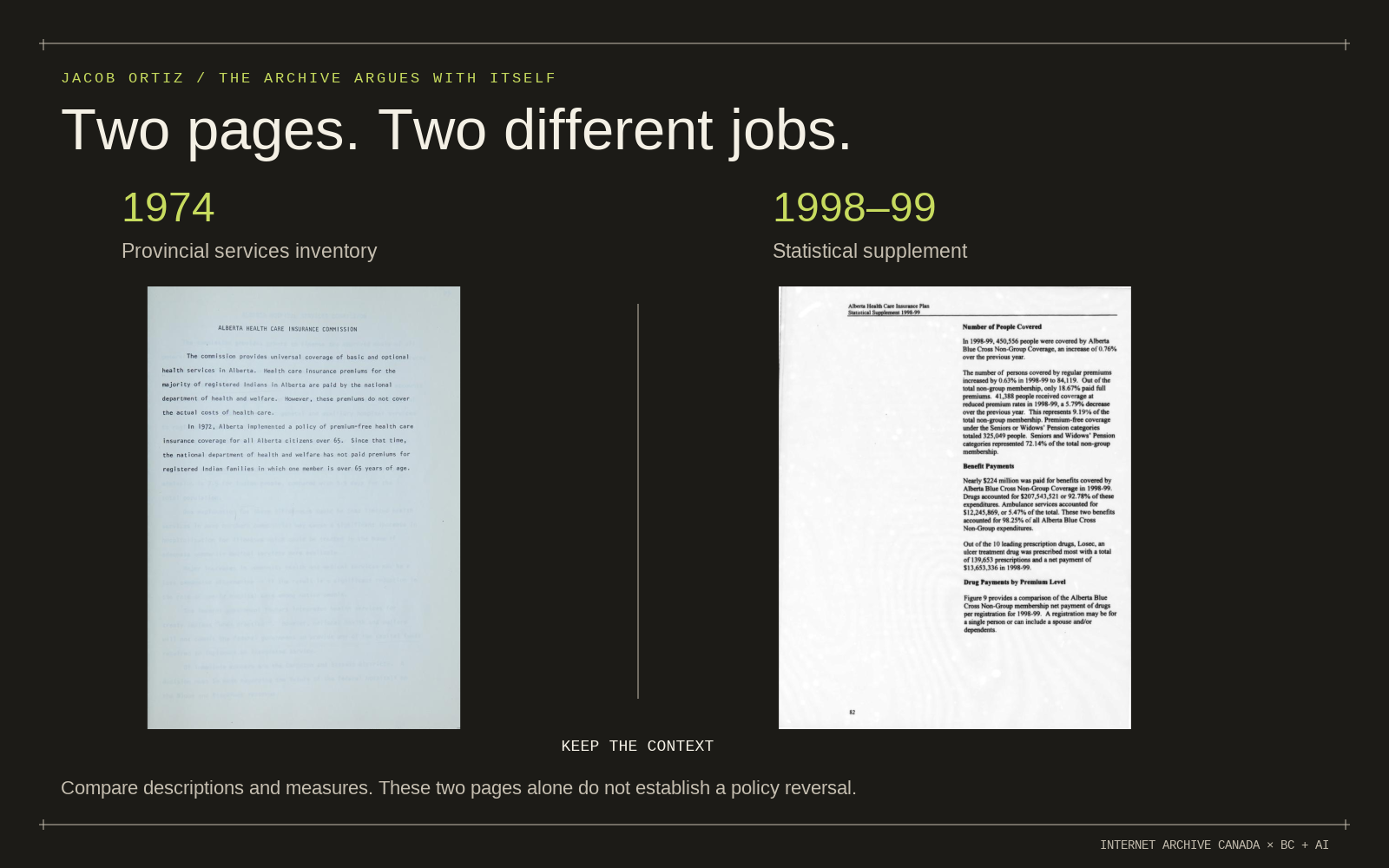
Alberta health coverage, described in two different kinds of document. Bring the pages together. Keep their context attached.
Two original scans. Select a page to enlarge it.
Alberta Health Care Insurance Commission
Alberta Health Care Insurance Plan
WHAT THE FIRST PAGE DOES
Describes coverage.
The inventory explains the commission’s services and who pays certain premiums. Read the rest of the paragraph, too.
WHAT THE SECOND PAGE DOES
Counts one program.
The supplement reports membership and spending for Alberta Blue Cross Non-Group Coverage. Its scope is narrower than the whole health system.
The 1974 scan contains historical government terminology for Indigenous peoples. The source files are unchanged. Night reading only changes how the scans appear on screen.
02 / DANIEL SHAVIT · TALE OF A CITY
A city is more
than one layer.
An outline gives you a shape. Height gives it another dimension. A council record gives you something to read. Trace how those parts meet.
Choose a marker, or take a short tour through the layers.
Conceptual block. These shapes and heights are illustrations, not measured Vancouver data.
04 / READ TOGETHER
A point is a place to begin.
Use a place to find a record, then open the source and read what it actually says. A location match does not establish cause.
Building dates describe surviving buildings. They do not reconstruct the complete historical city.
Explore Daniel’s Vancouver map Read the pipeline’s data notes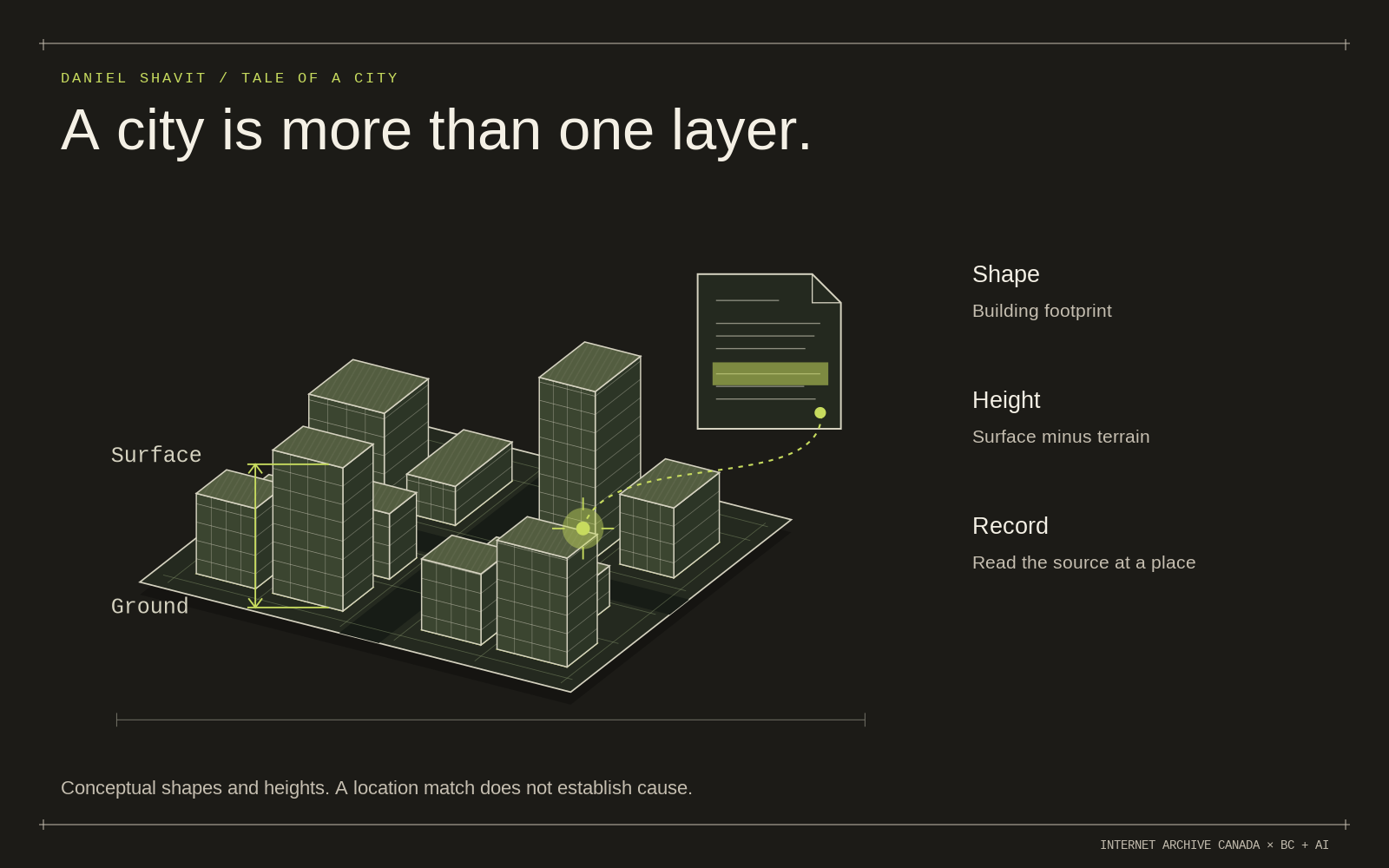
03 / THE WORK BEHIND THE TOOLS
The record didn’t
digitize itself.
A public record passes through many hands. Open a stop in the relay to see whose work makes the next step possible.
01Make the recordPublic servants+
Reports, minutes, and registers were created for particular public purposes. Their wording, authorship, and original context remain part of the evidence.
02Keep it availableLibrarians and archivists+
Libraries, digitization staff, and Internet Archive Canada preserve and describe material so people can find and read it.
Meet the preservation partnership ↗03Build a way inJacob Ortiz and Daniel Shavit+
BC + AI and Internet Archive Canada brought the fellows together with a collection and support. Jacob built a reading interface. Daniel built a civic-data pipeline.
Read the fellows’ announcement ↗04Read and questionYou, and the next reader+
Open a source. Ask what it supports. Notice what’s missing. Describe a mistake precisely enough for someone to investigate it.
Send a correction to Qipu ↗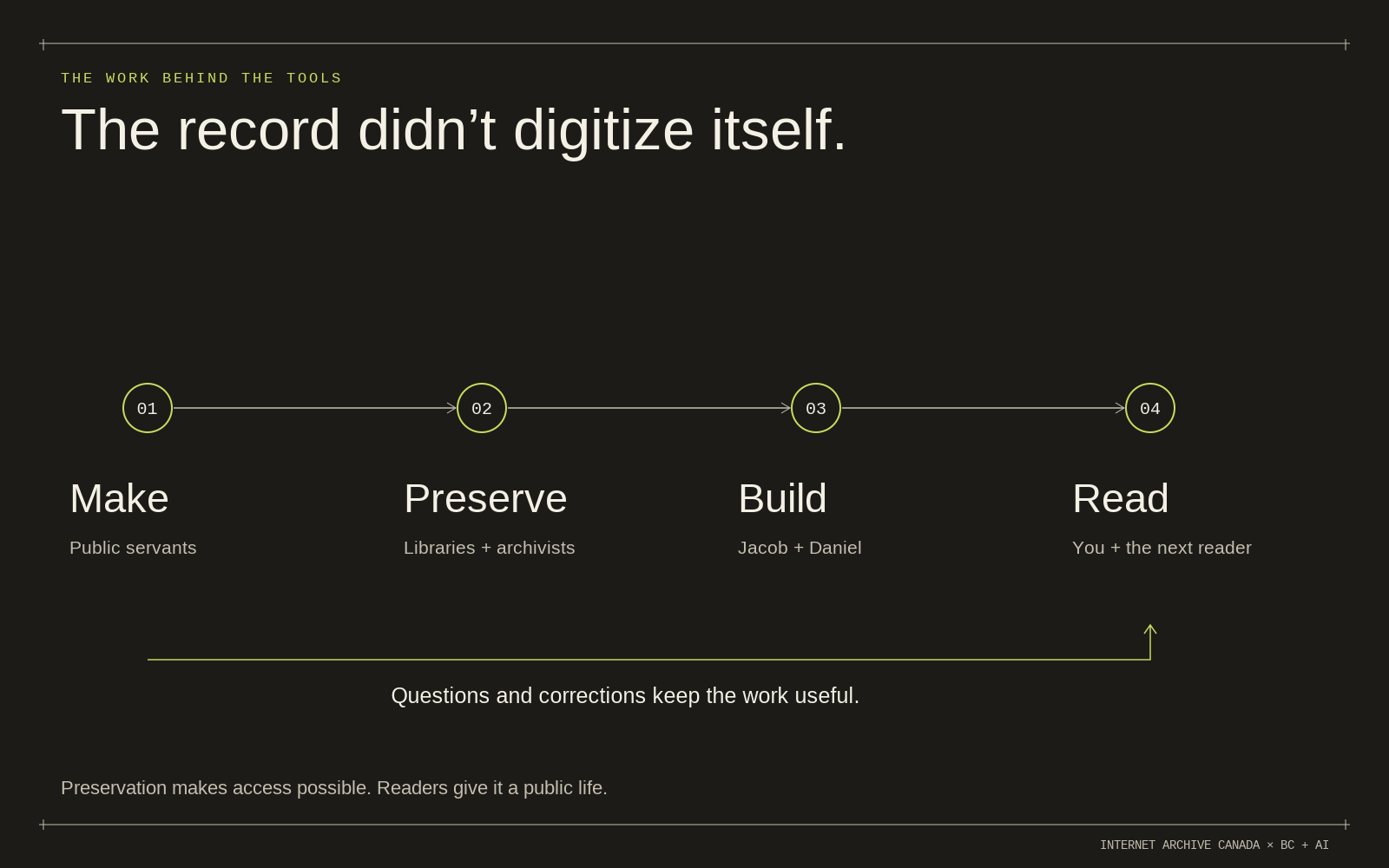
Internet Archive Canada × BC + AI
Source scans: Internet Archive. Explanatory diagrams: BC + AI.
Method sources checked October 17, 2026.