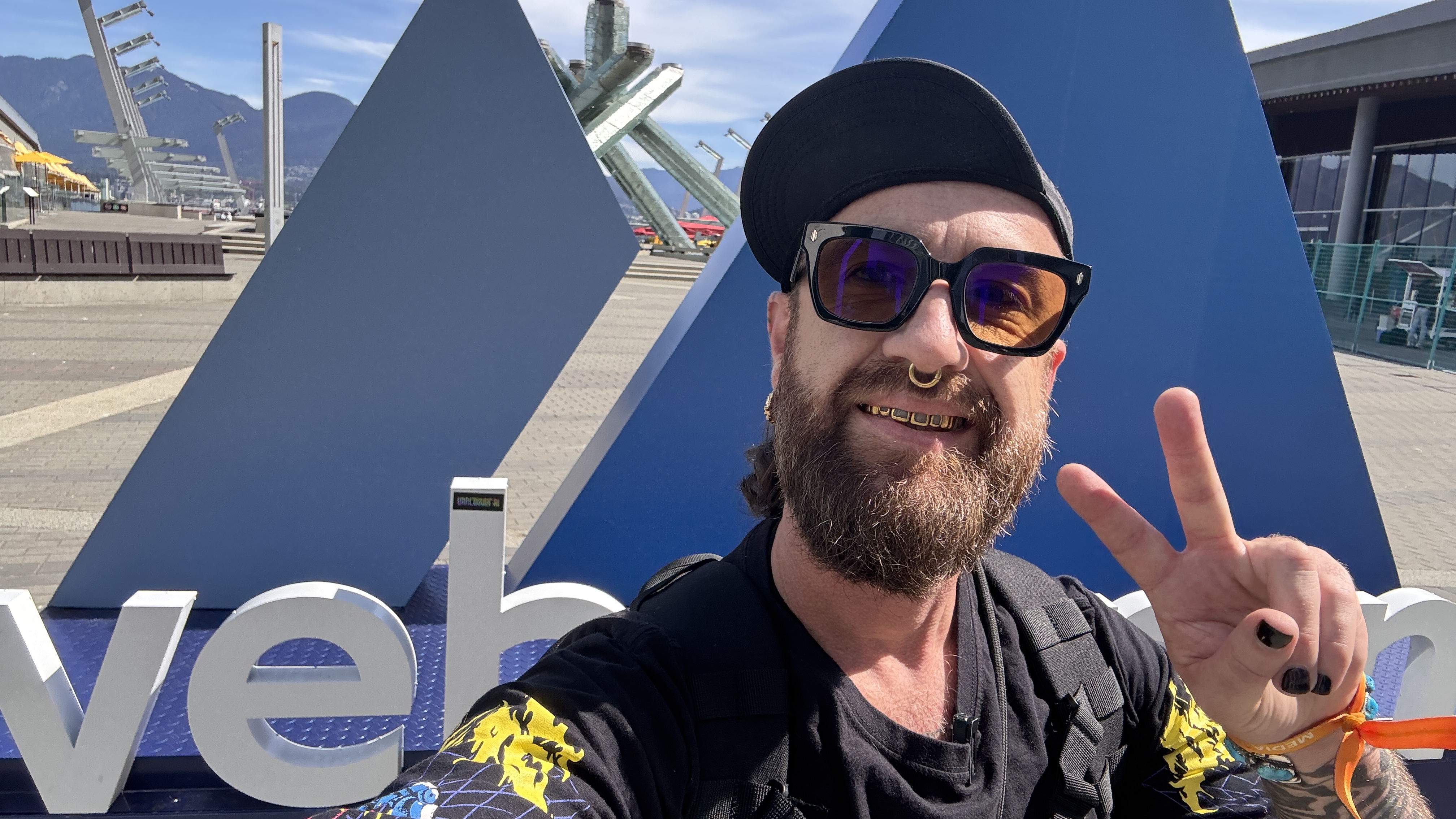
An open letter to Ministers Solomon and Robertson the morning after Web Summit Vancouver. We can have clean, green sovereign compute. We just need to know who it's for.
Minister Solomon, the panel you sat on Monday night was called AI for All. So let me start there. AI for all of whom?
You sat down with Cohere's Joelle Pineau on that stage and laid out the two camps you see in this moment. Team Pompoms, the cheerleaders. And Team Pitchforks, which you described in your own words: "team pitchforks are like, stop building."
Look. I'm not on Team Pom Pom and I'm not on Team Pitchfork. Neither is anyone I work with.
We've got both hands full.
That's a thing I've been saying for two years now and I'm gonna keep saying it because it keeps being true. One hand is building. We use this stuff every day. We train people on it. We ship with it. We want more compute, cleaner compute, closer to home. The other hand is holding ethics: consent, inclusion, host Nation governance, fair pay for the people whose work trains the models. Both hands. Full. At the same time. That's not a contradiction. That's the actual job.
And right before you got to the pitchfork line on stage, you said something I want to hold onto. You said the concerns about "sustainability, about water usage, heat usage, power usage, job training, security issues" are "very, very real and present issues." You said "citizens move at the speed of trust." You said you wanna build "the kind of company that is seven generations."
I agree with all of that. So I'm writing this the morning after, before tonight's keynotes, before the news cycle moves on, because the deal you announced doesn't match the speech you gave. Yet. The MOU isn't signed. The window is still open. Let's use it.
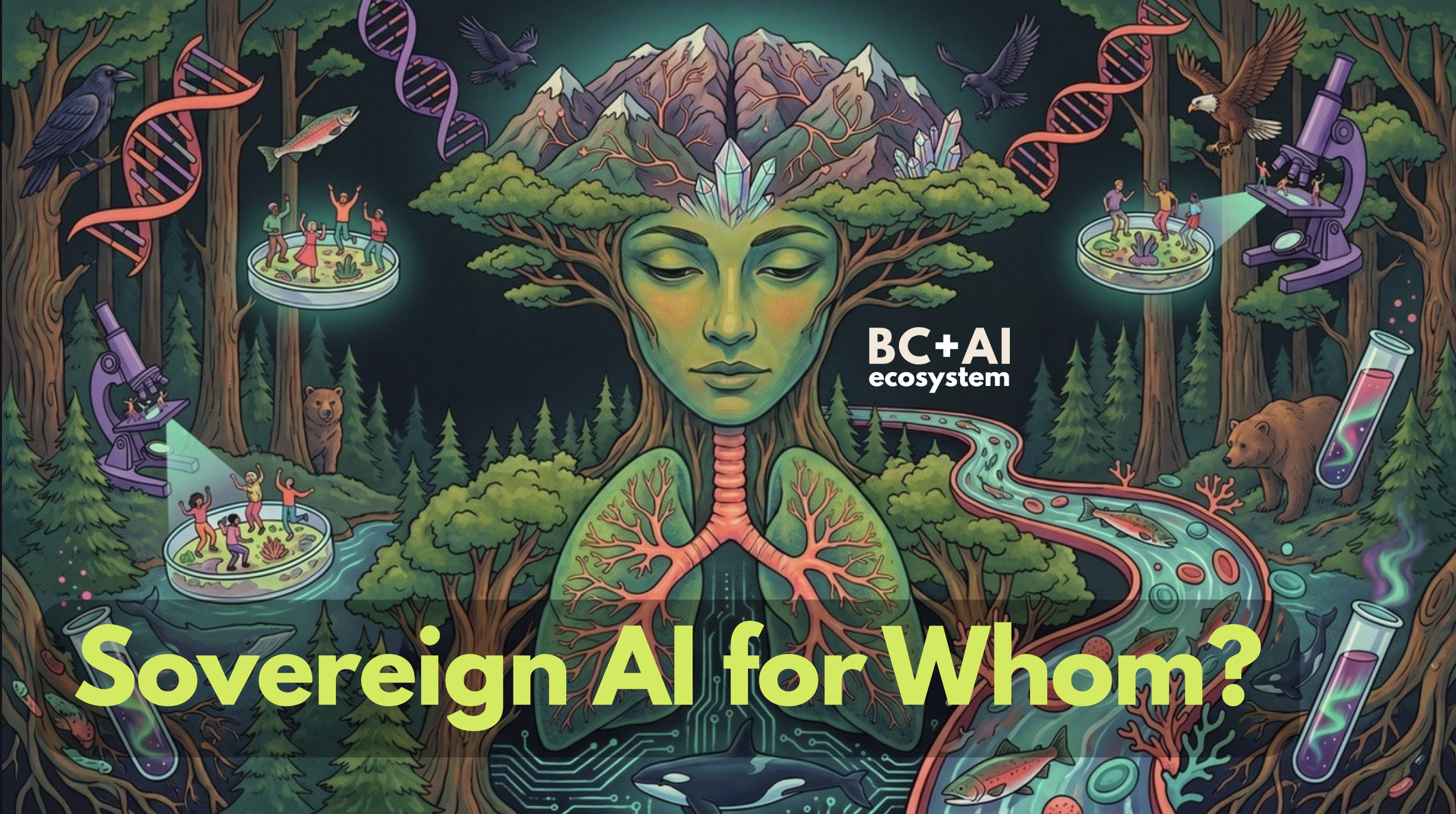
Which brings us back to the question. AI for All was the title of your panel. Sovereign AI for Whom? is the question I want to put on the next one.
Who's writing this
Quick stake in the ground before we get into the receipts.
I run BC + AI. Two hundred and fifty paid members. Three thousand event attendees. A hundred and fifty working practitioners trained through The Upgrade AI with seventy-five to a hundred per cent completion rates. The only AI ecosystem organization in Canada (and as far as we know, globally) with Indigenous leadership at the governance level.
Six hundred and forty-five British Columbians showed up to your federal AI Task Force consultation last year. Second only to Ontario. Your own Task Force experts (Patrick Pichette, Garth Gibson, Arvind Gupta) named Vancouver in three separate reports as the future of Canadian AI deployment.
We're the practitioners. We're the deployment engine. We're some of the people Monday's deal is theoretically for. We have receipts.
And we've been at Web Summit all week. In the BC Pavilion. On the trade show floor. In hallway conversations with cabinet members, parliamentary secretaries, board chairs, and the public servants who actually have to make this announcement work. Sharing the BC + AI story. Sharing our strategy. Listening. (At one point I just plugged my laptop into an empty corner of the floor, put up some BC + AI stickers, and let the day come to me. Worked better than expected.)
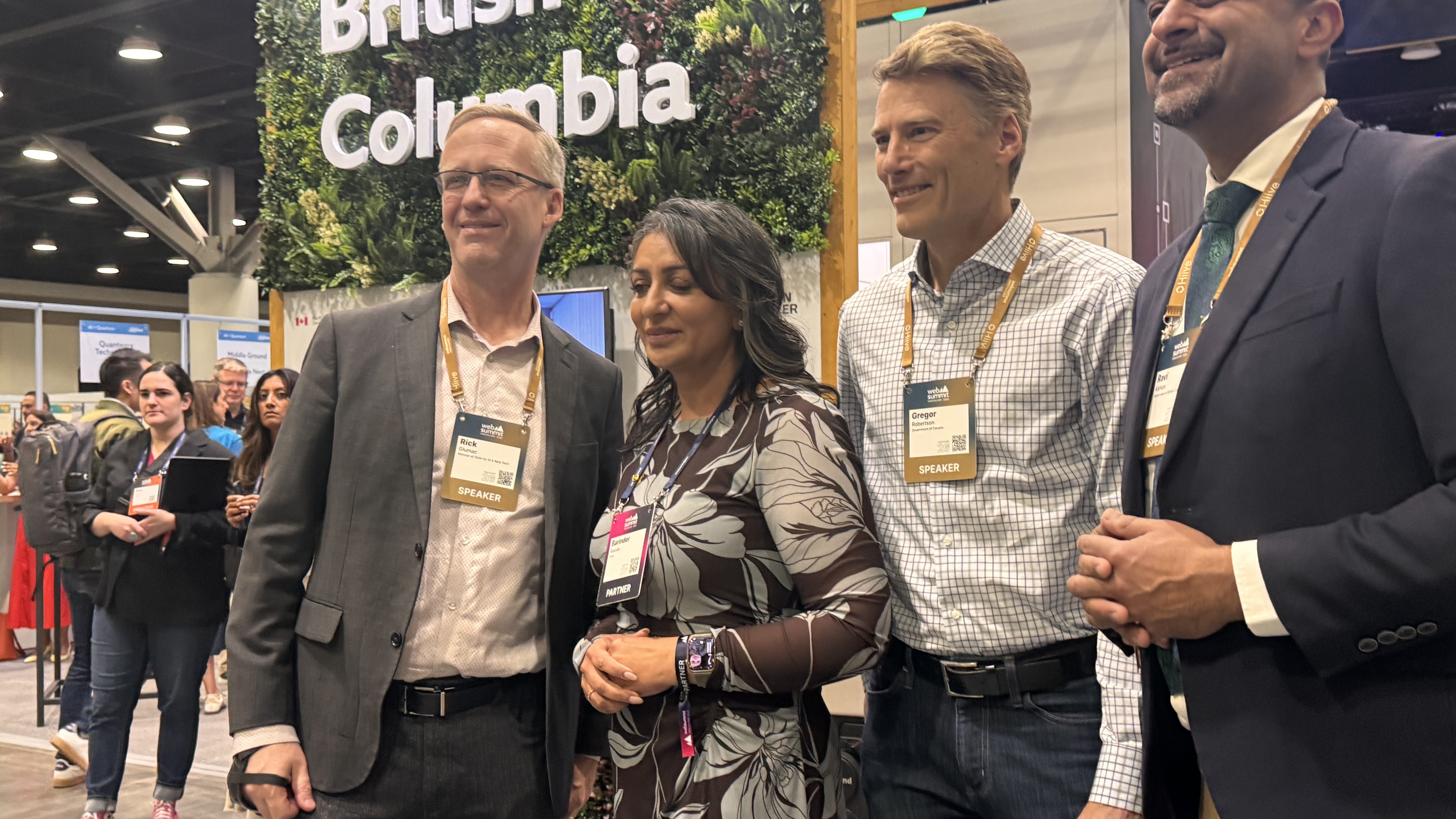
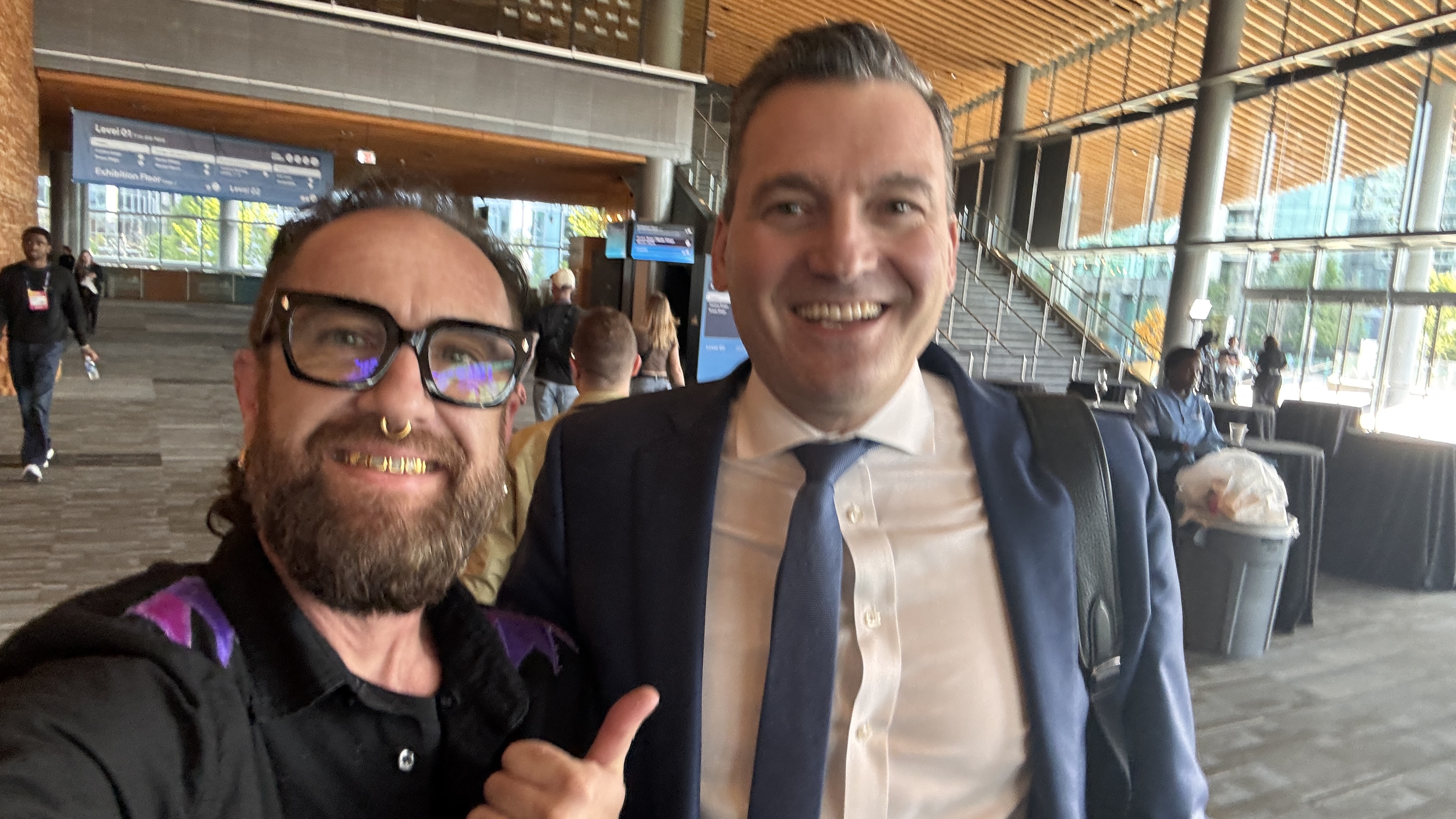
A few warm thank-yous while I'm at it. It was good to be reintroduced to Premier Eby on the floor by Minister Bailey, who has been thoughtfully engaged with the work we're doing. I also had great conversations with Dr. Bethany Edmonds, Chair of AInBC, who's been a steady connector between our two organizations and has opened the door to some collaborations we'll have more to say about soon. None of that softens what comes next. It just means these conversations are already real.
The letter you're reading is the public version of the conversation we've already been having in those rooms.
So let me hand them to you. Both hands full.
What you got right
Credit where it's due. The announcement isn't nothing.
You named our advantage. "Digital sovereignty looks like infrastructure," you said. You're right.
A country that can't host its own training and inference is a tenant on someone else's metal. And right now that someone else is three American hyperscalers running on the dirtiest grids in North America. Refusing to build in BC doesn't make AI smaller. It just sends our tokens south, to Texas gas and Virginia coal, with zero leverage over what runs on them. Building on BC Hydro's 98% renewable grid is, on its face, the cleanest sovereign-compute option on the continent.
You also did the thing the federal government rarely does. You put federal capital into BC. $2.4 billion in the Canadian Sovereign AI Compute Strategy. A hundred and sixty proposals received in the program's first call. TELUS named publicly as the first project moving forward, though you were careful to say on stage it's "moving forward on towards the MOU." So the deal isn't signed.
After two years of arguing that the federal AI conversation runs through Vancouver. Clean power, Pacific positioning, Indigenous governance, deployment muscle. Federal capital actually showed up. That's the hard part to admit. Thank you.
You got the urban data centre design right, too. Heat recovery into the city instead of dissipated into the atmosphere, water recycled from BC Place instead of pulled from drought-stressed watersheds, sites that sit inside neighbourhoods instead of on the edge of them. This is the good version of an AI data centre.
Honestly, it's the most Canadian thing in the announcement: building AI infrastructure that also keeps the neighbours warm in February. We'd want our name on that idea. It is what the rest of the cluster, and the rest of the federal program's hundred and sixty proposals, should look like. Don't let it be the exception. Make it the model.
So this isn't a "no thanks." This is a "yes, and." And because the MOU isn't signed, the and matters more than usual.
Here's the and.
What you didn't mention
Five answers to the question. Each one a not-yet.
1. Not for Mount Pleasant. Not for downtown. Not for Kamloops, by name.
Walk through Monday's three sites with me, because the paper trail matters.
Mount Pleasant, the former Hootsuite headquarters at 111 East 5th Avenue, went to a public Q&A from January 28 to February 10, 2026. The applicant was Westbank. The rezoning was filed as "Bulk Data Storage," with uses listed as "AI training, cryptocurrency mining, biotech simulations, visual effects render farms." No mention of a federal sovereign-compute cluster. No mention of TELUS. No mention that thirty thousand Mount Pleasant residents were being asked to host a flagship of Canadian AI strategy. Two-week online window, closed two months before any of this became public. That's not consultation. That's permitting. The people I represent know the difference.
The downtown facility at 150 West Georgia isn't even rezoned. It's a Westbank tower in pre-application stage, quietly repositioned to include a data centre alongside hotel rooms and condos. A residential tower where someone will sleep on top of a server room. No public file yet. But there is, as of Monday, a federal press release describing it as a 2029 facility.
The Kamloops expansion sits on Tk'emlúps te Secwépemc territory. Minister Robertson, you opened Monday night by acknowledging the unceded homelands of "Musqueam, Squamish, and Tsleil-Waututh peoples for countless generations" and thanking them for their "stewardship and welcoming." Right thing to say at a podium. It's not the same as putting host Nations on the deal.
The Canada.ca release names zero First Nations as partners on any of the three sites. Words on a stage, not structure in a contract. I won't speak for the Nations whose territory these sites sit on. That's not my place. I will say what's true on its face: a sovereign-compute strategy that opens with land acknowledgment and closes with an MOU naming no host Nation is using a word that doesn't belong to it.
Three sites. Zero public partnership files. One online Q&A that buried its real purpose. That's not consent. That's a press conference held on someone else's lawn.
2. Not for the people you called pitchforks.
Coming back to your framing, Minister, because I think it's the most important thing you said Monday. And the part that contradicts itself in the same paragraph.
You said the concerns are "very, very real and present issues." Your words. Then you said the people raising them are pitchforks who want to "stop building." Pick one. Either the concerns are real and present, or the people with both hands full asking about them are pitchforks. You can't have both.
The people in my replies this morning aren't asking you to stop building. They're asking you to build with us.
They're a local hero who runs cultural infrastructure across the street from Mount Pleasant.
They're a retired professor in Nanaimo who spent two years getting water caps on a data centre on Vancouver Island.
They're housing advocates noticing that the 150 West Georgia tower now lists "data centre" beside "residential" in the same building.
They're artists who watched the CHPC committee hear forty-three witnesses on AI and creative labour last fall and got another task force at the end of it.
They're climate researchers who'd like to know whether 150 megawatts have firm clean generation behind them or whether the press release is borrowing against a grid that hasn't been built yet.
These aren't people charging at things they don't understand. These are people who understand exactly what they're being handed.
Both hands full.
And asking for their seat at the table. Which is, by the way, the speed-of-trust work you said citizens need.
The opposite of Team Pitchfork isn't Team Pom Pom. It's Team Receipt. That's the team I'm building.
3. Not for the rest of BC's AI ecosystem. Not at 38%.
In January 2026, BC Hydro opened a competitive call for emerging industries (AI and data centres) with a total allocation of up to 400 megawatts over two years. The utility's own CEO said without a structured process, BC Hydro could be "easily overwhelmed."
TELUS just locked in 85 MW now, scaling to 150 MW by 2032. That's roughly 38% of the entire two-year allocation for the province. Going to one company, one cluster, without appearing through the call BC Hydro literally just published.
So I'll ask in public: did TELUS compete in that call, or did the federal MOU end-run it? And what's the rest of BC's AI ecosystem (the startups, the academic labs, the Indigenous data initiatives, the artist-trained-model researchers we work with at SFU's METACREATION Lab) supposed to do with what's left? Sovereign compute that encloses a public utility's allocation in a single MOU isn't sovereignty for the province. It's sovereignty for one telco.
4. Not for the artists. $2.4 billion for steel. Zero for them.
The CHPC committee heard forty-three witnesses on AI and creative industries last fall: SOCAN's two hundred thousand music creators, the Writers Guild, Access Copyright and Copibec, and the Indigenous Screen Office, whose brief on OCAP principles and an Indigenous AI Advisory Council was one of the most important submissions in the record. They heard, in plain language, that creative work is being ingested at scale, without consent, without compensation, and that what's happening is what Marc-Olivier Ducharme called "digital feudalism."
Monday's announcement is $2.4 billion for steel and concrete and zero new federal dollars for the people whose work will train what runs in the building. The consent infrastructure exists. SFU's METACREATION Lab and our collaboration on artist-trained models won an Ars Electronica honourable mention for a proof-of-concept where artists train models on their own work and retain ownership. The community demand exists. Ottawa chose to fund the substrate and not the rights layer.
On stage Monday you said "when we talk about competing, we should also talk about competing for the worldview we want." Agreed. A worldview that funds the building and not the people inside it isn't the one I'm here to compete for.
5. Not yet for the climate. The numbers need paperwork.
TELUS says 98% renewable hydro, 90% less water than a traditional data centre, waste heat to warm 150,000 homes, and recycled water from BC Place. I want to believe them. Those numbers are only as credible as the documents underneath them. And right now there aren't any.
What would make this real:
- A signed BC Hydro letter of agreement specifying the firm-generation commitment for 150 MW by 2032, and whether new generation is required to get there.
- A signed agreement with Creative Energy or another district utility to actually receive and distribute the waste heat. Customer numbers, build timeline, real households on a contract.
- A signed agreement with PavCo or City of Vancouver Engineering on the BC Place recycled-water plan.
- A published environmental impact assessment for each site, before permits proceed.
Without those, "sovereign" and "sustainable" are doing the same work the press release is.
What Nanaimo already proved
Kathryn Barnwell, a retired professor, and the Vancouver Island Water Watch Coalition spent two years organizing around a proposed data centre on East Wellington Road in Nanaimo. They didn't kill the project. They made the city do its job. In March 2026, Nanaimo imposed a Water Usage Covenant capping the facility at 25.2 million litres a year with a penalty clause for going over. Barnwell isn't satisfied. She's not sure the covenant will get enforced. But it exists, in writing, because the community made it expensive for the city to ignore.
That's the playbook. That's how a permit picks up conditions. That's what's about to happen in Vancouver, and it's gonna be louder than Nanaimo because the stakes are bigger and Web Summit is in town.
If you wanna lead this, lead it. Don't get out in front of it by calling them pitchforks.
And to Minister Robertson
Minister Robertson, you were on the opening-night stage Monday. You welcomed Web Summit to Vancouver, named the unceded homelands of Musqueam, Squamish, and Tsleil-Waututh, and walked through a list of BC tech anchor companies the province is proud of: "Electronic Arts to era wireless, Slack to Stemcell, Hootsuite, Clio, Avante."
You said Hootsuite from the same stage where, the same day, your government co-announced the conversion of Hootsuite's former Mount Pleasant headquarters into a TELUS data centre. The building keeps the address. The legacy gets replaced. The neighbourhood that hosted Hootsuite for fifteen years wasn't asked.
So this part's for you. Because two of your files landed on that stage Monday, and only one of them is named in the press release.
You hold Housing and Infrastructure. The single most ambitious environmental claim in the announcement (that waste heat from the two Vancouver facilities will warm enough homes to heat 150,000 households) isn't a TELUS deliverable. It's your portfolio's deliverable. Heat recovery from a data centre needs district energy pipe in the ground, customer agreements, and federal or municipal capital to lay it. Creative Energy already runs a downtown thermal loop. Mount Pleasant has nothing comparable. The 150,000-home claim only becomes operational if your portfolio chooses to make it operational. Right now, no one in Ottawa is on the hook to deliver it. The number lives in a press release. It needs to live in a contract.
You also hold the PacifiCan file. In March your agency announced $13.8 million for defence innovation in AI and aerospace in BC under the Regional Defence Investment Initiative. That money is already flowing. The cluster announced Monday will, without a published allocation policy, run defence and surveillance workloads alongside everything else. I'm not against defence research in Canada. I'm against a public grid powering it without a public conversation. 150 megawatts is gonna run something. We deserve to know what. And right now you're the cabinet member who can answer.
Here's the part that matters to me, and I think to you. You used to be the mayor of this city. You know Mount Pleasant. You know what density without consultation produces. You spent ten years working on the housing crisis from the other side of the table, and you came back to Ottawa with a portfolio that lets you shape it from this side. The two new data centres are in your old neighbourhood, drawing on your old grid, with waste heat that lands in your current file.
You're uniquely positioned to be the cabinet member who makes this announcement actually mean something to the people who live next door to it. You're also, with respect, uniquely positioned to be the cabinet member who let it skate.
I wanna work with the first version of you. Here's what that looks like:
- A federal-municipal heat-recovery agreement between Housing and Infrastructure, the City of Vancouver, Creative Energy, and TELUS, naming actual buildings and a build timeline for the 150,000-home number. The YWCA's social enterprise hotel across from 111 East 5th is a natural first signatory.
- A public allocation framework for any compute purchased on this cluster with federal defence dollars, with a Parliamentary review window before the first GPU racks up.
- A Mount Pleasant community benefits agreement with neighbourhood representatives at the table. The kind you used to advocate for as a mayor.
- A PacifiCan line item for the BC creator-rights and consent infrastructure work the CHPC committee heard about and Ottawa hasn't yet funded.
You made this city work by partnering with people who knew it. You're back at the table. Partner with us.
What we want
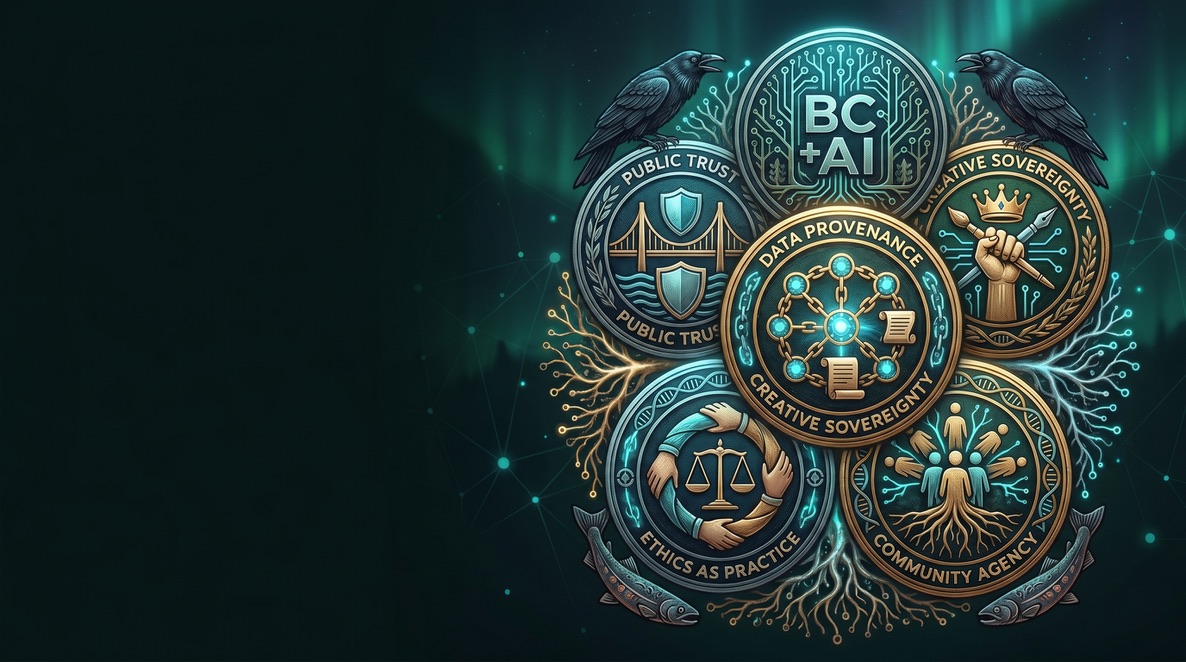
Your panel was titled AI for All. These are the five conditions that would make the title true. Public. Signed. Before the MOU is.
- Independent environmental impact assessments for each of the three sites, published, with a public comment window that names the federal partnership.
- A published allocation policy for the cluster: what percentage of compute is reserved for academic, civic, Indigenous, and public-interest workloads; what's excluded.
- A community benefits agreement for each Vancouver site, with neighbourhood representatives and the YWCA hotel as named signatories on waste-heat recovery.
- Indigenous governance built into the project structure, on the terms of the host Nations, before construction proceeds at Kamloops. And a meaningful share of the remaining BC Hydro emerging-industries allocation reserved for Indigenous-led or Indigenous-zoned data infrastructure, as a real pathway to economic reconciliation.
- A creator-rights line item in the next federal AI budget: funding for consent infrastructure, artist compensation rails, and the research the CHPC committee heard about and didn't fund.
Five conditions. We'd sign onto an announcement that meets them.
The invitation
Ministers, we've done this before. Six hundred and forty-five British Columbians showed up to your Task Force consultation. A hundred-plus practitioners trained while the federal AI conversation was still happening in Toronto. The only AI ecosystem in Canada with Indigenous board-level governance. Two years waiting for federal compute to land on the Pacific coast. This week we showed up in person. In the BC Pavilion. In the hallways. In the rooms where your colleagues were. We're not the obstacle. We're the operating partner.
There's a version of Monday's announcement we sign onto. Host Nations as named partners. The neighbourhood file public. BC Hydro's allocation shared. The artists get a budget line. And the people you called pitchforks turn out to be the ones who make the deal real.
I'm offering that version. So is the community I represent. We'll be in Vancouver, where we already live, when you come back to break the next set of ground.
Minister Solomon, you closed your panel Monday by saying you wanna build "the kind of company that is seven generations." That's borrowed from Indigenous teaching. If you mean it, the host Nations are signatories, not stage acknowledgments. Seven generations of consent, not two weeks of online comment.
So. Sovereign AI for whom?
For all of us. With inclusion, with consent, powering the future we actually want.
Both hands full. We showed up. We weren't asked. Now we're asking.
Kris Krüg is Executive Director of BC + AI Ecosystem Association. He attended Web Summit Vancouver 2026 on May 11–14, 2026. This piece reflects his personal perspective informed by two years of building BC + AI alongside an incredible community of practitioners, researchers, artists, and Indigenous leaders.