The Room Is the Tool: What Two Animation Accelerator Cohorts Taught Us
Last week we wrapped the second AI Animation and Filmmaking Accelerator with Luke Minaker and Mayumi Rollings from Tiny Ghost Studios.
Three Monday nights. Working animators, indie filmmakers, producers, tool-builders, and a few brave weirdos with a story stuck in their ribs. By the end, people had 30-to-40-second animated shorts that did not exist a month earlier.
Not mood boards. Not “prompt explorations.” Finished little films with characters, shots, sound, timing, bad first passes, better second passes, and the holy little panic that shows up when your idea has to survive contact with an audience.
We are not posting the lecture recordings here. We are not posting student work without permission. That part belongs to the room.
But the lessons can travel.
And after two cohorts, the lesson is pretty clear: the room is the tool.
First, Why Tiny Ghost
I have seen enough AI demos to smell theatre from across the street.
A slick keynote is easy. A repeatable creative pipeline is not. The reason we built this accelerator with Tiny Ghost is because Luke and Mayumi are not selling a fantasy about a button that makes cartoons. They have been through the mess.
Luke has been making animation professionally since he was 17, directing by 21, with major toy franchises, television work, and more than a billion views of animation behind him. Then the industry shifted under his feet. He got laid off. He and Mayumi spent two years building Tiny Ghost Studios with no revenue, no soft landing, and a very inconvenient amount of belief.
Then their original IP, Blood and Glitter, got greenlit.
That matters. Not because it makes them shiny. Because it means the class is taught by people who have paid the tuition in public.
Luke’s frame is the one the whole program hangs from:
“There’s like the 20% creative and there’s the 80% grind. And I think that with AI now, it’s flipped it on its head. There’s the 80% creative and the 20% grind.”
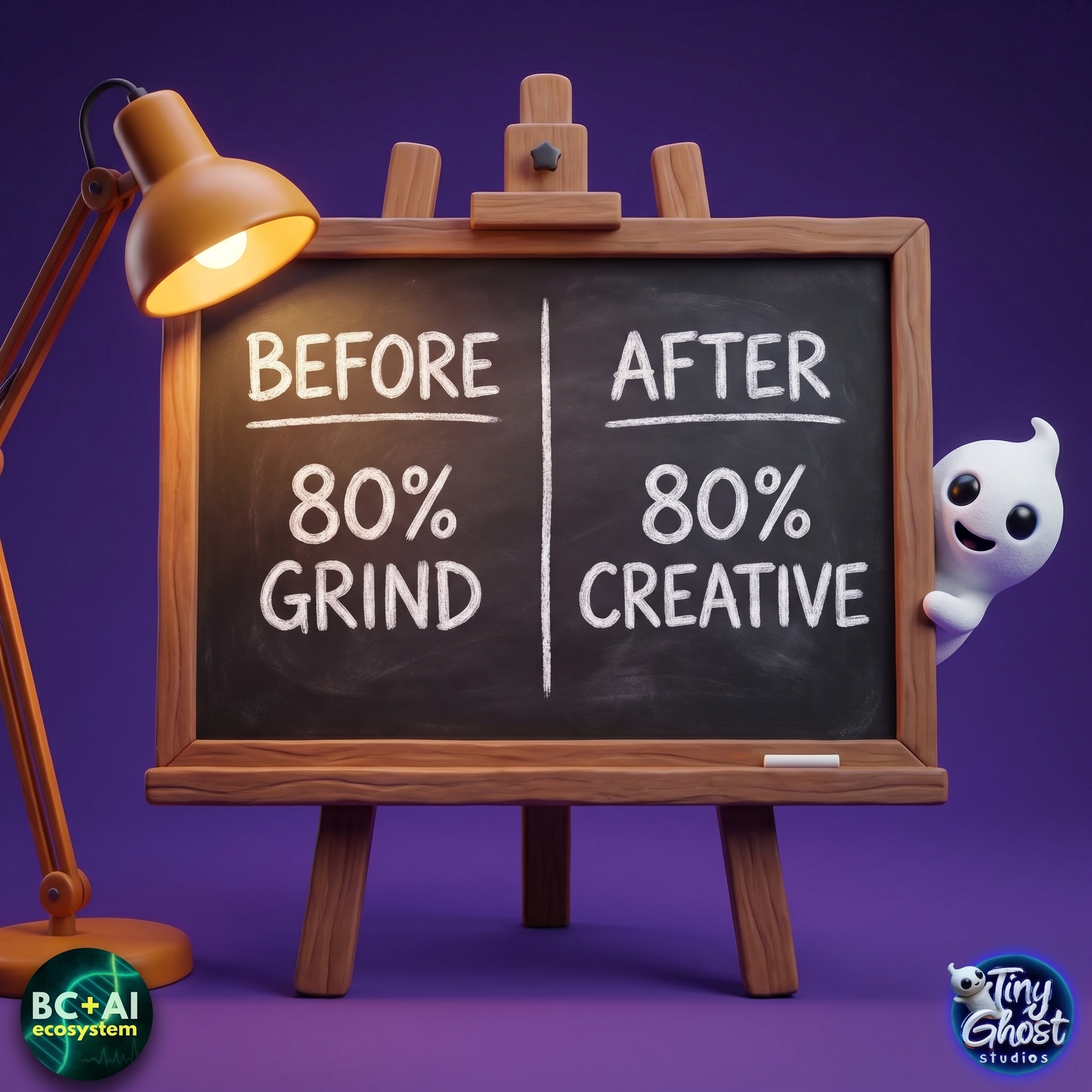
That is the 80/20 flip.
Not “AI replaces artists.” Please. Boring. Lazy. Also wrong.
The better version is: some of the grind is getting eaten, and now the artist has nowhere to hide. If the machine can make a pretty frame, your taste matters more. Your story matters more. Your ability to direct emotion matters more.
Congratulations. The tools got faster and the work got more honest.
The Industry Already Moved
Luke does not open with toys. He opens with layoffs.
That is important, because any cheerful conversation about AI animation that skips the labour reality is basically a pinata full of nonsense.
Animation, VFX, games, and film are contracting. Studios are cautious. People with deep craft are suddenly being told to wait, retrain, pivot, or pray. Vancouver feels that in its bones.
But here is the part that gets missed when the whole conversation turns into doom karaoke: the appetite for moving images did not die. The money moved. The audience moved. The gatekeepers got weirder. The old middle got squeezed.
The internet is full of people making niche work for specific audiences with no permission slip from a studio executive. Some of it is bad. Of course it is. So was cable television. So was most of YouTube. So were a lot of pitch decks, if we are telling the truth before breakfast.
Luke’s line for the shift is better:
“The death of high concept and the birth of ultra niche.”
That one landed in the room.
Because if production gets cheaper, the old question changes. It is no longer only, “Can we afford to make this?” It becomes, “Who is this for, and why would they care?”
That is a much sharper knife.
Story Is Still the Boss
The funniest thing about these tools is that they make basic craft less optional.
For decades, looking expensive could hide a lot. Big render. Big lens flare. Big budget. Tiny heart.
That trick is getting weaker by the week.
If a solo creator can get a polished shot out of a model, polish stops being the moat. Story comes back with a baseball bat.
What does the character want? What is the shot doing? Why this colour? Why this cut? Is the performance alive, or did you just accept the first haunted mannequin the machine gave you because it was 1:13 a.m. and your credits were running low?
Luke teaches animation like a director, not a prompt collector. Character design. Composition. Framing. Audio. Continuity. Acting. Timing. The tiny human decisions that make a thing breathe.
The line people kept repeating back was:
“AI is fast. Re-rolls are the work.”
That is not a slogan. That is the invoice.
Twelve generations to get one shot. Two more to fix the hand. Another pass because the eyes went dead. Composite two characters separately because the model loses its mind when you ask for a crowd. Stitch the good half of one take to the good half of another. Clean it in Photoshop. Bring it back. Listen to notes. Do it again.
If that sounds like work, good. You are awake.
The New Job Has an Old Soul
One reason this accelerator matters is that the job titles are not holding still.
Animator? Filmmaker? Director? Pipeline artist? Prompt wrangler? Creative technologist? Synthetic media producer? Half of those sound like badges from a trade show, and the other half are wearing shoes from the last century.
The people in the room were not waiting for the vocabulary to settle. They were doing the thing.
That feels like the real edge right now. The next wave of filmmakers will be part director, part editor, part production designer, part systems thinker, part gambler, part therapist for unruly software.
Deep craft still matters. Maybe more than before. But it is getting braided with taste, tooling, iteration, and the ability to keep a story alive while the machine keeps trying to sand it into beige paste.
So no, I do not think the right move is to call everyone an “AI creator” and go home. Too vague. Too clean. Too LinkedIn.
These are filmmakers with stranger instruments.
That is closer.
The Stack Is Not the Point. The Stack Is the Weather.
People always ask for the tools.
Fair. Tools matter. Tiny Ghost walks students through a real stack: stills and character design, scenes and sets, motion, sound, editing, cleanup, continuity, and polish. They talk about where the models are strong, where they lie, where they break, and where you should stop fighting and change the shot.
Weimo joined the cohort as a platform partner and walked people through their toolchain live. Other names came up too: Scenario, Higgsfield, Google Flow, the usual alphabet soup of shiny buttons and mysterious burn rates.
But the deeper lesson was constraint.
Pick a lane for a project. Keep your visual world stable. Budget your credits. Build assets before motion. Know when a weird result is a gift and when it is just garbage wearing eyeliner.
The stack changes. The taste stays with you.
What We Changed After Cohort 1
Cohort 1 taught us something beautifully unsexy: two sessions was not enough.
The bottleneck was not information. The bottleneck was reps.
People did not need more abstract explanation. They needed time to make a rough cut, bring it into the room, get honest notes, fix what was broken, and come back sharper.
So Cohort 2 became three sessions:
- Story and animatic.
- Animation and editing.
- Studio-style review.
That middle beat changed the whole shape. It gave the work a feedback loop. And feedback loops are where the cute ideas go to either die with dignity or grow teeth.
Two students came back from Cohort 1 for another lap. That told me something. The value was not a one-time download of secrets. It was the room, the reps, and the permission to be bad long enough to get good.
Why BC + AI Runs This
BC + AI is a registered nonprofit, but I try not to say that sentence too early because it sounds like someone is about to ask you to join a committee.
Here is the less boring version: we run rooms where people can learn the future with other humans in it.
That matters in animation because this shift is not theoretical. It is hitting jobs, portfolios, studios, schools, budgets, and identity. People are not just learning software. They are renegotiating what their craft means.
So the accelerator is not a webinar. It is a working room with an audience on the other side.
Strong student work can screen at BC + AI Film Club, in front of people from Vancouver’s film, animation, VFX, games, and creative-tech communities. That is not a vanity metric. It is a real room with real eyes and real feedback. The kind that changes a piece, and sometimes a person.
What Comes Next
Two more online cohorts are open now:
- Cohort 3: July 27, August 4, and August 10, 2026. Register at luma.com/Cartoon.
- Cohort 4: September 21, September 28, and October 5, 2026. Register at luma.com/Scene.
BC + AI members get 25% off with code BCAI25. If cost is the wall, email us. We keep a few community seats back when we can.
Then we bring the whole thing into the room for real.
Cohort 5 is planned as our first in-person Animation and AI Film Accelerator weekend at Future Proof, October 28-30, 2026, at the H.R. MacMillan Space Centre in Vancouver.
That feels right. The online cohorts are the runway. Future Proof is where it gets loud.
The festival ends with the second annual BC + AI Film Festival, which makes it the right place to screen work, test ideas, argue productively, and remind everyone that the future of film is not being decided by a model release note.
It is being decided by the people brave enough to make something.
If you want to argue about AI animation forever, the internet is open 24 hours and the seats are free.
If you want to make a thing, come to the room.
See you there.
Kris