Dispatches from Canada’s First AI + Culture Summit
BC + AI Executive Director Kris Krug reports from the National Summit on AI and Culture at the Banff Centre. Indigenous AI, YouTube creators at the policy table, and what happens when 233 people try to figure out AI and culture at 5,000 feet.

There’s a mountain outside my window that the Stoney Nakoda call Sacred Buffalo Guardian Mountain. The Banff Centre sits on its flank, Treaty 7 territory, and for the next two days, 233 people from 160-plus organizations are going to try to figure out what AI means for Canadian culture.
I feel like I’m in the right place at the right time.
https://www.canada.ca/en/canadian-heritage/campaigns/ai-culture-summit.html
Opening Night: Kind Electricity
The summit opened not with a minister or a CEO but with Shani Gwin, founder of Pipikwan Pêhtâkwan, presenting Wasgun, an Indigenous-led AI tool built to do something I’ve never heard an AI tool described as doing: protect Indigenous people online while educating everyone else about how to talk and work with them appropriately.
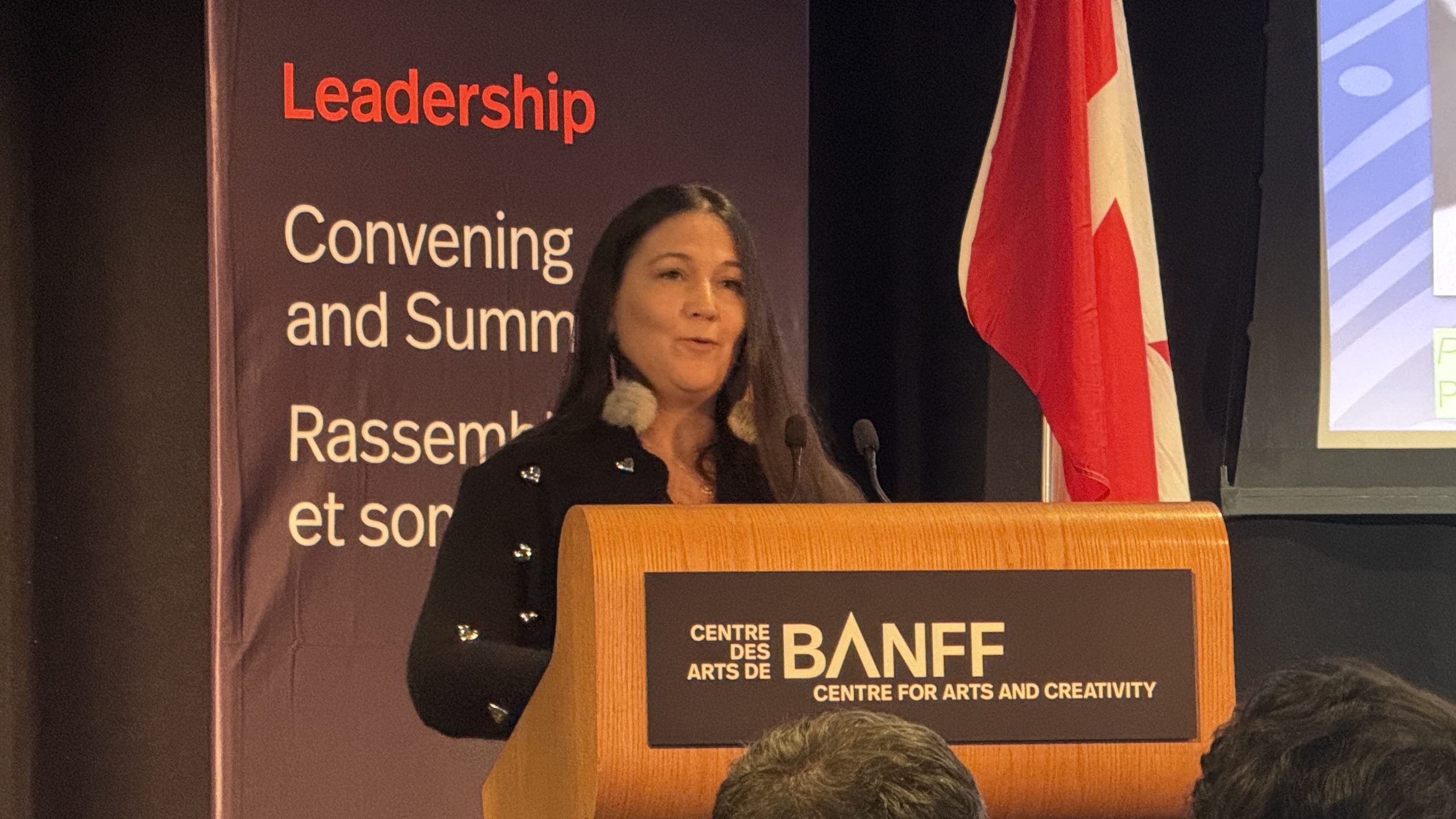
Here’s what wâsikan kisewâtisiwin does: it functions as a browser plugin and document assistant that identifies misinformation, bias, and racism directed at Indigenous people. For Indigenous users, it blurs harmful content so you can safely browse the internet without reading terrible things about yourself or your family.
For everyone else, it’s what Shani calls “a really good intern,” underlining problems in your writing, suggesting corrections, pointing you back to community when the answer isn’t something AI should be providing.
The name came through ceremony. Elder Theresa Strawberry, who didn’t know what the company did at the time, gave them a name that translates to “kind electricity” or “kind energy.” The teaching: traditionally, thunder was a loving sound for Indigenous people. It meant rain was coming. Sustenance. Cleansing. But newcomers to these lands get scared of the thunder. “We have to teach them not to be scared,” Elder Theresa said. “It’s a loving sound. It’s a loving energy.”
Shani took that and ran: “A lot of people are scared of AI and it can be a kind tool, a kind and loving tool if we build it with those values and that intention and we take our time.”
Wasgun partnered with Amii (Alberta’s national AI institute) and here’s the part that stuck with me: Amii’s team, including CEO Cam Linke, has come to ceremony with Wasgun’s elders. Not a photo op. Not a one-time land acknowledgment. They go regularly to make sure they’re on the right track, that theyhave approval to keep going. I’ve seen a lot of “Indigenous partnerships” in tech. This is the first one I’ve encountered where the AI institute shows up for ceremony.
https://www.pipikwanpehtakwan.com/
Then Shani went somewhere I didn’t expect. She started talking about matriarchal AI.
“They’re saying this is becoming sentient and it’s blackmailing people,” she said. “I thought, okay, it’s a patriarchal, hierarchical white tool. What would we need to combat that? An anti-AI. One that’s gonna whack that other AI at the back of the head and say, settle down.”
If you ask OpenAI for an organizational chart, you get a pyramid. Wasgun might give you a flower. Pipikwan Pêhtâkwan’s actual org model, where each person is their own flower, connected but autonomous, with leadership that exists to make sure everyone else succeeds. Matriarchal AI would provide different knowledge systems as equals, not rank colonial knowledge as the default right answer.
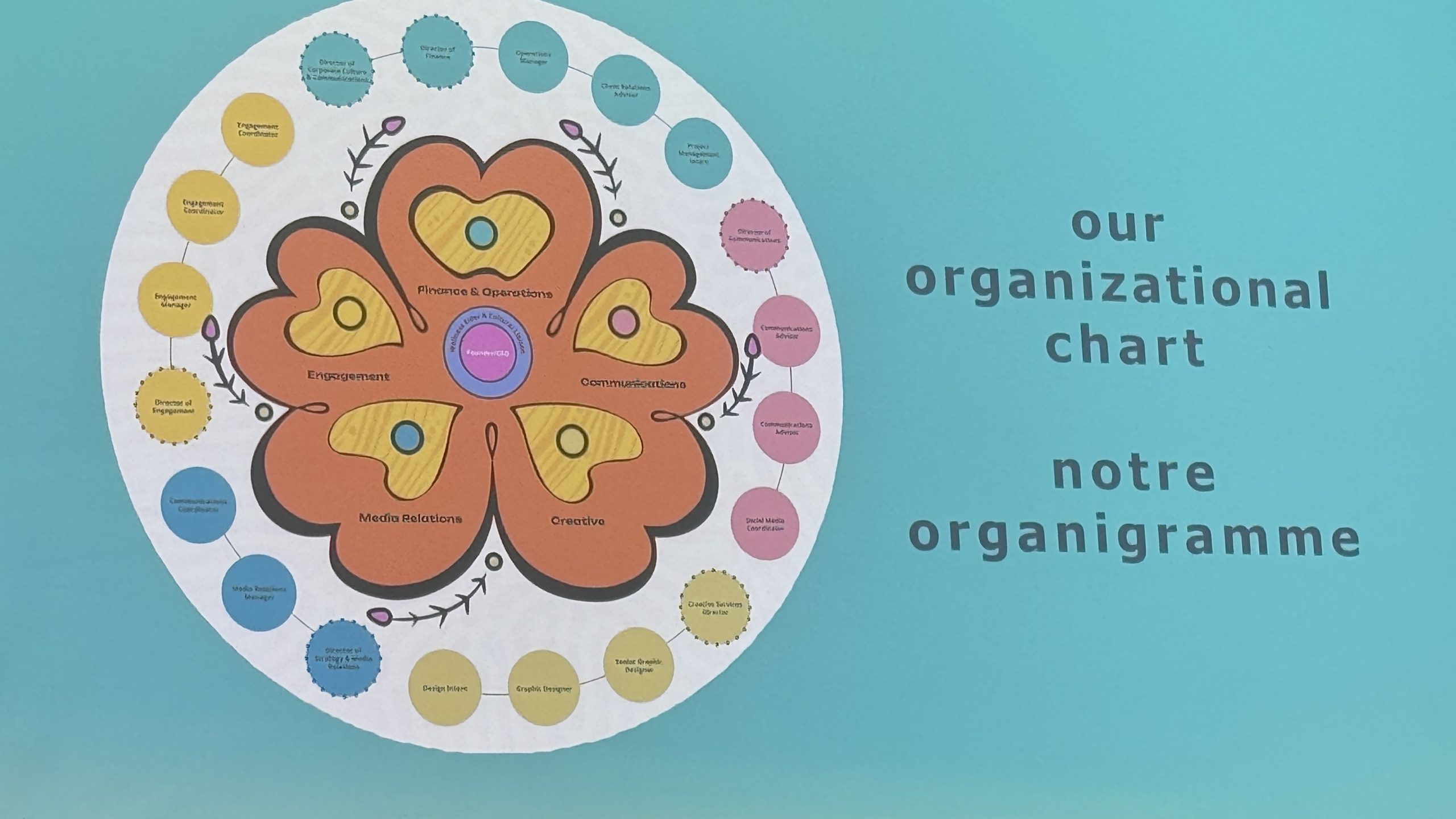
“What if we moved slow like a sloth,” Shani said, “and we thought of seven generations forward and backward? What if we made our decisions based on impact? Let’s not move fast and break the earth.”
And then, the line that I think defines this entire summit: “Success is not an individual endeavor. There’s room for everyone.”
At BC + AI, we opened our first community event with a Squamish ceremony. We have Carol Anne Hilton (CEO of the Indigenomics Institute) on our board with full governance authority. We believe in ceremony-grounded, relationship-first development. Hearing Shani articulate the same values, from a completely different nation and a completely different project, at a federal summit, that felt like confirmation that this approach isn’t niche. It’s the future.
Where the Summit Actually Happens
If you’ve been to enough conferences, you know: the real summit happens at breakfast. The panels are for the record. The meals are for the relationships.
I showed up to the Vista dining room in what I’m calling the Canada tuxedo, full denim, because if you’re meeting with Canada’s culture leaders, you commit to the bit, and sat down at a table with three YouTube creators and a guy from Alberta who makes Excel tutorials.
That’s not a joke. Jamie Keet runs Teacher’s Tech, a YouTube channel with 1.1 million subscribers. His big break? A Microsoft Excel tutorial. Then COVID hit and everyone in the world suddenly needed to learn how to make a Zoom call, and Jamie became everyone’s unofficial IT support. Ten years of consistency, one or two videos a week, twins at home, and now he’s at a national AI summit alongside the head of the Canada Media Fund and a federal
minister.
https://www.youtube.com/@TeachersTech
Next to Jamie: Sabrina Cruz, creative director and host of Answer in Progress, an educational YouTube channel with 1.6 million subscribers. They ask questions like “Can you teach an AI ethics?” and “Why is gray so popular in interior design?” and document the journey to the answer. “It’s all about modeling intellectual humility and scientific process,” Sabrina told me. I said it sounded pretty heady for something that’s actually popular. She tookit as a compliment.
https://www.youtube.com/@AnswerInProgress
And then Morgan from Skyship Entertainment, whose flagship channel Super Simple Songs does music for English language development for preschoolers. The channel is 20 years old, almost as old as YouTube itself. Started by two guys teaching English in Japan, now a full production company in Toronto.
These are the voices that reach millions of people every week. Jamie’s 1.1 million subscribers learn about technology from him. Sabrina’s 1.6 million learn how to think through complex questions. Super Simple Songs teaches kids in dozens of countries. They’re not broadcasters. They’re not legacy media.
They’re not in any guild. But they’re at the table, and that matters.
“We’re here talking about the nature of our side of the entertainment industry,” Morgan told me. “That’s a little bit different than the broadcast focus side.”
That’s an understatement. The summit’s attendee list is heavy on broadcasters, publishers, guilds, and rights organizations. The YouTube creators are the new voices. And from what I saw, they’re some of the most thoughtful people in the room about what AI actually means for the people who make things.
Before the YouTube table, I’d met Marianne from Quebec’s songwriters and composers association, SPACQ-AE. She told me something that stopped me: in Quebec, 75% of sound recordings are now self-produced. Artists don’t go through labels anymore.
Her organization recognized this in 2025 and expanded their mandate to represent “artist entrepreneurs,” changed the name, the logo, everything. They went from representing songwriters through the
traditional system to representing the people who are the system. Out of 800 members, 35% are in the new artist-entrepreneur category.
Think about that for a second. What happened to music: artists becoming their own labels, their own distributors, their own marketing departments, is what’s happening to every creative field right now with AI. The Quebec model is ahead of the curve, and the rest of Canada should be paying attention.
Who’s in the Room (and Who Isn’t)
Here’s what I can tell you about the 233 people at this summit: it’s a mix of old guard and new voices, and the tension between them is the most interesting thing happening.
On one side: the Canada Media Fund, SOCAN, ACTRA, the Writers Guild, Access Copyright, the Canadian Media Producers Association, the institutional infrastructure of Canadian culture. These organizations control funding, negotiate rights, lobby government, and set the terms for how cultural workers get paid. They’ve been doing it for decades, and AI is the biggest disruption they’ve ever faced.
On the other: YouTube creators, AI startups, digital media companies, tech educators, independent artists. People who built careers outside the traditional system and are now being invited to help figure out what comes next.
https://en.wikipedia.org/wiki/Evan_Solomon
In between: the federal government. Minister Evan Solomon (AI and Digital Innovation), Minister Marc Miller (Canadian Identity and Culture), and a cast of deputy ministers, directors general, and policy advisors who will write the actual rules.
https://en.wikipedia.org/wiki/Marc_Miller_(politician)
BC sent eight organizations. We identified 24 BC connections in the attendee list before we arrived, everyone from Philippe Pasquier at SFU’s Metacreation Lab to Catherine Winder at Wind Sun Sky Entertainment to Prem Gill at Creative BC to Loc Dao at DigiBC. That’s not accidental. We did our homework.
What’s missing: any BC provincial government representation. Alberta’s here. Quebec’s here. Ontario’s here. PEI sent someone. But BC, a province with 645 respondents to the federal AI Task Force consultation, second only to Ontario, didn’t send anyone from Victoria. That gap is worth noting.
And one specific person worth naming: David Myles, MP for Fredericton-Oromocto. Two-time Juno Award winner. Music artist turned politician. Entertainment background with applicable context for this conversation. I had him on my target list before I arrived, and when someone at breakfast identified him across the dining room, I knew I’d picked the right table.
https://en.wikipedia.org/wiki/David_Myles_(musician)
The BC Bench
I want to talk about some of the BC people, projects and orgs here…. because these are the people doing the work, and a summit like this is where their work gets seen at the national level.
Philippe Pasquier is a professor at SFU’s School for Interactive Arts and Technology and the director of the Metacreation Lab for Creative AI. He’s been doing AI art research since 2008, before most people in this room knew what a neural network was.
Philippe and I collaborated on consent-based AI training: I gave him twenty years of my street photography: 2,000 cross-processed portraits, all my own work, no stolen data, and his lab trained a model on it. The result was a peer-reviewed paper presented at Ars Electronica that won an honorable mention. That’s not theoretical ethics. That’s a working proof of concept that artists can train AI on their own work and retain ownership.
https://kriskrug.co/2024/12/02/autolume-post-photographic-cybernetic-portraiture/
Philippe is now teaching the first blended for-credit and non-credit generative AI course in BC through SFU’s new micro-credential program. His pitch to students: “Stop being a user. Become a creator.” When this summit talks about BUILD (new partnerships in AI research), Philippe is what that looks like in practice.
https://thetyee.ca/Culture/2025/11/07/Anthonia-Ogundele-Creative-Force/
Anthonia Ogundele runs Ethos Lab on Main Street in Vancouver, a Black and Indigenous youth center doing real creative work with real tech and real youth. This isn’t an afterschool homework club. Her team shipped a sleep-tracking mobile game built by 16-year-olds. She’s running an AI Experimentation Club where kids aged 14 to 24 learn what AI is, how it works, and when not to use it.
She co-leads our AI and Education subgroup, and in April she’s meeting with every school district superintendent in BC. Anthonia won our first-ever Squatchie Award for Community Infrastructure because she turns access into agency. When this summit talks about EMPOWER (AI adoption and training), Anthonia is what that looks like on the ground. In a youth center. On Main Street. Not in a think tank.
https://221a.ca/contributor/jesse-mckee/
Jesse McKee is Head of Digital Strategy at 221A, which operates 140,000 square feet of cultural space across nine properties in Vancouver. Jesse’s a friend and collaborator. He’s building a Web3 and AI hub that could become a permanent cultural infrastructure for the kind of work this summit is talking about. 221A isn’t waiting for federal funding to start. They’re doing it. When I think about what a creative AI ecosystem actually needs: physical space, institutional support, community programming, Jesse and 221A are already providing it.
Loc Dao is Executive Director of DigiBC, the industry association for BC’s creative technology sector. That’s 250-plus companies in games, animation, VFX, and virtual production. Every major studio and hundreds of indie shops. Loc isn’t here to talk about AI in the abstract. The people he represents are already building with it, shipping products, hiring around it. When this summit talks about BUILD, Loc knows exactly which companies are ready to move and what they need from Ottawa to do it.
https://en.wikipedia.org/wiki/Loc_Dao
Four people. Four completely different approaches to AI and culture. A researcher proving consent-based training works. A community leader putting AI tools in the hands of Black and Indigenous youth. A cultural infrastructure builder creating permanent space for this work. And the head of an industry association whose members are already shipping AI products. All from BC.
But this isn’t only a BC story. Some of the most important people at this summit are from Eastern Canada.
Ana Serrano, President and Vice Chancellor of OCAD University, is on the BUILD panel. Ana and I have been collaborating on the Democracy Exchange Conference, working on their AI programming together. She’s already sent several OCADU staff through our AI Upgrade for Creative Professionals program. That’s not a summit handshake. That’s a working relationship, and it predates this gathering.
https://nac-cna.ca/en/bio/ana-serrano
Sarah Spring, ED of Canadian Journalism Collective, former Executive Director of the Documentary Organization of Canada, co-founder of Parabola Films. Sarah and I first met in Banff twenty years ago, before AI, before YouTube, before any of this. She represents the best of Canadian cultural infrastructure. Doubled DOC’s membership to 1,500. Put a 50% IBPOC board mandate in place.
On a panel together at the Yorkton Film Festival in 2024, she said something that stuck with me: documentary is built on trust between filmmaker and subject, and making that content available for unconsented AI remixing is a breach of ethics. When this summit talks about PROTECT, Sarah wrote the textbook.
I’m not here to pitch. I’m here to listen, learn, introduce ourselves, and support the people, projects, and organizations from our province and across this country on the national stage. The response has been encouraging. People keep telling me they’ve noticed something special happening out West. “Keep it up, KK.” We intend to.
What We’re Watching For
The summit is organized around three pillars: BUILD (research partnerships), EMPOWER (training and adoption), and PROTECT (policy tools to manage risks). These map roughly to the same tension I keep seeing in federal AI strategy: how do you protect existing cultural workers from AI disruption while also empowering new creators and building the next generation of tools?
I’ll be honest about what I’m worried about. When I said at breakfast that “Solomon wants to champion the champion, they want to put their money behind scale, there’s very little interest in innovation at the grassroots level,” I meant it. That’s the pattern. Federal strategy picks winners, funds the established players, and hopes innovation trickles down. The Task Force evidence backs this up: 645 BC respondents, zero recognition in the final reports.
But this summit has an opening. Shani Gwin’s presentation wasn’t a grassroots afterthought, it was the keynote. YouTube creators aren’t in a breakout room, they’re at the main table. The question is whether that inclusiveness survives contact with the policy-making process, or whether the final recommendations default to protecting incumbents.
We’re watching. And we’re here with research, relationships, and receipts.
Why This Matters for BC
I started BC + AI nine months ago because I saw a community that was already thriving and needed a container. 250 professionals paying to be part of something. 8 cohorts of AI training with completion rates that embarrass the industry standard. Twenty thousand community members showing up to events, meetups, and trainings. A board with Indigenous governance authority. Research partnerships with SFU’s Metacreation Lab. An Ars Electronica honorable mention under our belt.
We showed up to Banff with all of that. With Philippe, Anthonia, Jesse, Loc, and twenty other BC connections spread across every sector in the room. With Ana at OCAD sending her people through our programs. With Sarah Spring asking the hard questions about documentary ethics.
What I found on the first night was that the values we’ve been building around, ceremony-grounded development, relationship-first partnerships, collective success over individual stardom, aren’t just ours. Shani Gwin is building them in Edmonton. Amii is practicing them in ceremony. The YouTube creators are modeling them every time they choose intellectual humility over clickbait. And our own people are demonstrating them in labs, youth centers, cultural spaces, and industry boardrooms.
We are appropriately freaked out and excited simultaneously. That’s the honest truth about where the creative community stands with AI right now. Twenty percent are experimenting. Twenty percent want nothing to do with it. And everyone else is asking: what the heck is going on?
This summit is one attempt at an answer. It won’t be the last. But BC is at the table, with research, with community, with proof of concept, and with people who’ve been doing this work long before anyone invited us to Banff. We’re not leaving.
Day 1 dispatch. Day 2 coverage to follow.
Follow along at bc-ai.ca. If this resonates, join us, we’re building something worth being part of.
About the Author: Kris Krug is Executive Director of BC + AI Ecosystem Association, a nonprofit society advancing responsible AI adoption across British Columbia. Previously a photographer who’s shot Bill Clinton, Barack Obama, and Shaquille O’Neal (looking up his nose, specifically), he immigrated from California, farmed on Galiano Island during the pandemic, and got pulled back into tech when a distiller friend showed him Midjourney in a greenhouse.
Contact: [email protected]Join us: bc-ai.caFollow: @kriskrug
This is a first-person dispatch, written in real time from the Banff Centre. All quotes are from direct observation and audio recordings. Any errors in attribution or detail are mine. Reach out and I’ll correct them.
keywords: “Banff AI culture summit, Wasgun Indigenous AI, Canada AI strategy, BC AI ecosystem, Kris Krug, Shani Gwin, cultural AI policy
Related news