Data for Good Keynote: The Story of BC + AI
This is adapted from the keynote Sev Geraskin and I delivered at the Data Administration Management Association (DAMA) Annual Conference on October 22, 2024. The event brought together nonprofits, data professionals, and AI builders to talk about artificial intelligence for public good. We told them about the organic growth of BC + AI over 22 months, Sev demonstrated his AGI data interfaces, and we talked about the infrastructure crisis that just hit BC. Here’s the story.
This week I got to tell a story that’s never been told before, mainly because it just happened. Three months ago we became a nonprofit society. Twenty-two months ago we were hosting our first meetup in my studio. Three years ago I was on a farm on Galiano Island having my mind completely blown apart by Midjourney.
And yesterday, literally yesterday, Minister Adrian Dix announced that BC is limiting AI data centers to 100 megawatts every two years while spending $6 billion on a power line for the mining industry.
Premier David Eby’s response to criticism? “If voters don’t like it, they can vote me out next year.”
No consultation. No industry input. Just done.
So let me tell you how we got here and why this matters more than you think.
The Midjourney Moment
I need to back up to 2017 first. Got absolutely destroyed by a Bitcoin hack that year. Not just financially, it broke my relationship with the internet. I’d been living this pretty public digital life, and suddenly I was like, nope, I’m out. Retreated to Galiano Island. Started farming. Withdrew.
Fast forward to mid-pandemic. Friend comes to visit, shows me Midjourney. Within five minutes my mind is set ablaze. I start sleeping less. Can’t stop thinking about what this means for creative industries, for work, for everything.
And here’s the weird part: I feel this pull back to the digital world, but I’m not ready to just throw myself into Discord channels that feel like hacker dens. So I spin up my own Discord server that first day, invite like 200 friends from web one and web two, and we all start exploring together. Going down rabbit holes. Sharing learnings. True grassroots collaboration.
That was my re-entry point. That’s where this starts.
The Thing I Couldn’t Find
I moved back to Vancouver, started getting booked for AI talks, got into the Google AI Lab accelerator in September 2023. Took it seriously, built out The AI Upgrade Academy w/ Peter Bittner, we’ve been doing six-week AI certifications for different sectors for two years now.
But I was also going to every AI event I could find, looking for real-life community that felt like that Discord energy. And I kept finding very specific pockets. LangChain users group, UBC AI security, various technical meetups. All good. All necessary.
But nobody was holding both things at once: the critical questioning AND the optimistic building. The “this is amazing” and “this is dangerous” in the same conversation without people thinking you’re confused.
That philosophical tension felt essential. Still does.
So we started hosting meetups in my studio. Eighty people showed up to the first one. Now we’re 22 months in, about 250 people each time, at the HR MacMillan Space Centre. And what’s happened isn’t just growth, it’s emergence.
Subgroups have sprung up organically. Surrey AI and other AI meetups, people taking the spirit and adapting it for their communities. And then topical groups that just go deep.
There’s Mind AI & Consciousness, MAC for short. They’re exploring what human consciousness is, what synthetic consciousness might be, what we can learn from AI about our own humanity.
It’s a technical reading group. You have to do homework before you show up. You can’t come late or leave early. They hold each other to a high standard.
Then there’s AI & Education, run by Anthonia from Ethos Lab, this amazing Black-centered youth space in Vancouver. Last month, 50 people crammed into their studio, administrators, teachers, students, tutors, asking the hard questions. What’s the value of school now? Where should learning come from? How do we adapt to this paradigm shift?
Right now they’re creating a working paper on the characteristics of human-centric AI in the classroom. Because they kept using that buzzword for three meetings and finally said, you know what, we need to actually define this. We need to be able to point to it when we see it.
That’s the kind of work that emerges when you create space for it.
The Hackathon Series
(Or: How to Partner With Corporations Without Selling Your Soul)
In January, Andrew Reid reaches out. He runs Reach3 and Rival Technologies and Angus Reid Forum, the big market research and survey company in Canada. He says, “You guys are up to interesting things. I want to be part of it. How can I help?”
I love hackathons. They’re the cultural performance sport of our industry. You get stretched, you get pushed, you make friends, you learn new skills. So I said, let’s do a hackathon series.
Andrew came to the table with 20 grand. Ten in prize money, ten in operations. But here’s the critical part: his lawyers initially wrote this restrictive IP transfer agreement where the corporation suddenly owns everything anyone builds.
I said no.
And Andrew, to his enormous credit, didn’t even question it. Told his lawyers: anything this guy says about how we run these things, that’s what we do.
So the agreement literally says: we don’t own your stuff, we don’t want access to your ideas, if you build something good we might hire you later, but that’s it.
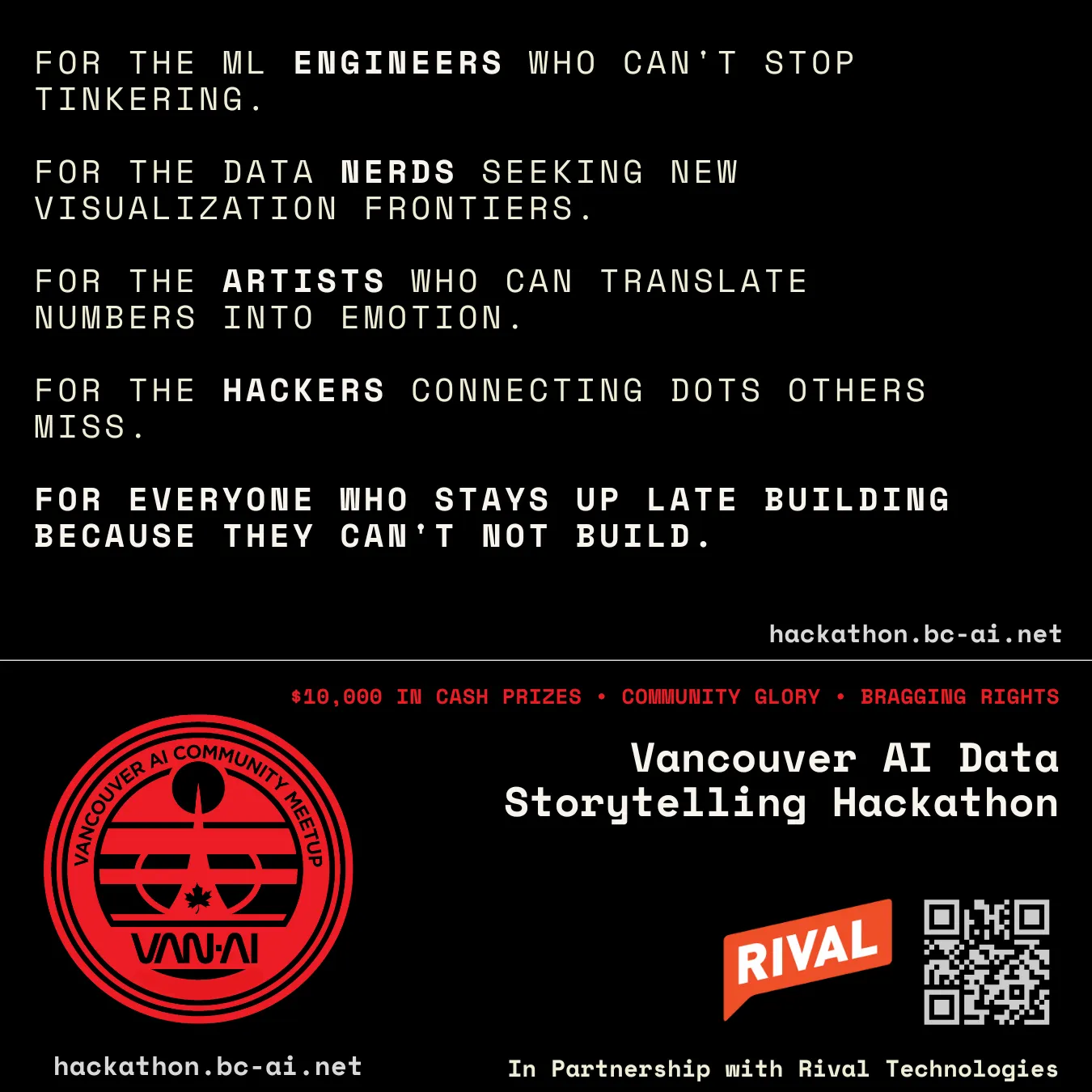
The hackathons are about data storytelling. Andrew’s clients are paying millions for surveys, getting results back in PowerPoint decks with pie charts. There’s this massive gap between today’s storytelling technologies and what they’re actually using. So we’re bridging that.
We just wrapped our fourth round. One submission that came in Sunday, I showed it at the keynote, takes music survey data and turns it into this narrative journey with animations, the whole thing. It’s technically sophisticated and creatively wild.
That’s what happens when you don’t trap people in restrictive agreements. That’s what community-first looks like.
We also just launched a Youth Access Fund two weeks ago. Scholarships for people under 25 to participate in hackathons and events. Week one: created the fund. Week two: sponsored a guy named Ubuff Consul to go to the Ocean Hackathon in Victoria. Week three: he won first place and is going to France for the global competition.
https://www.zeffy.com/en-CA/donation-form/youth-access-fund
We’re moving at real-time AI speed.
What Happens When You Give Smart People Interesting Problems
Sev Geraskin has won two out of our four hackathons. He’s a data nerd, CTO of PolarGrid.ai, founder of the Economies of Wisdom Foundation, and has a huge heart. I had to invent a Hall of Fame category to put him in so other people could win.
What he’s building is legitimately next-level: AGI data interfaces that generate insights in real time.
Traditional approach to survey data: spend millions collecting it, get PowerPoint with pie charts, call it a day. Sev’s approach: feed the data into an LLM context window, let the AI generate a custom dashboard specific to that dataset, make it conversational.
He demonstrated two examples at the keynote. First one was the Future of Canada survey, 1,100 responses about Canadian values and tensions around Canadian Identity. The AI auto-generated an animation with indigenous voice narration, extracted key insights (81% feel deeply Canadian while 62% fear polarization), curated representative video clips from transcriptions.
Second one was a “choose your own adventure” interface for BC AI sentiment data. You can literally talk to it. Ask it questions. Get instant analysis.
And here’s a wild finding it surfaced: rural skeptics have a higher average AI sentiment score (5.19) than creative professionals (4.84).
Think about that. The people who are supposed to be early adopters, the creatives, are more apprehensive than rural Canadians. That’s a paradox traditional analysis would miss. That’s what AI surfaces instantly.
Sev’s point: “We don’t need deterministic tools anymore. We just need intelligence to sit on top of data.”
Just-in-time insights. Talk to your phone on a run, get briefed before a presentation. Democracy of data access.
This is what we’re building toward.
The Part Where BC Decides to Fuck It All Up
Which brings me to this week.
Premier David Eby and Minister Adrian Dix announced that BC is limiting AI data centers to 100 megawatts per year, available only through a bid and regulatory. Instead, we’re spending $6 billion on a power line from the north to the Yukon for national defense against Russia, then south to Vancouver Island to power the mining industry.
Eby’s official response when asked about skipping public consultation: “I feel good about it. If voters don’t like it, they can vote me out next year.”
https://www.cbc.ca/news/canada/british-columbia/bc-ai-power-centres-9.6946054
That’s not governance. That’s hubris.
Meanwhile, Alberta is rolling out the red carpet. Unlimited compute. Paid trade missions. Come build your AI future here.
And we’re saying… we’re good with rocks, I guess?
This is the exact same story as our forestry industry. We exported raw logs instead of building value-added industry here. Now we’re going to export our clean hydropower, our clean energy advantage, to other jurisdictions instead of using it to build sovereign AI infrastructure.
https://www.youtube.com/watch?v=UzJfMJzkFwc
The federal government is talking about “AI sovereignty” while BC is giving away the foundation it requires.
Here’s what’s at stake: Geoffrey Hinton, Nobel Prize winner for his work on neural networks has his lab here in Canada. We have 20 years of Metacreation Lab research at SFU with Philippe Pasquier. We have world-class AI talent at UBC with people like Alan Mackworth. We have CS chops, data chops, use cases, and clean energy that the world wants.
But we’re choosing not to use any of it.
We’re choosing to create a bidding process that will pit us against each other for scraps while Alberta builds an AI industry.
The Regulation Debate
There was a petition this week, 800-plus people signing on for world controls on superintelligent AGI. Someone asked me at the keynote how likely that is to stop development.
I did this little jig and said: 100% unlikely, because there’s not a governing body that can do that. Not while China and the US are racing.
But Sev reframed it in a way that stuck with me: “Do we really need more intelligence? The answer is no, we don’t even know what to do with what we have. So why are we using centralized hyperscalers versus deploying our own models?”
That’s the real question.
We have high-performance phones. We can push computation to the edge. We don’t necessarily need the cloud for everything. But that’s a different paradigm than we’re living in, and maybe something like BC’s shitty policy wall forces us to actually explore it.
Open source models. Edge deployment. Distributed infrastructure. Every one of us has that capability. If we collectively choose to use it, we control how fast this evolves.
Behavior over regulation.
And here’s the Canadian angle: healthcare data that has to stay on Canadian soil. Use cases where sovereignty actually matters. Sev’s building GPU infrastructure closer to home with Polar Grid. When OpenAI wants lower latency for voice agents, they’ll need to come to distributed infrastructure like that.
The constraint might be the catalyst we need to build differently.
The Counter-Narrative We’re Offering
Look, we can’t put the genie back in the bottle. But we can offer a counter-narrative to Elon Musk, Sam Altman, and Silicon Valley.
Indigenous-led. Open source. Grassroots. Community-first.
That requires investment, vision, leadership, and a story people can rally around. We have all of those things.
That’s why we became a nonprofit society three months ago. That’s why we’re organizing to give this industry a voice so we’re at the table when decisions get made, not reading about them afterwards in shocked disbelief.
We’re putting the best of what we’ve got in the middle and trying to make something bigger than all of us.
Twenty-two months from a Discord server to fighting for BC’s AI future. We’re just getting started.
And David Eby and Adrian Dix can keep their regulatory redtape bidding process.. We’ll build the alternative anyway.
Kris Krüg is the founder of BC + AI Ecosystem Association and The AI Upgrade Academy. He builds communities and fights for the future.
If you want to be part of what we’re building, come join us. We’ve got events throughout November, hackathons, subgroups diving deep on everything from consciousness to education. The real value isn’t the perks, it’s getting together regularly with engaged, passionate, smart people who are trying to make an impact.
We’re putting the best of what we’ve got in the middle and making something bigger than all of us.
Join the BC + AI Ecosystem Association: https://bc-ai.ca/membership/
BC + AI Ecosystem Association | Multi-modal, multi-cultural, radically local, and future-facing.
The BC + AI Ecosystem Association is Canada’s first community-powered AI association. We help businesses, institutions, and citizens navigate artificial intelligence through education, advocacy, and collaboration.
Guided by principles of ethics, inclusivity, transparency, and sustainability, we champion AI that serves public good from climate resilience and healthcare equity to Indigenous language revitalization and creative expression.
Mail: Suite 123, 100 W Pender St, Vancouver, BC V6B 1R8
Phone: 778-898-3076
BC + AI Ecosystem Association | Multi-modal, multi-cultural, radically local, and future-facing.
The BC + AI Ecosystem Association is Canada’s first community-powered AI association. We help businesses, institutions, and citizens navigate artificial intelligence through education, advocacy, and collaboration.
Guided by principles of ethics, inclusivity, transparency, and sustainability, we champion AI that serves public good from climate resilience and healthcare equity to Indigenous language revitalization and creative expression.
Mail: Suite 123, 100 W Pender St, Vancouver, BC V6B 1R8
Phone: 778-898-3076
Related news