BC’s AI Crossroads
Wolves, Welders & the Wicked Problems of AI
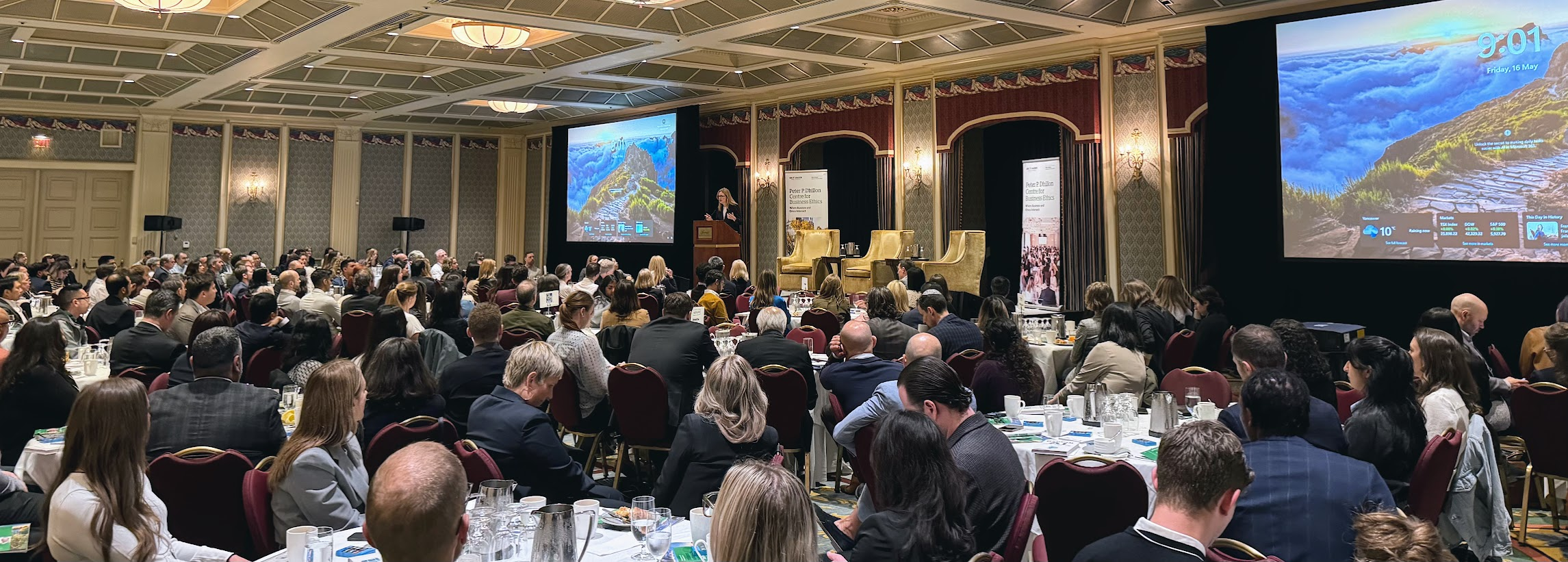
Onstage mashup: Tsleil-Waututh First Nation councillor Dennis Thomas-Whonoak grounding the room in Indigenous futurism; Finance Minister-entrepreneur Brenda Bailey riffing on ethics, jobs, and power grids; KPMG’s Mark Low pushing for Monday-morning pragmatism; UBC brass saluting values-driven research.
Audience: students in crisp name-tags, founders and funders, policy wonks, resource execs, and the many friendly faces from the mycelial BC + AI Ecosystem.
Transcript
Hello, my name is Amitak Kukwilum, I am from Moscow, I am from Skohomish, I am from Slavutown, I am from Wanaak, I am from Dennis Thomas, I am from Squalewitz, I am from Zikusnaala. In translation I said good day to you all respected peoples, Wanaak is my ancestral name, I am a member, citizen, elected councillor of the Slavutown Nation and it gives me great honour here to welcome everyone to the beautiful shared territory of the Musqueam, Squamish and Slavutown Nations. Here celebrating the Peter Dillon Centre, 10 years, that’s fantastic, thank you. Yes, and in this current context, I am the Executive Director for the very new, this is 3 days in, celebrated on Tuesday, the official Spitz Centre for Indigenous Business Education. I just really want to thank the staff at Peter Dillon, thank you for organising this, I remember I did this last year and these events take time, it takes a lot of people, it takes a lot of passionate people to help put on these functions and showcase all of the beautiful and amazing work that we are trying to do, how we are trying to change the world for the better. In my context, how I can try and interweave Indigenous knowledge systems within a business context and that’s one of the secret things that I’m working on and I know that there’s many other people out there that have been doing it for many years and the time is now. I’m really appreciative of being honoured here to come up and share a few words around AI, AI, this whole week was all about AI for me and I did a deep dive of course, a deep dive into how can AI help Indigenous peoples, how can AI speak the way I speak or think the way that I think, write how I write. But I came across a few different beautiful articles around interweaving Indigenous knowledge systems with AI and two important areas, one was around education and this is only from last year. It came from Indigenous knowledge holders which is critically important, it came from real people and it came from Indigenous peoples and how there is a change of having our Indigenous knowledge holders, our elders, there is a shift happening and sometimes our culture isn’t captured and how can that be transferred down to the next generation. So I watch this, you can Google it later, it’s fascinating, they have these bots and algorithms learning how to not take and maximize everything and learning for example fishing, they have these little mini robots that have algorithms in it and talk to these kids about only take what you need and so that it can be repopulated year after year and it actually gave you a little warning if you took too much. It came around agricultural farming, we didn’t take all of the berries when it was ripe, so these little algorithms were able to teach the kids to only take what you needed. I found that very fascinating because I speak about it all the time and for it to be interwoven with new technologies is great. Another story came around the Inuit and how because of climate change, this actually relates to what this conference speaks about, about sustainability and trying to navigate climate change and because their fishing pools and areas are starting to be depleted. The elders all know where they used to traditionally fish and because of the clouds up in the Inuit, they can’t get good data and so they’re actually using AI with Inuit indigenous knowledge holders of the traditional areas that they used to fish and they’re able to find where their ancestors fished. So I also found that very interesting as well. But we all got to be safe, we all got to make sure that you put the good information in to get accurate information out. I’m always reminded of a spirit animal and I’m going to sing a song here later today around being a wolf. Takaya in my language means wolf. They’re adaptive. They’re able to be part of the community. They’re able to take care. They meander everywhere but they’re able to always come back home and protect their family. And within my community.
That’s our spirit animal. We’re a specialty nation people of the Inlet Wolf Clan. And not too long ago, probably five years ago, after urbanism, depletion of ecosystems and wild meat, they vanished from our core territory of the Indian Arm and Leotard. And through acts of using technology, Western science with indigenous knowledge systems, we were able to re-put a lot of the natural elements that attracted wolves to come to our territory. And so we’re very proud to say that there’s a pack of four wolves that have came back after a hundred years. And I really… I really wanted to honor this event, honor you business leaders, change makers, you know, with this wolf song. And hopefully that can be a metaphor and strength as we navigate this new world of AI and to be adaptive. But always, talk to them who you are and where you come from. If If If If If If If If If If If If If If If If If If If If If If If If If If If If If If High Tesla, High Tesla Applause Wow, what a perfect start to this morning And we’re really excited for today We’ve got a great program, we’ve got a great crowd Members of the Spanx River Business Community EBC, Sauder Faculty, Alumni, Students, Staff People joining us from near and far And for a quick note for students We have a little special note on student name tags Because they love to meet IRL business professionals Laughter Hi And last summer when we were putting this event together Just starting to think about it We actually had unanimous agreement Among the center and the board Which let me say is actually pretty rare Because we have a very strong culture of debate And discussion on our board But this time it was pretty clear The topic on everyone’s mind was AI But you have to get more specific Because at this point in time Having a conference or a summit on AI Is like having an event on the internet We’ve got to get, we’ve got to go deeper And so in this case we were thinking What would we tackle? And we thought really what we’re curious about Is what does AI mean for business and for society? Is it this once in a lifetime opportunity for business And they should universally immediately leverage it? Or is it this existential threat That business and consumers are concerned about And should avoid at all costs? Or is it possible that it’s a little more useful? And that’s what we want to talk about today What are those nuances? What are the opportunities? How can they be leveraged? What are the dangers? How can they be avoided or surmounted? What are the gray areas? What do we know? What don’t we know? And that’s what we hope to get through today We want to be thought provoking We want to stir conversation We’re going to hear from different perspectives We want to hear from your perspectives It’ll be time to talk at tables And to share questions with our speakers We hope to have some interesting back and forth And we hope that all of us leave today With a nicer, richer, more nuanced understanding Of the debate on the future of AI So to do this today We have a great program We’ll first hear from the Honorable Emily Brenda Bailey Who will provide a bit of a lay of the land When it comes to AI and VC And throughout the morning we’ll be using Slido We have it up on the screen It’s also in the programs And we’ll have it on the screen Anytime there’s an opportunity for questions After the first break We’ll have our first spotlight session These sessions will have two speakers Speaking back to back Then we’ll go to tables And have time for you to chat at your tables And we’ll have some questions to stir conversation We’ll have moderated discussion between those speakers
[…] Really thrilled to bring the community together. Thanks to all of you for being here to take time out of your schedule to learn a little bit, to kick the ball around. I hope to have a good discussion and to leave today, you know, maybe a little inspired, maybe a little scared, maybe thinking about what the future might hold for you and your organization. Now obviously you saw the little video there. The Peter Dillon Center has just been fantastic at the school. And those of you who don’t know the school, the university, we really have three jobs, right? Probably the biggest is education in terms of young people, and old people, coming through the system, learning, growing, preparing themselves for a successful life, successful career. Second is research. UBC is a powerhouse in research, ranked in the top 50 in the world year on year. And we just produce great knowledge that changes society. And then the third is working with community, doing things like this where we can have an impact more broadly on Vancouver, BC, and in the country, around the world. And what the Peter Dillon Center has done is it’s hit all of these marks very effectively. It provides a playground for students, everything from case competitions to working in the center to working on these issues of ethics in business. It supports our researchers in a really big way. It enables them to go out and do fundamental research on what ethics means in business and where the next frontier is going to be in terms of good business decision making. And finally, it hosts events like this, bringing the community together to interact, to network, and to continue learning and questioning as we go through our daily lives and through our careers. So as I said in the video, I’m excited about the future. I’m excited about the past. The Dillon Center is a big part of this school, and we look forward to seeing how it contributes as we move forward. Now my two jobs now are to introduce our president. President Macron could not be with us here personally today, but he knows Peter very well, and he wanted to share a few words. So here’s a few words from our president at UBC. Bonjour tout le monde. Hello everyone. I’m Benoît-Antoine Bacon, President and Vice-Chancellor of UBC. It’s a great pleasure to join you virtually at the Business for Social Good Summit today and to celebrate 10 years of the Peter P. Dillon Center for Business Ethics. Moments like this reaffirm why UBC is without a doubt the most impactful and most exciting university campus. For a decade, the Dillon Center has championed values-based research, shaped future leaders, and worked with businesses and policymakers to put ethics into practice. The Center’s mission aligns closely with UBC’s vision to inspire people, ideas, and actions for a better world. By placing ethics, sustainability, and social responsibility at the core, the Center extends its impact far beyond the world of business. In a world marked by complexity and division, acting with integrity and compassion has never mattered more. I am so grateful to Peter Dillon for his vision, his partnership in bringing this important center to life. Peter has a vision of how the world can be, how businesses can be both a force for social good and economic prosperity at the same time. Thanks to his investment, UBC Sauder is equipping students, the leaders of tomorrow, with an education that is centered around ethical leadership and decision-making. And there’s truly no better place for this than here at UBC. Thank you, Peter, for placing your trust in our great university. Today, the Dillon Center is a crucial element of our great UBC Sauder School of Business. Over the past decade, the Center has already sponsored research that sets the standard for ethical business practices, empowered students to make decisions that are both smart and responsible, and integrated ethics into academics, student initiatives, and engagements with the business community. What a tremendous impact in just ten years, and I’m excited to see this continue to grow in the years to come. I hope that today’s discussions on AI give you a glimpse of the Dillon Center’s reach and the true meaning of business for social good. Again, my warmest congratulations to Peter, our great Dean Darren Dull, the Dillon Center team, and the entire Sauder School of Business on this exciting ten-year anniversary. Félicitations, congratulations, and enjoy the summer. Okay, now let’s get it started. I want to invite to the stage KPMG’s Mark Clough. KPMG, when we asked them if they would like to be involved in this session, they just said yes.
organization that looks to lead in terms of AI. And Mark is the Director of Innovation, Growth, and Emerging Tech at KPMG Ignition GBI. And really his job is to help clients imagine, design, and build a future in a rapidly evolving competitive landscape. Mark, do you want to come up? And he is going to introduce our first session and talk a little bit more about what the vision is with respect to AI at KPMG. Thank you. Thank you. Thank you. Thank you. Thank you. Thank you. Thank you. Thank you. Thank you. Good morning. You have my notes. Some notes here for me. Thank you. I was nervous for a moment. Great to be here. Innovation and Emerging Tech is a role at KPMG. And my job really is to help articulate for clients this very, very quickly evolving landscape. And more practically, kind of what to do on a Monday morning on a four-day, which is kind of a small task. If you spend any time in this space, you know the models are moving very, very quickly and unlocks a whole bunch of new possibilities. And so that’s really the challenge at foot. But it’s been kind of a three-ish year journey for us specifically in this space. And about three years ago, when Chad GPT kind of came to the fore, we started putting together our AI summits because of our attempt to convene conversations like this, which is why Sam was mentioning when I asked if we would sponsor today, it wasn’t easy yet. Because this is exactly the conversation that needs to happen. It’s easy to get lost, I think, in the tech of it and be enamored by the technology and think how wild and wonderful it is. And for the people who do our tech first, of course, that’s kind of our natural inclination. But what the technology also does is it cuts right to the core of how we support our families and care for the ones that we love and create meaning in the work that we do. And so these are the conversations that all of us are wrestling with and why I think today is going to be so, so meaningful. So it’s a real pleasure for KPMG to be part of this conversation. Thank you to you, Solder. Great to see students in the audience as well because I think the other kind of point to make here is that whilst it can feel like the technology is something that’s happening to us, that we have agency in the story. We are actually writing the script in terms of how this rolls out. So we talk about things like trusted AI and responsibility AI. The part that’s often missed is the role that we have in shaping the story and the narrative. And so the students that are in the room, it’s actually, I’m speaking to you now with the official old guy in conversation. I don’t know how that happens. But it’s actually, you know, the botany of you. And you get to shape the story in terms of how you are going to take these tools into your careers and shape the organizations that you serve. And the core question, I think, is whether we’re going to use these tools to grow the pie or whether we’re going to fight over the same pie. And so, again, I would say that this is a deep, rich, and meaningful conversation today, so thank you. I had the great pleasure of introducing the first panel. And I got to know our first guest in a political sense a number of years ago when she was first elected as the MLA for Vancouver Falls Creek. Politics can be a funny game. You hope that your representatives have their cohorts in the right place as they step into that arena. Most of the time, that’s true. And every now and again, you get somebody where you know that their morals, their ethics, their values align specifically with the great experience, the relevant experience that they bring to the role. And we are extremely grateful to have you as one of our representatives here in the province. So she was first elected to Vancouver Falls Creek named at that time to the Minister of Jobs, Economic Development, and Innovation, which also is a small role, right? Go ahead and develop our economy and do some innovation. Like, yeah, okay, no problem. Took that on with grace and has subsequently been re-elected now to the renamed Vancouver South Granville riding and now Minister of Finance here in the province. As I mentioned in her background, previously the Executive Director of DGPC, which is the Interactive and Digital Media Association for BC. She served as the Executive Director for Big Sisters of BC in the Lower Mainland here, so just a fantastic member of the community, fantastic relevant business experience that she brings to the role. And again, very, very grateful to have her in her seat and having us start with her today. That’s the Honorable Rebecca Bailey who I’ll bring up in just a moment. She also is going to be… Now I’ve messed it up because I’ve lost the slides. There we go. And she’s going to be joined today by Alicia Solberg.
who is the Associate Dean of Students at UBC Salisbury. She teaches commercial law, land law, new venture development, and business fundamentals at the undergraduate and graduate level. And comes to UBC through private practice, where she was a tech lawyer at national firms, specializing in mergers and acquisitions and private equity. So again, a very rich and thoughtful discussion to be had. So please welcome the Honorable Brendan Bailey and your Associate Dean, Alicia Salisbury. Please. Thank you. So if I close the laptop, you still good? What an awesome room. I see a few old friends in the room. I see leaders in our business community. I see leaders in AI. I see a lot of people who know more about this topic than I do. But that’s a good thing. That’s a good thing. Before we get started, I just want to acknowledge Councillor Dennis’s welcome to the territory. Thank you very much. And thank you for the welcome. I think the question of the relationship to Indigenous community and AI is one that’s really worth exploring. It’s interesting hearing from Dennis. There’s lots more that we can say about that topic. And so much really, really integral work going on in that space, which is really exciting. Thank you very much for inviting me to be here. I have the pleasure to get to know people who are here. And it’s an honour to be here. That’s a forum that is sponsored by the Peter David School of Ethics. And the importance of ethics in business just can’t be overstated. So it’s an honour, truly. So first question, why am I up here as MLA instead of Minister of Finance? I wear lots of different hats. I’m wearing my MLA hat today. So what does that mean in terms of what I’m going to say and what you’re going to see from me? Well, Minister of Finance, if you’ve seen the costume that I’m speaking as Minister of Finance, I’m too confused. And someone would have written my email. So I’m just here as Brenda, which is a different thing. So we can still talk about productivity and AI if you want. But what you’re going to hear from is from my view of the world. And if you’d like to open the door to my background, what I’m doing here is I’m a serial entrepreneur in the text space. I’ve done two companies in that space. And I deeply, deeply love technology. So that’s the lens you’re getting to. You’re not getting the finance lens. I’ll go and get some questions there. I think we’ll go over it first. So about 15 minutes. So what can we do in 15 minutes to talk about AI? That’s a challenge in itself. So I thought we’d begin on the topic of ethics and talk a little bit about the risks as I see them. And then I thought we’d talk very quickly about government and AI through that lens. And should we move fast or should we move slow? So I think that’s an interesting lens. Not to be frustrated by slow. But sometimes it’s good to be slow. So I thought we’d just share my perspective on that. And I think when you’re looking at such a huge topic as AI, that’s really the thing that we can all bring into it. That particular lens. What’s your lens on it? You know, you see those shows with someone looking at a diamond and it falls and it breaks down. So ethics in AI. What keeps you up at night about ethics? And I hear a lot about the concern about what’s going to happen when the robots take over the land. That’s not where I go when I think about ethics in AI. I think about the rights of workers. I think about people. I think about the racism at scale. I think about misogyny. I think about Indigenous knowledge. I think about those questions. So I’m less thinking about long-term ethical implications in the world and more near-term. Where we are right now. Where we’ve been in this last 10 years of kind of bringing AI into the mainstream. And of course, AI has been with us much longer than that. In its current formation. And I think folks know that one of the biggest risks that we see is the question of bias in training data. And that question remains really prescient. And I think it’s just important to keep talking about it. It’s not a new topic.
But it’s an important topic. Discriminatory outcomes. We’ve got so many stories about this, right? And we need to all know them. Even though some of them are from 2014 or 2019 or 2022, we still need to all know them. Because we haven’t solved for this just yet. And so it is to stay on the front burner, in my view. I’ll share with you that one of my favorite organizations, and if you’ve heard me speak on this topic, this will be an inspiration to you, is the Algorithmic Justice League. Not only the great name, perhaps, of any organization I’ve ever heard of, but they’re just doing phenomenal work on this question, keeping it really present, keeping it really relevant. And I was a very happy person when I saw the cover of a woman’s film last year, where there were seven women who were really breakthrough people in ethics and AI doing that important work. If you haven’t seen that magazine, that’s a good article to check out. The lack of representation that we’re seeing in this space is still very real, and I’ll share with you, I started in the video game sector in 2003, was very often the only woman in the room of CEOs. And it’s important that that change, it is changing, it’s certainly changing in that space, it’s changing in tech generally, we need it to change more. And it’s not just because, you know, that’s a woke thing, it’s good, that’s not the issue. The issue is that our values, our lenses, show up in our work, that’s the issue, right? It shows up in our technology, it shows up in how we choose to do things, it shows up everywhere. And so if we don’t have people from all kinds of backgrounds, with all kinds of lenses, doing this work, we end up with all kinds of problems for people with all kinds of backgrounds, all kinds of lenses. And we’ve seen that, we’ve seen it again and again and again. You know, the fact that facial recognition, when it first came out, if you look like me, talk to the racist, chances are you’re going to be in the high 90s percentage likelihood that you’re correctly identified, no problem. And if I’m using it to open Facebook, not a huge issue. But if I’m a woman of color, particularly a black woman, and facial recognition is applied to me, the likelihood of it being wrong is quite significant, 20-30%. Again, opening Facebook, so what? Enter your passcode. But it’s being applied in many other contexts. By the Atlantic Police, for example. And there’s a case that I read about where a woman was imprisoned because she was wrongly identified through facial recognition, and because she was late to pick up her kids, because she was thrown in the slammer over the weekend, her kids were taken away. These are not inconsequential outcomes. These are significant. And I can say to you, had there been people of color, particularly black women on the team who were making that AI, that sure as heck wouldn’t have happened. So representation is not a nice-to-have, right? This impacts what we make. It impacts the values we embed into our technology, and you have to take that really, really seriously. And I think the question of capacity and accountability and data sets is really something that we continue to need to look at. The black box question that is kind of inherent to the work, but again feeds that concern of what is this data set? Who does it represent? Lots of really interesting stories about how this has shown up. You might remember Amazon’s AI hiring tool. What’s the name of that story? We’ll leave that a goodie. Not a goodie. So the reason that this bias showed up is that, well, really how it showed up is it penalized women’s resumes. If the resume included something like, it was meant not to specifically be gender-focused, but if the resume included something like women’s chess club, then the quality of that resume was considered downgraded. And remember, to be clear, this is not a person making a decision. This is what the data has told, what the story of the data is in the analysis. And it’s because, historically, due to our own human biases over time, men performed and received higher positions at Amazon than women, and that was reflected in the data, and so therefore the data replicated it. So, challenging. Well, there’s many examples. But let’s talk for a minute about government-owned AI, because I think this is a really interesting topic. And I think about it from the question, again, fast or slow? It’s removing fast, it’s removing slow. Speed versus caution. And a couple different frameworks, I think, about government’s place in AI.
One of them is regulation, and there’s a worry always in technology of over-regulation. Regulation can slow us down in the tech sector. So regulation has to be, it’s a careful lens. But I think regulation, where it’s most useful, is when we tackle things like social illness, the things that I’ve just highlighted. And I’ll share with you, in this space, the federal government needs the responsibility for regulation and has done a lot of work on this. I think many people in the room are probably familiar with ADA. And I was actually kind of excited about it. I thought it was going to go through. But unfortunately, this died on the wallpaper when the last election was called. And we’re back to the beginning. But there was some good work done there. It really provided a legal framework to try to mitigate some of the discriminatory factors and discriminatory outcomes we would see in AI. I want to share with you that the rule of the province has really been one of the general guidelines. I’m developing five principles to have an overlap on how we’re going to deal with AI. One is transparency. Second is accountability. And third is public benefit. Fourth is fairness. And fifth is reliability. And sixth is safety. So, from my view of the world, not moving aggressively into regulation of AI is probably okay. Providing some guidance on some of the social harms, that’s a good thing. We’re going to get that done federally. I think it’s still needs to be done. And then the province needs to be saying, here’s a framework that we think is appropriate. So, going slow there, I’m okay with. A little bit too slow. I wish the federal government would help us. But there are areas where we also need to go fast. And that worries me, too, for a different reason. And we’re going to go fast in supporting the AI community in Canada. And that’s going to be a patchwork across the province. And even though, if you’re representing British Columbia, not enough here in BC. There’s a lot of work to be done there. There’s leadership happening in that space, a lot of people in that space. I think KKG deserves a particular shout out. You guys have just been doing a really great job in there. I think people in Britain are going to find tremendous leadership in the United States. The opportunity for us to do more here is enormous. I’m very excited about Evan Solomon’s recognition that having a minister federally, the way it’s going to be done, I’m super excited about that. I think that’s amazing. I went to Yale several million years ago. It was a jackpot. But I do want to just share a caution, which is the tech file federally lives in two places right now. One of them is the ministry of industry. And the second one is AI. And each of those people have an additional component to their file. Because currently the Canadian economist is making a very small cabinet for efficiency. I think that’s great. What are the attachments that these two ministers responsible for technology have? Well, for me it’s all things Quebec. And Evan Solomon’s attachment is all things Ontario. So if you’re not concerned about where BC fits in our federation in regards to future technology and AI, may I encourage you to be concerned. I am. There’s much advocacy ahead of us to ensure that people don’t forget the incredible technology sector that’s across the mountains. So please join me in that work. I’m working on it. I’ve got two minutes left. So let me just sort of jump to the other piece. So I think we should move faster in terms of support for AI in our sector, in terms of attracting all of the tools that we need to continue to grow in our tech sector. Our tech sector’s been doing well, but not great. We’ve doubled our tech sector between 2017 and 2023. External measures of that, not government measures. We’ve got a lot going on. We’re supporting growth in many different ways. Still there’s more to do, particularly in regards to AI. But the other piece that is important to bear in mind is the question of AI adoption within government and using AI tools. And again, looking at the questions fast and slow in different communities here, I’d like government to be adopting AI tools faster, and I’m trying to drive that from within. Like, how can we solve this through AI?
Really good. Do we need people on that particular piece, particularly in a time where there’s a massive deficit and I’m deeply focused on reducing costs. There’s a lot of things to be made from our own processes within government. So that’s, I’m saying, where we go fast. Things like permitting. I’m doing some really good work on permitting within AI. Things like forest fire detection. You can imagine all of these. There are many examples. That’s where we should be moving fast. And we’re moving. We’re moving. But the place that I would argue that we need to move a little bit more slowly is the place where AI and citizens connect. That’s where I’m encouraging us to be a little bit careful. A little bit more slow. Because often where people connect with government, it’s the most vulnerable people. And we have to make sure we get it right. Because the risk there is going to be much, much less. So fast and slow. Careful and aggressive. Both of those are important in different contexts. I think I’m out of time. So I’m happy to answer some questions from you folks. Thanks for listening. Thank you. Thank you, Ellen and Bailey. So we have 15 minutes. I’m giving away your time. Okay. All right. We can do it in 15. I’ve got a couple that I just sort of really crystallized. We’ll go to Slack. So I encourage you, if you do want to submit your own questions, I’ve got an iPod, which we’ll turn on in a second. Which I’ll kindly put here. All right. First question. So I think I love what you were saying about going fast and going slow are perfect. And then I had this horrible flashback to Sam Altman. Sam Altman testifying in a Senate hearing recently. And this was like 2025. 2020, he was talking about democracy. He was talking about bias. And this was when Biden’s executive order, where it was, you know, we’re going to take things slow. We’re going to figure it out. And in 2025, he says, this is Sam Altman now saying, we can’t afford to take things slow. No regulation. China’s going to leapfrog us. So I wrestle with this, right? Where bias, discrimination, misogyny, these things that you mentioned, they are at the fore. And at the same time, we’re competing with different jurisdictions, different countries, different companies, where those types of considerations may not be as binding or may not be as topical. So thoughts there? Yeah, I think it’s a worthwhile thing to flag. But most of the big American companies are developing policies. And if you look at the guiding principles of Microsoft, for example, everything that I mentioned is included in those examples. So I think, you know, there is great leadership that’s happening in major tech companies. Maybe not the one that you just gave the example. Specifically, there’s been some changes with Sam Altman thinking on what are they doing, obviously. But Microsoft has embedded those principles. And I think that’s important. It is a bizarre time in terms of their changing perspectives in corporate culture and in America. And it has, you know, you know what they say? Don’t get angry, but yes. But obviously, the impacts on all of us are significant. So I do see that challenge for sure. But when you have a neighborhood with shifting challenges that have that kind of impact, you have to ask yourself how to respond to it. And does it mean to abandon principles that people fear? And we already know. I think you have to be adaptive and figure out how to work with that in there. But not the time to throw everything down. And in fact, other partnerships arise. And we see this happening, you know, in clean energy and clean technology. The interest that we see in Europe, for example, is heightened as the U.S. steps back a bit. So I think it’s a good question to ask, but not to despair. And to partner with other countries. I think it’s a good answer. I mean, the silent player in that question was T.C., right? So it’s kind of in the health of everybody. So I think the interesting thing, too, is to sort of contrast it with the EU.
So unlike the EU has been able to put in a bi-act where there’s a, some would argue, very strong government around sensitive infrastructure, around human in the loop, where there’s questions of bias. And you sort of look at what’s coming out of Europe versus what’s coming out of other jurisdictions. Do you think that’s the balance? Do you think that’s swung too far in terms of regulation? What I would say is this, is that our opportunity to work more closely with Europe has never been higher. And my next meeting after this is with the head commissioner of the UK. Our trade relationship with them is, we had a great meeting with all the trade commissioners and trade commissioners from the EU. I think that the collaboration opportunity right now is just massive. So I think that’s, that’s kind of the outcome as I’m seeing it in terms of what does it look like for us as we find ways to grow our economy that aren’t necessarily to the south. I find that common and that shared coalition of the women, coalition of the knowing around the types of inclusion, the types of representation. I really like how you went about that to our place and our relationships and how we will sort of go forward in relation to other things. I’m trying to wake up my hand. Sorry. So I’ll go to one more question of mine. Oh my God. My fingers must be really cold. It’s like registered gene is dead. I’ll do one of mine and then I’ll go back to you. The other thing that I sort of wanted to comment on, I know you guys are on innovation and jobs and he co-founded a YouTube, so you know your way around. The way we work with AI, right, where Shopify is coming out with announcements, Microsoft, where they’re thinking about how one person might be able to work with five with AI or we need to see a position where we can AI with, some with a mandate that they have to actually answer that question. I can do it. No one even gets hired. What are we doing? And you can see what we do with our sort of practice and our sorority. How can we think about this in a way that’s productive and sustainable? So you asked in regards to students, I want to ask it in regards to workforce, generally, if you don’t mind. The way that I often see this debate showing up is AI is going to get a lot of jobs and I just don’t buy it. I just don’t buy it. And I have a couple of examples that I want to share with you. One time this morning, I just, I loved learning this. So I’ll give you some background. I grew up in New York. My dad is a heavy mechanic. He taught, he worked in a lot of industry. He taught at Mount St. College, welding and heavy mechanics. I love my dad. Sometimes he’d go off and do things. I would go with him. I’m a mechanical nerd kid. I can’t go to St. Malek. One of the things he did when I was like 11, when he came over to North Vancouver, it was a big trip for us. It was a big trip over North from the Nile. And he was teaching at BCIT. BCIT was trying to train enough welders so that they could grow their local workers. 50 years ago. I get the job, economic development and innovation, and I meet with CSUN and guess what they’re trying to do? They’re trying to hire enough welders to grow their local workers. What? Right? And so why? Are they not diverse enough? What are they doing wrong? They’re doing nothing wrong. They’ve had women in trades programs, indigenous people in trades programs, you know, trying to identify students that can come. They have worked so hard on this issue for 50 flipping years and have not been able to solve it. How are they solving it? So they took me on a tour. I loved this. It was amazing. And I met this guy on the tour who was a welder. And instead of a welder, he was standing like this at a laptop. And I asked him about that and he said, you know, I’ve got these 10 machines that are robotic and AI and they’re doing the work of 10 welders. And I’m one welder and I’m overseeing that. So is that telling the story that nine people lost their job? Hell no. It’s telling the story that they’re local workers.
is getting bigger and more people are left getting hired. That’s the story, right? So I think we have to be really careful about the assumptions about what AI means for the workforce, because it’s complicated. Some people, yes, will not be doing some things, but that doesn’t mean that the overall workforce is gonna be shrinked. People are gonna change their roles, there’s disruptions, absolutely. But what does it mean in terms of the growth? What does it mean in terms of the opportunity? What does it mean in terms of productivity, right? These are the opportunities in AI, so I think we just have to think about it differently, and I think we also have to think about meanings differently. So some of my colleagues in the union movement are worried about this, I get that, it’s important. Some also are seeing a different role that they have in unions, which is one of figuring out how this piece works, this C-SPAN example, ensuring that they’re helping with that growth. And also the question of being the kind of protector where things get a bit sketchy on their eyes, AI is going, and we saw it in the film industry. We saw it in women stepping up and saying, why do we think we’re hurting a person’s entire, now that we can kill an entire human, right, and don’t need Brad Pitt to fly to Tibet to make seven years in Tibet, so we can just kill him over there. This brings me thinking, and women are at the forefront of these issues, and it’d be difficult if we didn’t. I find it fascinating and very hopeful. I really like how you went about your thinking around, what Mark’s saying around the referral and the pie, and that versus the division, and sort of thinking about the contracted pie. On that hopeful note, I’m gonna go a bit bleak and dark. I’m just, the one thing that I think is missing from our conversation, and the world conversation at this point has dropped off the table at the environment, right, and we’re seeing the need for infrastructure to support AI is immense. It’s hungry. You saw the United States and the UAE go up with building data centers or deals for a mega deal. You see a portion of coal. Thoughts there? Like, how can we refocus the conversation on things like climate, on things that should come to the fore, certainly not have in Canada? Yeah, and this is really a question of prioritization of our scarce electricity resources. And also, stop writing, could you please find GPP? I don’t know if anyone else saw that survey of when you write, could you please, thank you, how much electricity it takes to be polite in GPP. You have to always stop doing that. And maybe get rid of the 17,000 photos in my comments, but anyway, yeah, it is a tough question, but there’s two things that I would say. One is it’s a prioritization exercise, and in British Columbia, we’re deeply devoted to more energy and huge, huge devotion to clean energy as well. We’ve just moved forward with nine major projects, and the Northwest Transmission Line is coming in, and that’s gonna be about how we prioritize, not just that it’s prioritized towards both natural gas and mining, but questions of prioritizing energy are going to be really relevant. So that’s one piece. And the second piece is, and I’ll just share, we in British Columbia, and I support this, even though I’m in the tech sector, we did not support growing a Bitcoin in British Columbia. We didn’t want Bitcoin data centers because it doesn’t create jobs and it uses so much electricity, and we know that we could assign that electricity to something else that would create way more jobs, and that’s the land that we use, and I think it was correct. So the question of that same question in regards to AI is a little bit different because there’s a question of does latency play into this, and I don’t know yet what that decision will look like, but it is one of figuring out prioritization. And then the second is, we’re very good at optimization over time, and we’re still in the early days here, and so the sort of techno-optimist in me thinks that there will be solutions that come forward on this difficult challenge because if you put a difficult problem in front of technologists, they find solutions that’s literally like this. So I’m just nodding those differently on the last point. They’re already seeing these lighter solutions that aren’t requiring the same sort of power, that aren’t requiring the same sort of energy. That one was from my iPad, the other is, I’m just looking at my time, is that it? Okay, lovely, then I’m gonna take this off the iPad. They were also curious, you were talking about how using AI in government is something that you’re looking at, where can we find efficiencies, where can we automate, whatever makes sense. They were looking for examples, and particularly now in permitting, have you started to sort of already deploy in that state? Yeah, there’s been some really great work happening here. Actually, Mr. Cameron, who has the housing file,
It’s just such an obvious place for AI disruption to help us with some of the solutions there. And so we went to Digital Supercluster, now called Digital, Sue Page, and worked with them on a project to solve for this and I understand they’ll be rolling out immediately. So really, really good use of the sector and the tools and reaching solution there. But I’m seeing AI coming in in lots of different ways and I’ll share what people may have heard. We’re doing a major efficiency review across government, which we’re leading in my office. And that’s about overcoming the deficit that we’re in and ensuring it doesn’t become structural and getting us back to balance. And so as difficult as that work is and as hard as that work is, it’s also a massive opportunity. And that’s the part that gets me really excited is where are the places where AI can assist us in efficiencies and ensuring that we’re really doing our best work and measuring things accurately and ensuring that every dollar’s lining where it should and all of that work. So an AI lens going live right now is really quite fascinating. We’ve seen some really good work already in the hopper. One place where AI’s really showing some great benefit is in biodiversity measurements in the forestry sector, for example. Forestry’s been relatively slow to move into use of AI, but now they’re doing it quite slow, slow, slow now. And so we’re seeing sensors and cameras and satellite imagery and so on in regards to both biodiversity but also wildfire detection. And when you think about AI and the predictive capacity and when you enter the data of wildfires and historical weather patterns, it makes perfect sense that this is a great use case for AI and there’s a lot of people doing really good work in that space. Many other examples, but those are the ones that quickly come to mind. I think those examples are also surprising for me, the forestry, mineral, like our main drivers in our economies are areas where AI can really move the dial in terms of the data capacity. Can I speak in one little comment? Please. I just wanna share that just philosophically where I am in regards to technology in British Columbia and industry, I really love the collision of technology and industry. And one of the sort of guiding lights in the work that I’ve been doing since being elected is Dan Resnick’s work. He’s a professor at the Munk School in Toronto and brought us on to be a board member at Innovate BC and really be birthed in Innovate BC and make it much stronger, more involved, doing a lot more things. Peter Cohen is now running, he’s an AI, an IP expert. But we brought Dan and he’s standing as a philosophically, sorry, professor-president of innovation in real places. That was his book. And I’ve read this book three times. I believe it so much. It’s, of course we can do technology in any way we want in British Columbia. But when we do it in this particular way with our incredibly rich resources, this is where we can really move in. And we’ve seen some good results in Australia and Sweden, but we can beat them. And so this is an area where we’ve got a lot of focus. And I just mentioned it because you kind of touched on it a little bit. No, I, well, Lauren, I think there are areas where we are absolutely connected. I think we’re quite a power. And that’s number two in terms of upvotes. I’ll go there right now. How do we build an AI? I even wondered how did, how did we miss the opportunity to build one? So I’ll put that in the, in where we are. How do we marshal these types of things here, these types of advances that we already have? Yeah, I spend a lot of time thinking about this question and going to Ottawa and turning people upside down and shaking them to the point all over the place. Thank you. Thank you. I’m small in my area, I’ll help you. I like that. We all need to work on this. I guess the first thing I would ask is, is do we need one? And if so, what should the focus be? Because years of banging my head against the wall to get funding on projects that go to Ontario and Quebec, I just don’t want to keep doing that. I think we need to figure out what our niche is, what we have that’s different. And part of that to me is about what we’re selling to them, clearly. I think of it that way. I mean, we’re in this federation, but we are kind of selling ourselves to them. And to me, it may be about that sort of industrial tech focus, I’m not sure. But this is work we have to do, that we have to solve together. I’ll share with you that I did want to work with many other people to bring WebComp here. She just told me to do that. I’ll do that to you. Write a position paper about manufacturing, industrial tech, and AI.
and connecting with our entrepreneurs and our startup community, but also the world of media. Every tech media person is coming to Web Summit and that’s really important for us. And so I mentioned it because let’s make sure we’re using that, selecting that opportunity as well, because we struggle with the long, sad story of amazing things happening here and people not talking about it. So we’ve got to do that and doing that as well as getting funding out of the feds is how we’re going to help build up, I think. Yes, yeah, I think I’m buying into her telling me some stories so far. We’ve taken one last one that’s the most quoted. They’re looking at your personal use of AI. They’re asking, Emily and Bailey, how are you personally using AI in your work? And that’s a little quick. Well, Chat TT wrote my speech. I use it. You think I’m kidding? I work 12 hour days, 14 hour days, and it’s just insanely busy. I use Chat TT all the time in my work. I get so much help. Lots of different ways, though, and I play with AI a lot. I make little apps for myself. I mean, I just, yeah. Yeah, lots of GPTs. Yeah, exactly. But I think within my ministry, there’s a lot of really good opportunities for us to apply AI, and I’m trying to drive a culture of exploration and curiosity within the ministry as we do the hard work that we do. So maybe I can model a little bit, I guess I would say. I’m hoping. Yeah. I think that’s a good answer. I mean, that kind of strikes a parallel right now in terms of like we’re experimenting and trying to figure out, it’s so frontier and so uneven. Where is it doing the best work? How can we deploy it into our organizations and how can we model that ourselves? Curiosity, I think the openness and the values-led perspective you have, I really hope that centers BC’s perspective and I really hope it centers this country’s perspective. So with that, thank you. It was just such an honor. Thank you. Yeah. Thank you. Yeah. Good keynote, good interview. Thank you. Thank you. Thank you. Thank you. Thank you. Thank you. Thank you. Thank you. Thank you. Thank you. Thank you. Bye.
Hello, my name is Amitak Kukwilum, I am from Moscow, I am from Skohomish, I am from Slavutown, I am from Wanaak, I am from Dennis Thomas, I am from Squalewitz, I am from Zikusnaala. In translation I said good day to you all respected peoples, Wanaak is my ancestral name, I am a member, citizen, elected councillor of the Slavutown Nation and it gives me great honour here to welcome everyone to the beautiful shared territory of the Musqueam, Squamish and Slavutown Nations. Here celebrating the Peter Dillon Centre, 10 years, that’s fantastic, thank you. Yes, and in this current context, I am the Executive Director for the very new, this is 3 days in, celebrated on Tuesday, the official Spitz Centre for Indigenous Business Education. I just really want to thank the staff at Peter Dillon, thank you for organising this, I remember I did this last year and these events take time, it takes a lot of people, it takes a lot of passionate people to help put on these functions and showcase all of the beautiful and amazing work that we are trying to do, how we are trying to change the world for the better. In my context, how I can try and interweave Indigenous knowledge systems within a business context and that’s one of the secret things that I’m working on and I know that there’s many other people out there that have been doing it for many years and the time is now. I’m really appreciative of being honoured here to come up and share a few words around AI, AI, this whole week was all about AI for me and I did a deep dive of course, a deep dive into how can AI help Indigenous peoples, how can AI speak the way I speak or think the way that I think, write how I write. But I came across a few different beautiful articles around interweaving Indigenous knowledge systems with AI and two important areas, one was around education and this is only from last year. It came from Indigenous knowledge holders which is critically important, it came from real people and it came from Indigenous peoples and how there is a change of having our Indigenous knowledge holders, our elders, there is a shift happening and sometimes our culture isn’t captured and how can that be transferred down to the next generation. So I watch this, you can Google it later, it’s fascinating, they have these bots and algorithms learning how to not take and maximize everything and learning for example fishing, they have these little mini robots that have algorithms in it and talk to these kids about only take what you need and so that it can be repopulated year after year and it actually gave you a little warning if you took too much. It came around agricultural farming, we didn’t take all of the berries when it was ripe, so these little algorithms were able to teach the kids to only take what you needed. I found that very fascinating because I speak about it all the time and for it to be interwoven with new technologies is great. Another story came around the Inuit and how because of climate change, this actually relates to what this conference speaks about, about sustainability and trying to navigate climate change and because their fishing pools and areas are starting to be depleted. The elders all know where they used to traditionally fish and because of the clouds up in the Inuit, they can’t get good data and so they’re actually using AI with Inuit indigenous knowledge holders of the traditional areas that they used to fish and they’re able to find where their ancestors fished. So I also found that very interesting as well. But we all got to be safe, we all got to make sure that you put the good information in to get accurate information out. I’m always reminded of a spirit animal and I’m going to sing a song here later today around being a wolf. Takaya in my language means wolf. They’re adaptive. They’re able to be part of the community. They’re able to take care. They meander everywhere but they’re able to always come back home and protect their family. And within my community.
That’s our spirit animal. We’re a specialty nation people of the Inlet Wolf Clan. And not too long ago, probably five years ago, after urbanism, depletion of ecosystems and wild meat, they vanished from our core territory of the Indian Arm and Leotard. And through acts of using technology, Western science with indigenous knowledge systems, we were able to re-put a lot of the natural elements that attracted wolves to come to our territory. And so we’re very proud to say that there’s a pack of four wolves that have came back after a hundred years. And I really… I really wanted to honor this event, honor you business leaders, change makers, you know, with this wolf song. And hopefully that can be a metaphor and strength as we navigate this new world of AI and to be adaptive. But always, talk to them who you are and where you come from. If If If If If If If If If If If If If If If If If If If If If If If If If If If If If If High Tesla, High Tesla Applause Wow, what a perfect start to this morning And we’re really excited for today We’ve got a great program, we’ve got a great crowd Members of the Spanx River Business Community EBC, Sauder Faculty, Alumni, Students, Staff People joining us from near and far And for a quick note for students We have a little special note on student name tags Because they love to meet IRL business professionals Laughter Hi And last summer when we were putting this event together Just starting to think about it We actually had unanimous agreement Among the center and the board Which let me say is actually pretty rare Because we have a very strong culture of debate And discussion on our board But this time it was pretty clear The topic on everyone’s mind was AI But you have to get more specific Because at this point in time Having a conference or a summit on AI Is like having an event on the internet We’ve got to get, we’ve got to go deeper And so in this case we were thinking What would we tackle? And we thought really what we’re curious about Is what does AI mean for business and for society? Is it this once in a lifetime opportunity for business And they should universally immediately leverage it? Or is it this existential threat That business and consumers are concerned about And should avoid at all costs? Or is it possible that it’s a little more useful? And that’s what we want to talk about today What are those nuances? What are the opportunities? How can they be leveraged? What are the dangers? How can they be avoided or surmounted? What are the gray areas? What do we know? What don’t we know? And that’s what we hope to get through today We want to be thought provoking We want to stir conversation We’re going to hear from different perspectives We want to hear from your perspectives It’ll be time to talk at tables And to share questions with our speakers We hope to have some interesting back and forth And we hope that all of us leave today With a nicer, richer, more nuanced understanding Of the debate on the future of AI So to do this today We have a great program We’ll first hear from the Honorable Emily Brenda Bailey Who will provide a bit of a lay of the land When it comes to AI and VC And throughout the morning we’ll be using Slido We have it up on the screen It’s also in the programs And we’ll have it on the screen Anytime there’s an opportunity for questions After the first break We’ll have our first spotlight session These sessions will have two speakers Speaking back to back Then we’ll go to tables And have time for you to chat at your tables And we’ll have some questions to stir conversation We’ll have moderated discussion between those speakers
[…] Really thrilled to bring the community together. Thanks to all of you for being here to take time out of your schedule to learn a little bit, to kick the ball around. I hope to have a good discussion and to leave today, you know, maybe a little inspired, maybe a little scared, maybe thinking about what the future might hold for you and your organization. Now obviously you saw the little video there. The Peter Dillon Center has just been fantastic at the school. And those of you who don’t know the school, the university, we really have three jobs, right? Probably the biggest is education in terms of young people, and old people, coming through the system, learning, growing, preparing themselves for a successful life, successful career. Second is research. UBC is a powerhouse in research, ranked in the top 50 in the world year on year. And we just produce great knowledge that changes society. And then the third is working with community, doing things like this where we can have an impact more broadly on Vancouver, BC, and in the country, around the world. And what the Peter Dillon Center has done is it’s hit all of these marks very effectively. It provides a playground for students, everything from case competitions to working in the center to working on these issues of ethics in business. It supports our researchers in a really big way. It enables them to go out and do fundamental research on what ethics means in business and where the next frontier is going to be in terms of good business decision making. And finally, it hosts events like this, bringing the community together to interact, to network, and to continue learning and questioning as we go through our daily lives and through our careers. So as I said in the video, I’m excited about the future. I’m excited about the past. The Dillon Center is a big part of this school, and we look forward to seeing how it contributes as we move forward. Now my two jobs now are to introduce our president. President Macron could not be with us here personally today, but he knows Peter very well, and he wanted to share a few words. So here’s a few words from our president at UBC. Bonjour tout le monde. Hello everyone. I’m Benoît-Antoine Bacon, President and Vice-Chancellor of UBC. It’s a great pleasure to join you virtually at the Business for Social Good Summit today and to celebrate 10 years of the Peter P. Dillon Center for Business Ethics. Moments like this reaffirm why UBC is without a doubt the most impactful and most exciting university campus. For a decade, the Dillon Center has championed values-based research, shaped future leaders, and worked with businesses and policymakers to put ethics into practice. The Center’s mission aligns closely with UBC’s vision to inspire people, ideas, and actions for a better world. By placing ethics, sustainability, and social responsibility at the core, the Center extends its impact far beyond the world of business. In a world marked by complexity and division, acting with integrity and compassion has never mattered more. I am so grateful to Peter Dillon for his vision, his partnership in bringing this important center to life. Peter has a vision of how the world can be, how businesses can be both a force for social good and economic prosperity at the same time. Thanks to his investment, UBC Sauder is equipping students, the leaders of tomorrow, with an education that is centered around ethical leadership and decision-making. And there’s truly no better place for this than here at UBC. Thank you, Peter, for placing your trust in our great university. Today, the Dillon Center is a crucial element of our great UBC Sauder School of Business. Over the past decade, the Center has already sponsored research that sets the standard for ethical business practices, empowered students to make decisions that are both smart and responsible, and integrated ethics into academics, student initiatives, and engagements with the business community. What a tremendous impact in just ten years, and I’m excited to see this continue to grow in the years to come. I hope that today’s discussions on AI give you a glimpse of the Dillon Center’s reach and the true meaning of business for social good. Again, my warmest congratulations to Peter, our great Dean Darren Dull, the Dillon Center team, and the entire Sauder School of Business on this exciting ten-year anniversary. Félicitations, congratulations, and enjoy the summer. Okay, now let’s get it started. I want to invite to the stage KPMG’s Mark Clough. KPMG, when we asked them if they would like to be involved in this session, they just said yes.
organization that looks to lead in terms of AI. And Mark is the Director of Innovation, Growth, and Emerging Tech at KPMG Ignition GBI. And really his job is to help clients imagine, design, and build a future in a rapidly evolving competitive landscape. Mark, do you want to come up? And he is going to introduce our first session and talk a little bit more about what the vision is with respect to AI at KPMG. Thank you. Thank you. Thank you. Thank you. Thank you. Thank you. Thank you. Thank you. Thank you. Good morning. You have my notes. Some notes here for me. Thank you. I was nervous for a moment. Great to be here. Innovation and Emerging Tech is a role at KPMG. And my job really is to help articulate for clients this very, very quickly evolving landscape. And more practically, kind of what to do on a Monday morning on a four-day, which is kind of a small task. If you spend any time in this space, you know the models are moving very, very quickly and unlocks a whole bunch of new possibilities. And so that’s really the challenge at foot. But it’s been kind of a three-ish year journey for us specifically in this space. And about three years ago, when Chad GPT kind of came to the fore, we started putting together our AI summits because of our attempt to convene conversations like this, which is why Sam was mentioning when I asked if we would sponsor today, it wasn’t easy yet. Because this is exactly the conversation that needs to happen. It’s easy to get lost, I think, in the tech of it and be enamored by the technology and think how wild and wonderful it is. And for the people who do our tech first, of course, that’s kind of our natural inclination. But what the technology also does is it cuts right to the core of how we support our families and care for the ones that we love and create meaning in the work that we do. And so these are the conversations that all of us are wrestling with and why I think today is going to be so, so meaningful. So it’s a real pleasure for KPMG to be part of this conversation. Thank you to you, Solder. Great to see students in the audience as well because I think the other kind of point to make here is that whilst it can feel like the technology is something that’s happening to us, that we have agency in the story. We are actually writing the script in terms of how this rolls out. So we talk about things like trusted AI and responsibility AI. The part that’s often missed is the role that we have in shaping the story and the narrative. And so the students that are in the room, it’s actually, I’m speaking to you now with the official old guy in conversation. I don’t know how that happens. But it’s actually, you know, the botany of you. And you get to shape the story in terms of how you are going to take these tools into your careers and shape the organizations that you serve. And the core question, I think, is whether we’re going to use these tools to grow the pie or whether we’re going to fight over the same pie. And so, again, I would say that this is a deep, rich, and meaningful conversation today, so thank you. I had the great pleasure of introducing the first panel. And I got to know our first guest in a political sense a number of years ago when she was first elected as the MLA for Vancouver Falls Creek. Politics can be a funny game. You hope that your representatives have their cohorts in the right place as they step into that arena. Most of the time, that’s true. And every now and again, you get somebody where you know that their morals, their ethics, their values align specifically with the great experience, the relevant experience that they bring to the role. And we are extremely grateful to have you as one of our representatives here in the province. So she was first elected to Vancouver Falls Creek named at that time to the Minister of Jobs, Economic Development, and Innovation, which also is a small role, right? Go ahead and develop our economy and do some innovation. Like, yeah, okay, no problem. Took that on with grace and has subsequently been re-elected now to the renamed Vancouver South Granville riding and now Minister of Finance here in the province. As I mentioned in her background, previously the Executive Director of DGPC, which is the Interactive and Digital Media Association for BC. She served as the Executive Director for Big Sisters of BC in the Lower Mainland here, so just a fantastic member of the community, fantastic relevant business experience that she brings to the role. And again, very, very grateful to have her in her seat and having us start with her today. That’s the Honorable Rebecca Bailey who I’ll bring up in just a moment. She also is going to be… Now I’ve messed it up because I’ve lost the slides. There we go. And she’s going to be joined today by Alicia Solberg.
who is the Associate Dean of Students at UBC Salisbury. She teaches commercial law, land law, new venture development, and business fundamentals at the undergraduate and graduate level. And comes to UBC through private practice, where she was a tech lawyer at national firms, specializing in mergers and acquisitions and private equity. So again, a very rich and thoughtful discussion to be had. So please welcome the Honorable Brendan Bailey and your Associate Dean, Alicia Salisbury. Please. Thank you. So if I close the laptop, you still good? What an awesome room. I see a few old friends in the room. I see leaders in our business community. I see leaders in AI. I see a lot of people who know more about this topic than I do. But that’s a good thing. That’s a good thing. Before we get started, I just want to acknowledge Councillor Dennis’s welcome to the territory. Thank you very much. And thank you for the welcome. I think the question of the relationship to Indigenous community and AI is one that’s really worth exploring. It’s interesting hearing from Dennis. There’s lots more that we can say about that topic. And so much really, really integral work going on in that space, which is really exciting. Thank you very much for inviting me to be here. I have the pleasure to get to know people who are here. And it’s an honour to be here. That’s a forum that is sponsored by the Peter David School of Ethics. And the importance of ethics in business just can’t be overstated. So it’s an honour, truly. So first question, why am I up here as MLA instead of Minister of Finance? I wear lots of different hats. I’m wearing my MLA hat today. So what does that mean in terms of what I’m going to say and what you’re going to see from me? Well, Minister of Finance, if you’ve seen the costume that I’m speaking as Minister of Finance, I’m too confused. And someone would have written my email. So I’m just here as Brenda, which is a different thing. So we can still talk about productivity and AI if you want. But what you’re going to hear from is from my view of the world. And if you’d like to open the door to my background, what I’m doing here is I’m a serial entrepreneur in the text space. I’ve done two companies in that space. And I deeply, deeply love technology. So that’s the lens you’re getting to. You’re not getting the finance lens. I’ll go and get some questions there. I think we’ll go over it first. So about 15 minutes. So what can we do in 15 minutes to talk about AI? That’s a challenge in itself. So I thought we’d begin on the topic of ethics and talk a little bit about the risks as I see them. And then I thought we’d talk very quickly about government and AI through that lens. And should we move fast or should we move slow? So I think that’s an interesting lens. Not to be frustrated by slow. But sometimes it’s good to be slow. So I thought we’d just share my perspective on that. And I think when you’re looking at such a huge topic as AI, that’s really the thing that we can all bring into it. That particular lens. What’s your lens on it? You know, you see those shows with someone looking at a diamond and it falls and it breaks down. So ethics in AI. What keeps you up at night about ethics? And I hear a lot about the concern about what’s going to happen when the robots take over the land. That’s not where I go when I think about ethics in AI. I think about the rights of workers. I think about people. I think about the racism at scale. I think about misogyny. I think about Indigenous knowledge. I think about those questions. So I’m less thinking about long-term ethical implications in the world and more near-term. Where we are right now. Where we’ve been in this last 10 years of kind of bringing AI into the mainstream. And of course, AI has been with us much longer than that. In its current formation. And I think folks know that one of the biggest risks that we see is the question of bias in training data. And that question remains really prescient. And I think it’s just important to keep talking about it. It’s not a new topic.
But it’s an important topic. Discriminatory outcomes. We’ve got so many stories about this, right? And we need to all know them. Even though some of them are from 2014 or 2019 or 2022, we still need to all know them. Because we haven’t solved for this just yet. And so it is to stay on the front burner, in my view. I’ll share with you that one of my favorite organizations, and if you’ve heard me speak on this topic, this will be an inspiration to you, is the Algorithmic Justice League. Not only the great name, perhaps, of any organization I’ve ever heard of, but they’re just doing phenomenal work on this question, keeping it really present, keeping it really relevant. And I was a very happy person when I saw the cover of a woman’s film last year, where there were seven women who were really breakthrough people in ethics and AI doing that important work. If you haven’t seen that magazine, that’s a good article to check out. The lack of representation that we’re seeing in this space is still very real, and I’ll share with you, I started in the video game sector in 2003, was very often the only woman in the room of CEOs. And it’s important that that change, it is changing, it’s certainly changing in that space, it’s changing in tech generally, we need it to change more. And it’s not just because, you know, that’s a woke thing, it’s good, that’s not the issue. The issue is that our values, our lenses, show up in our work, that’s the issue, right? It shows up in our technology, it shows up in how we choose to do things, it shows up everywhere. And so if we don’t have people from all kinds of backgrounds, with all kinds of lenses, doing this work, we end up with all kinds of problems for people with all kinds of backgrounds, all kinds of lenses. And we’ve seen that, we’ve seen it again and again and again. You know, the fact that facial recognition, when it first came out, if you look like me, talk to the racist, chances are you’re going to be in the high 90s percentage likelihood that you’re correctly identified, no problem. And if I’m using it to open Facebook, not a huge issue. But if I’m a woman of color, particularly a black woman, and facial recognition is applied to me, the likelihood of it being wrong is quite significant, 20-30%. Again, opening Facebook, so what? Enter your passcode. But it’s being applied in many other contexts. By the Atlantic Police, for example. And there’s a case that I read about where a woman was imprisoned because she was wrongly identified through facial recognition, and because she was late to pick up her kids, because she was thrown in the slammer over the weekend, her kids were taken away. These are not inconsequential outcomes. These are significant. And I can say to you, had there been people of color, particularly black women on the team who were making that AI, that sure as heck wouldn’t have happened. So representation is not a nice-to-have, right? This impacts what we make. It impacts the values we embed into our technology, and you have to take that really, really seriously. And I think the question of capacity and accountability and data sets is really something that we continue to need to look at. The black box question that is kind of inherent to the work, but again feeds that concern of what is this data set? Who does it represent? Lots of really interesting stories about how this has shown up. You might remember Amazon’s AI hiring tool. What’s the name of that story? We’ll leave that a goodie. Not a goodie. So the reason that this bias showed up is that, well, really how it showed up is it penalized women’s resumes. If the resume included something like, it was meant not to specifically be gender-focused, but if the resume included something like women’s chess club, then the quality of that resume was considered downgraded. And remember, to be clear, this is not a person making a decision. This is what the data has told, what the story of the data is in the analysis. And it’s because, historically, due to our own human biases over time, men performed and received higher positions at Amazon than women, and that was reflected in the data, and so therefore the data replicated it. So, challenging. Well, there’s many examples. But let’s talk for a minute about government-owned AI, because I think this is a really interesting topic. And I think about it from the question, again, fast or slow? It’s removing fast, it’s removing slow. Speed versus caution. And a couple different frameworks, I think, about government’s place in AI.
One of them is regulation, and there’s a worry always in technology of over-regulation. Regulation can slow us down in the tech sector. So regulation has to be, it’s a careful lens. But I think regulation, where it’s most useful, is when we tackle things like social illness, the things that I’ve just highlighted. And I’ll share with you, in this space, the federal government needs the responsibility for regulation and has done a lot of work on this. I think many people in the room are probably familiar with ADA. And I was actually kind of excited about it. I thought it was going to go through. But unfortunately, this died on the wallpaper when the last election was called. And we’re back to the beginning. But there was some good work done there. It really provided a legal framework to try to mitigate some of the discriminatory factors and discriminatory outcomes we would see in AI. I want to share with you that the rule of the province has really been one of the general guidelines. I’m developing five principles to have an overlap on how we’re going to deal with AI. One is transparency. Second is accountability. And third is public benefit. Fourth is fairness. And fifth is reliability. And sixth is safety. So, from my view of the world, not moving aggressively into regulation of AI is probably okay. Providing some guidance on some of the social harms, that’s a good thing. We’re going to get that done federally. I think it’s still needs to be done. And then the province needs to be saying, here’s a framework that we think is appropriate. So, going slow there, I’m okay with. A little bit too slow. I wish the federal government would help us. But there are areas where we also need to go fast. And that worries me, too, for a different reason. And we’re going to go fast in supporting the AI community in Canada. And that’s going to be a patchwork across the province. And even though, if you’re representing British Columbia, not enough here in BC. There’s a lot of work to be done there. There’s leadership happening in that space, a lot of people in that space. I think KKG deserves a particular shout out. You guys have just been doing a really great job in there. I think people in Britain are going to find tremendous leadership in the United States. The opportunity for us to do more here is enormous. I’m very excited about Evan Solomon’s recognition that having a minister federally, the way it’s going to be done, I’m super excited about that. I think that’s amazing. I went to Yale several million years ago. It was a jackpot. But I do want to just share a caution, which is the tech file federally lives in two places right now. One of them is the ministry of industry. And the second one is AI. And each of those people have an additional component to their file. Because currently the Canadian economist is making a very small cabinet for efficiency. I think that’s great. What are the attachments that these two ministers responsible for technology have? Well, for me it’s all things Quebec. And Evan Solomon’s attachment is all things Ontario. So if you’re not concerned about where BC fits in our federation in regards to future technology and AI, may I encourage you to be concerned. I am. There’s much advocacy ahead of us to ensure that people don’t forget the incredible technology sector that’s across the mountains. So please join me in that work. I’m working on it. I’ve got two minutes left. So let me just sort of jump to the other piece. So I think we should move faster in terms of support for AI in our sector, in terms of attracting all of the tools that we need to continue to grow in our tech sector. Our tech sector’s been doing well, but not great. We’ve doubled our tech sector between 2017 and 2023. External measures of that, not government measures. We’ve got a lot going on. We’re supporting growth in many different ways. Still there’s more to do, particularly in regards to AI. But the other piece that is important to bear in mind is the question of AI adoption within government and using AI tools. And again, looking at the questions fast and slow in different communities here, I’d like government to be adopting AI tools faster, and I’m trying to drive that from within. Like, how can we solve this through AI?
Really good. Do we need people on that particular piece, particularly in a time where there’s a massive deficit and I’m deeply focused on reducing costs. There’s a lot of things to be made from our own processes within government. So that’s, I’m saying, where we go fast. Things like permitting. I’m doing some really good work on permitting within AI. Things like forest fire detection. You can imagine all of these. There are many examples. That’s where we should be moving fast. And we’re moving. We’re moving. But the place that I would argue that we need to move a little bit more slowly is the place where AI and citizens connect. That’s where I’m encouraging us to be a little bit careful. A little bit more slow. Because often where people connect with government, it’s the most vulnerable people. And we have to make sure we get it right. Because the risk there is going to be much, much less. So fast and slow. Careful and aggressive. Both of those are important in different contexts. I think I’m out of time. So I’m happy to answer some questions from you folks. Thanks for listening. Thank you. Thank you, Ellen and Bailey. So we have 15 minutes. I’m giving away your time. Okay. All right. We can do it in 15. I’ve got a couple that I just sort of really crystallized. We’ll go to Slack. So I encourage you, if you do want to submit your own questions, I’ve got an iPod, which we’ll turn on in a second. Which I’ll kindly put here. All right. First question. So I think I love what you were saying about going fast and going slow are perfect. And then I had this horrible flashback to Sam Altman. Sam Altman testifying in a Senate hearing recently. And this was like 2025. 2020, he was talking about democracy. He was talking about bias. And this was when Biden’s executive order, where it was, you know, we’re going to take things slow. We’re going to figure it out. And in 2025, he says, this is Sam Altman now saying, we can’t afford to take things slow. No regulation. China’s going to leapfrog us. So I wrestle with this, right? Where bias, discrimination, misogyny, these things that you mentioned, they are at the fore. And at the same time, we’re competing with different jurisdictions, different countries, different companies, where those types of considerations may not be as binding or may not be as topical. So thoughts there? Yeah, I think it’s a worthwhile thing to flag. But most of the big American companies are developing policies. And if you look at the guiding principles of Microsoft, for example, everything that I mentioned is included in those examples. So I think, you know, there is great leadership that’s happening in major tech companies. Maybe not the one that you just gave the example. Specifically, there’s been some changes with Sam Altman thinking on what are they doing, obviously. But Microsoft has embedded those principles. And I think that’s important. It is a bizarre time in terms of their changing perspectives in corporate culture and in America. And it has, you know, you know what they say? Don’t get angry, but yes. But obviously, the impacts on all of us are significant. So I do see that challenge for sure. But when you have a neighborhood with shifting challenges that have that kind of impact, you have to ask yourself how to respond to it. And does it mean to abandon principles that people fear? And we already know. I think you have to be adaptive and figure out how to work with that in there. But not the time to throw everything down. And in fact, other partnerships arise. And we see this happening, you know, in clean energy and clean technology. The interest that we see in Europe, for example, is heightened as the U.S. steps back a bit. So I think it’s a good question to ask, but not to despair. And to partner with other countries. I think it’s a good answer. I mean, the silent player in that question was T.C., right? So it’s kind of in the health of everybody. So I think the interesting thing, too, is to sort of contrast it with the EU.
So unlike the EU has been able to put in a bi-act where there’s a, some would argue, very strong government around sensitive infrastructure, around human in the loop, where there’s questions of bias. And you sort of look at what’s coming out of Europe versus what’s coming out of other jurisdictions. Do you think that’s the balance? Do you think that’s swung too far in terms of regulation? What I would say is this, is that our opportunity to work more closely with Europe has never been higher. And my next meeting after this is with the head commissioner of the UK. Our trade relationship with them is, we had a great meeting with all the trade commissioners and trade commissioners from the EU. I think that the collaboration opportunity right now is just massive. So I think that’s, that’s kind of the outcome as I’m seeing it in terms of what does it look like for us as we find ways to grow our economy that aren’t necessarily to the south. I find that common and that shared coalition of the women, coalition of the knowing around the types of inclusion, the types of representation. I really like how you went about that to our place and our relationships and how we will sort of go forward in relation to other things. I’m trying to wake up my hand. Sorry. So I’ll go to one more question of mine. Oh my God. My fingers must be really cold. It’s like registered gene is dead. I’ll do one of mine and then I’ll go back to you. The other thing that I sort of wanted to comment on, I know you guys are on innovation and jobs and he co-founded a YouTube, so you know your way around. The way we work with AI, right, where Shopify is coming out with announcements, Microsoft, where they’re thinking about how one person might be able to work with five with AI or we need to see a position where we can AI with, some with a mandate that they have to actually answer that question. I can do it. No one even gets hired. What are we doing? And you can see what we do with our sort of practice and our sorority. How can we think about this in a way that’s productive and sustainable? So you asked in regards to students, I want to ask it in regards to workforce, generally, if you don’t mind. The way that I often see this debate showing up is AI is going to get a lot of jobs and I just don’t buy it. I just don’t buy it. And I have a couple of examples that I want to share with you. One time this morning, I just, I loved learning this. So I’ll give you some background. I grew up in New York. My dad is a heavy mechanic. He taught, he worked in a lot of industry. He taught at Mount St. College, welding and heavy mechanics. I love my dad. Sometimes he’d go off and do things. I would go with him. I’m a mechanical nerd kid. I can’t go to St. Malek. One of the things he did when I was like 11, when he came over to North Vancouver, it was a big trip for us. It was a big trip over North from the Nile. And he was teaching at BCIT. BCIT was trying to train enough welders so that they could grow their local workers. 50 years ago. I get the job, economic development and innovation, and I meet with CSUN and guess what they’re trying to do? They’re trying to hire enough welders to grow their local workers. What? Right? And so why? Are they not diverse enough? What are they doing wrong? They’re doing nothing wrong. They’ve had women in trades programs, indigenous people in trades programs, you know, trying to identify students that can come. They have worked so hard on this issue for 50 flipping years and have not been able to solve it. How are they solving it? So they took me on a tour. I loved this. It was amazing. And I met this guy on the tour who was a welder. And instead of a welder, he was standing like this at a laptop. And I asked him about that and he said, you know, I’ve got these 10 machines that are robotic and AI and they’re doing the work of 10 welders. And I’m one welder and I’m overseeing that. So is that telling the story that nine people lost their job? Hell no. It’s telling the story that they’re local workers.
is getting bigger and more people are left getting hired. That’s the story, right? So I think we have to be really careful about the assumptions about what AI means for the workforce, because it’s complicated. Some people, yes, will not be doing some things, but that doesn’t mean that the overall workforce is gonna be shrinked. People are gonna change their roles, there’s disruptions, absolutely. But what does it mean in terms of the growth? What does it mean in terms of the opportunity? What does it mean in terms of productivity, right? These are the opportunities in AI, so I think we just have to think about it differently, and I think we also have to think about meanings differently. So some of my colleagues in the union movement are worried about this, I get that, it’s important. Some also are seeing a different role that they have in unions, which is one of figuring out how this piece works, this C-SPAN example, ensuring that they’re helping with that growth. And also the question of being the kind of protector where things get a bit sketchy on their eyes, AI is going, and we saw it in the film industry. We saw it in women stepping up and saying, why do we think we’re hurting a person’s entire, now that we can kill an entire human, right, and don’t need Brad Pitt to fly to Tibet to make seven years in Tibet, so we can just kill him over there. This brings me thinking, and women are at the forefront of these issues, and it’d be difficult if we didn’t. I find it fascinating and very hopeful. I really like how you went about your thinking around, what Mark’s saying around the referral and the pie, and that versus the division, and sort of thinking about the contracted pie. On that hopeful note, I’m gonna go a bit bleak and dark. I’m just, the one thing that I think is missing from our conversation, and the world conversation at this point has dropped off the table at the environment, right, and we’re seeing the need for infrastructure to support AI is immense. It’s hungry. You saw the United States and the UAE go up with building data centers or deals for a mega deal. You see a portion of coal. Thoughts there? Like, how can we refocus the conversation on things like climate, on things that should come to the fore, certainly not have in Canada? Yeah, and this is really a question of prioritization of our scarce electricity resources. And also, stop writing, could you please find GPP? I don’t know if anyone else saw that survey of when you write, could you please, thank you, how much electricity it takes to be polite in GPP. You have to always stop doing that. And maybe get rid of the 17,000 photos in my comments, but anyway, yeah, it is a tough question, but there’s two things that I would say. One is it’s a prioritization exercise, and in British Columbia, we’re deeply devoted to more energy and huge, huge devotion to clean energy as well. We’ve just moved forward with nine major projects, and the Northwest Transmission Line is coming in, and that’s gonna be about how we prioritize, not just that it’s prioritized towards both natural gas and mining, but questions of prioritizing energy are going to be really relevant. So that’s one piece. And the second piece is, and I’ll just share, we in British Columbia, and I support this, even though I’m in the tech sector, we did not support growing a Bitcoin in British Columbia. We didn’t want Bitcoin data centers because it doesn’t create jobs and it uses so much electricity, and we know that we could assign that electricity to something else that would create way more jobs, and that’s the land that we use, and I think it was correct. So the question of that same question in regards to AI is a little bit different because there’s a question of does latency play into this, and I don’t know yet what that decision will look like, but it is one of figuring out prioritization. And then the second is, we’re very good at optimization over time, and we’re still in the early days here, and so the sort of techno-optimist in me thinks that there will be solutions that come forward on this difficult challenge because if you put a difficult problem in front of technologists, they find solutions that’s literally like this. So I’m just nodding those differently on the last point. They’re already seeing these lighter solutions that aren’t requiring the same sort of power, that aren’t requiring the same sort of energy. That one was from my iPad, the other is, I’m just looking at my time, is that it? Okay, lovely, then I’m gonna take this off the iPad. They were also curious, you were talking about how using AI in government is something that you’re looking at, where can we find efficiencies, where can we automate, whatever makes sense. They were looking for examples, and particularly now in permitting, have you started to sort of already deploy in that state? Yeah, there’s been some really great work happening here. Actually, Mr. Cameron, who has the housing file,
It’s just such an obvious place for AI disruption to help us with some of the solutions there. And so we went to Digital Supercluster, now called Digital, Sue Page, and worked with them on a project to solve for this and I understand they’ll be rolling out immediately. So really, really good use of the sector and the tools and reaching solution there. But I’m seeing AI coming in in lots of different ways and I’ll share what people may have heard. We’re doing a major efficiency review across government, which we’re leading in my office. And that’s about overcoming the deficit that we’re in and ensuring it doesn’t become structural and getting us back to balance. And so as difficult as that work is and as hard as that work is, it’s also a massive opportunity. And that’s the part that gets me really excited is where are the places where AI can assist us in efficiencies and ensuring that we’re really doing our best work and measuring things accurately and ensuring that every dollar’s lining where it should and all of that work. So an AI lens going live right now is really quite fascinating. We’ve seen some really good work already in the hopper. One place where AI’s really showing some great benefit is in biodiversity measurements in the forestry sector, for example. Forestry’s been relatively slow to move into use of AI, but now they’re doing it quite slow, slow, slow now. And so we’re seeing sensors and cameras and satellite imagery and so on in regards to both biodiversity but also wildfire detection. And when you think about AI and the predictive capacity and when you enter the data of wildfires and historical weather patterns, it makes perfect sense that this is a great use case for AI and there’s a lot of people doing really good work in that space. Many other examples, but those are the ones that quickly come to mind. I think those examples are also surprising for me, the forestry, mineral, like our main drivers in our economies are areas where AI can really move the dial in terms of the data capacity. Can I speak in one little comment? Please. I just wanna share that just philosophically where I am in regards to technology in British Columbia and industry, I really love the collision of technology and industry. And one of the sort of guiding lights in the work that I’ve been doing since being elected is Dan Resnick’s work. He’s a professor at the Munk School in Toronto and brought us on to be a board member at Innovate BC and really be birthed in Innovate BC and make it much stronger, more involved, doing a lot more things. Peter Cohen is now running, he’s an AI, an IP expert. But we brought Dan and he’s standing as a philosophically, sorry, professor-president of innovation in real places. That was his book. And I’ve read this book three times. I believe it so much. It’s, of course we can do technology in any way we want in British Columbia. But when we do it in this particular way with our incredibly rich resources, this is where we can really move in. And we’ve seen some good results in Australia and Sweden, but we can beat them. And so this is an area where we’ve got a lot of focus. And I just mentioned it because you kind of touched on it a little bit. No, I, well, Lauren, I think there are areas where we are absolutely connected. I think we’re quite a power. And that’s number two in terms of upvotes. I’ll go there right now. How do we build an AI? I even wondered how did, how did we miss the opportunity to build one? So I’ll put that in the, in where we are. How do we marshal these types of things here, these types of advances that we already have? Yeah, I spend a lot of time thinking about this question and going to Ottawa and turning people upside down and shaking them to the point all over the place. Thank you. Thank you. I’m small in my area, I’ll help you. I like that. We all need to work on this. I guess the first thing I would ask is, is do we need one? And if so, what should the focus be? Because years of banging my head against the wall to get funding on projects that go to Ontario and Quebec, I just don’t want to keep doing that. I think we need to figure out what our niche is, what we have that’s different. And part of that to me is about what we’re selling to them, clearly. I think of it that way. I mean, we’re in this federation, but we are kind of selling ourselves to them. And to me, it may be about that sort of industrial tech focus, I’m not sure. But this is work we have to do, that we have to solve together. I’ll share with you that I did want to work with many other people to bring WebComp here. She just told me to do that. I’ll do that to you. Write a position paper about manufacturing, industrial tech, and AI.
and connecting with our entrepreneurs and our startup community, but also the world of media. Every tech media person is coming to Web Summit and that’s really important for us. And so I mentioned it because let’s make sure we’re using that, selecting that opportunity as well, because we struggle with the long, sad story of amazing things happening here and people not talking about it. So we’ve got to do that and doing that as well as getting funding out of the feds is how we’re going to help build up, I think. Yes, yeah, I think I’m buying into her telling me some stories so far. We’ve taken one last one that’s the most quoted. They’re looking at your personal use of AI. They’re asking, Emily and Bailey, how are you personally using AI in your work? And that’s a little quick. Well, Chat TT wrote my speech. I use it. You think I’m kidding? I work 12 hour days, 14 hour days, and it’s just insanely busy. I use Chat TT all the time in my work. I get so much help. Lots of different ways, though, and I play with AI a lot. I make little apps for myself. I mean, I just, yeah. Yeah, lots of GPTs. Yeah, exactly. But I think within my ministry, there’s a lot of really good opportunities for us to apply AI, and I’m trying to drive a culture of exploration and curiosity within the ministry as we do the hard work that we do. So maybe I can model a little bit, I guess I would say. I’m hoping. Yeah. I think that’s a good answer. I mean, that kind of strikes a parallel right now in terms of like we’re experimenting and trying to figure out, it’s so frontier and so uneven. Where is it doing the best work? How can we deploy it into our organizations and how can we model that ourselves? Curiosity, I think the openness and the values-led perspective you have, I really hope that centers BC’s perspective and I really hope it centers this country’s perspective. So with that, thank you. It was just such an honor. Thank you. Yeah. Thank you. Yeah. Good keynote, good interview. Thank you. Thank you. Thank you. Thank you. Thank you. Thank you. Thank you. Thank you. Thank you. Thank you. Thank you. Bye.
Recap—Thread by Thread
Indigenous Knowledge × AI
Dennis Thomas opened in his traditional langugage and laid down the “take only what you need” algorithm: mini-robots teaching kids sustainable berry-picking; Inuit elders + AI sonar mapping fish runs lost to climate chaos.
His bigger frame: tech that mirrors the wolf—”Takaya”—adaptive, roaming, always returning home to protect the pack.” Five years of eco-restoration plus sensor data lured a wolf pack back to Indian Arm after a century. Proof-of-concept for two-eyed seeing: Western science and Indigenous law running in parallel threads.
Ethics: From Bias to Black Boxes
Minister Brenda Bailey dragged ethics out of sci-fi doom loops and into “the here-and-now mess of racism, misogyny, labour rights, and data consent.”
She shouted-out the Algorithmic Justice League and reminded us that Amazon’s résumé-ranker tanked any CV mentioning the “Women’s Chess Club.”
Facial-rec bias stats sliced the room: 95% accuracy for white faces, <70% for Black women—and the real-world arrest that followed.
Core thesis: representation is a safety feature, not a DEI slogan.
Fast Lanes / Slow Lanes
Bailey’s speed matrix:
Fast → internal government ops (AI permitting triage, wildfire prediction, biodiversity lidar).
Slow-and-careful → any AI that touches citizens directly, especially “the most vulnerable walking into Service BC.”
Patchwork worry → Ottawa’s split tech portfolios (Industry + AI) both anchored in ON/QC, leaving B.C. stuck “across the mountains.”
Jobs:The Welder Parable
Bailey’s dad taught welding. Fifty years later C-SPAN still can’t hire enough spark-throwers.
Now one welder commands ten AI-guided rigs. Net result? More ships finished, more people hired upstream—fewer backs wrecked.
Translation: job discourse must ditch the zero-sum mindset. Roles mutate; the labour pie can still rise.
Climate & Compute
The summit finally named the elephant: AI’s power-hunger.
BC Hydro just green-lit nine new renewable builds; province already nixed Bitcoin mines for being “all juice, no jobs.”
Open question: do we grant similar wattage to GPU farms—if they’re training wildfire models, not Doge-coins?
Voices that Popped
“They have these little mini robots … that talk to these kids about only take what you need … and it actually gave you a little warning if you took too much.”
— Dennis Thomas (Wanaak)
“I hear a lot about what happens when the robots take over… That’s not where I go. I think about the racism at scale, I think about misogyny.”
— Brenda Bailey
“Had there been people of colour, particularly Black women, on that team, that sure as heck wouldn’t have happened.”
— Brenda Bailey
“The core question is whether we’re going to use these tools to grow the pie or fight over the same pie.”
— Mark Low
What’s on the Table Right Now
Provincial Moves
- Efficiency Review + AI Lens inside Finance: every workflow is a candidate for a co-pilot.
- Digital Supercluster permitting pilot launching this summer—watch housing approvals first.
- Forestry & wildfire AI partnerships ramping (satellite+drone+edge compute).
Federal Levers
- Federal AI Funding Election Pledge—but risk of Ottawa bandwidth concentrating east of the Rockies.
- Bill C-27’s AI regs died on the order paper; reboot uncertain.
Grassroots Momentum
- BC + AI Ecosystem is blooming. What started as a scrappy Vancouver AI Meetup has mushroom‑networked into the BC + AI Community—1,000‑plus humans jamming who believe in the intrinsic value of community and organizing to build something bigger than the sum of it’s parts.
- Cascadia Compute‑Punk labs. Indie builders are rescuing ex‑bitcoin GPU rigs, juicing them on clean hydro, and fine‑tuning open‑source LLMs for wildfire mapping, salmon‑run forecasting, and Coast Salish language preservation. Call it Compute Punk or call it BC’s answer to Bay‑Area GPU hoarding—either way it’s turning recycled silicon into community cloud.
- BC + AI Industry Association lift‑off. The brand‑new non‑profit is channeling that street‑level charge into policy briefs, micro‑grants, and the ecosystem development—proof that the province’s AI muscle isn’t corporate trickle‑down; it’s grassroots updraft.
BC + AI Ecosystem Targets for 2025-2028
#1 Launch the Shared Compute Commons
Hydro-powered, province-backed GPU cluster with sliding-scale access for startups, labs, and First Nations data trusts.
Goal: 10 PFLOPS online by Q4-2026; 200 BC firms/research groups onboard by year two.
#2 Seed an Indigenous-Owned Land & Climate Data Trust
Built on OCAP principles—First Nations control, province guarantees sustained funding.
Use-cases: climate adaptation models, cultural heritage mapping, carbon-credit verification.
Target: first pilot datasets (Fraser watershed, old-growth biodiversity) live by Earth Day 2026.
#3 Stand-up a Provincial AI Skills Transition Fund
Bursaries + employer wage-top-ups for mid-career workers in VFX, forestry, health admin, logistics.
5,000 learners by 2027; 40% from rural or under-represented communities.
#4 Create a ServiceBC AI Sandbox
Public-facing experiments (chatbot triage, plain-language intent classification) with mandatory red-team reports published quarterly.
Metric: cut average permit turnaround 30% while maintaining zero-complaint privacy record.
#5 Turbo-charge Community Micro-grants
$4M over three years routed through AInBC & local partners; max $25k per meetup, hackathon, or rural pilot.
KPI: 50 new AI community nodes outside Metro by 2028.
#6 Forge the BC-EU Responsible AI Pact
Leverage Europe’s AI Act momentum; align on model cards, audits, green compute standards; open export channels for BC climate-AI startups.
Deliverables: joint white-paper + trade mission by late 2025.
How We Get There—Operating Code
Community-First: Policy is co-created in open channels, not whispered by lobbyists.
Open-Source-Bias: Default to permissive licences unless sovereignty requires a lock-box.
Two-Eyed Seeing: Every provincial AI pilot program pairs Western engineering with Indigenous governance from day one.
Regenerative Metrics: Success ≠ GDP alone—track biodiversity restored, carbon sliced, skills uplifted.
DIY to DPI: Grassroots prototypes can and should graduate into Digital Public Infrastructure if they prove values-aligned.
Calls-to-Action for the Pack
Founders—pitch ideas that fuse creative tech, resource stewardship, and Indigenous wisdom; B.C. is the only jurisdiction brand-ready for that triangulation.
Policy shapers—join the forthcoming AI Commons design sprints (dates to be posted on the Vancouver AI Community Slack).
Researchers—plug into the Compute Commons task-force; spec out the node architecture before Ottawa reroutes the funding eastward.
Meet-up hosts—apply for micro-grants; replicate the Vancouver vibe in your town, add your regional flavour, and tell the story back.
Journalists—spotlight failures as loudly as wins; public trust is a non-renewable resource unless sunlight regenerates it.
https://kriskrug.co/2025/02/16/bcs-ai-ecosystem-a-mycelial-network-of-creation/
Final Word
The summit opened with KPMG’s Mark Low asking whether we’ll “grow the pie or fight over the same pie.” The wolf metaphor gives us the answer: roam wide, adapt fast, but always circle back to protect kin and territory.
B.C.’s AI playbook isn’t Silicon Valley Lite; it’s Coastal, Cultural, and Carbon-smart. The table is set—compute, skills, data sovereignty, grassroots energy, and a provincial finance minister who codes her own GPTs after midnight.
Time to eat.
Related news